Descriptions
The autoinhibited protein was predicted that may have potential autoinhibitory elements via cis-regPred.
Autoinhibitory domains (AIDs)
Target domain |
|
Relief mechanism |
|
Assay |
cis-regPred |
Accessory elements
No accessory elements
Autoinhibited structure

Activated structure
29 structures for P01869
| Entry ID | Method | Resolution | Chain | Position | Source |
|---|---|---|---|---|---|
| 15C8 | X-ray | 250 A | H | 1-98 | PDB |
| 1A0Q | X-ray | 230 A | H | 1-97 | PDB |
| 1A3L | X-ray | 195 A | H | 1-99 | PDB |
| 1ACY | X-ray | 300 A | H | 1-100 | PDB |
| 1AE6 | X-ray | 300 A | H | 1-98 | PDB |
| 1C12 | X-ray | 260 A | B | 1-99 | PDB |
| 1CIC | X-ray | 250 A | D | 1-102 | PDB |
| 1CK0 | X-ray | 250 A | H | 1-98 | PDB |
| 1CL7 | X-ray | 300 A | I | 21-102 | PDB |
| 1F11 | X-ray | 300 A | B/D | 1-102 | PDB |
| 1F58 | X-ray | 200 A | H | 1-102 | PDB |
| 1IGY | X-ray | 320 A | B/D | 1-320 | PDB |
| 1JRH | X-ray | 280 A | H | 1-97 | PDB |
| 1KC5 | X-ray | 250 A | H | 1-101 | PDB |
| 1KCR | X-ray | 290 A | H | 1-102 | PDB |
| 1KCU | X-ray | 220 A | H | 1-101 | PDB |
| 1KEN | X-ray | 350 A | H/T | 1-101 | PDB |
| 1ORS | X-ray | 190 A | B | 1-103 | PDB |
| 1QFU | X-ray | 280 A | H | 1-101 | PDB |
| 1S5I | X-ray | 270 A | H | 1-102 | PDB |
| 25C8 | X-ray | 200 A | H | 1-98 | PDB |
| 2AJS | X-ray | 170 A | H | 1-100 | PDB |
| 2AJU | X-ray | 150 A | H | 1-100 | PDB |
| 2AJV | X-ray | 150 A | H | 1-100 | PDB |
| 2AJX | X-ray | 185 A | H | 1-100 | PDB |
| 2AJY | X-ray | 210 A | H | 1-100 | PDB |
| 2AJZ | X-ray | 230 A | B/H | 1-100 | PDB |
| 2AK1 | X-ray | 185 A | H | 1-100 | PDB |
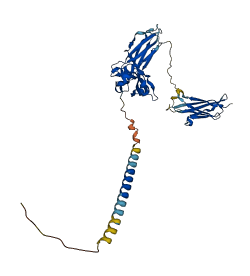
| AF-P01869-F1 | Predicted | AlphaFoldDB |
No variants for P01869
| Variant ID(s) | Position | Change | Description | Diseaes Association | Provenance |
|---|---|---|---|---|---|
| No variants for P01869 | |||||
No associated diseases with P01869
6 regional properties for P01869
| Type | Name | Position | InterPro Accession |
|---|---|---|---|
| domain | Immunoglobulin C1-set | 8 - 92 | IPR003597-1 |
| domain | Immunoglobulin C1-set | 117 - 203 | IPR003597-2 |
| domain | Immunoglobulin C1-set | 225 - 312 | IPR003597-3 |
| domain | Immunoglobulin-like domain | 6 - 98 | IPR007110-1 |
| domain | Immunoglobulin-like domain | 112 - 214 | IPR007110-2 |
| domain | Immunoglobulin-like domain | 223 - 319 | IPR007110-3 |
6 GO annotations of cellular component
| Name | Definition |
|---|---|
| cytoplasm | The contents of a cell excluding the plasma membrane and nucleus, but including other subcellular structures. |
| external side of plasma membrane | The leaflet of the plasma membrane that faces away from the cytoplasm and any proteins embedded or anchored in it or attached to its surface. |
| extracellular space | That part of a multicellular organism outside the cells proper, usually taken to be outside the plasma membranes, and occupied by fluid. |
| IgG immunoglobulin complex | A protein complex composed of two identical immunoglobulin heavy chains of an IgG isotype and two identical immunoglobulin light chains, held together by disulfide bonds. An IgG immunoglobulin complex may be embedded in the plasma membrane or present in the extracellular space, in mucosal areas or other tissues, or circulating in the blood or lymph. |
| immunoglobulin complex, circulating | An immunoglobulin complex that is secreted into extracellular space and found in mucosal areas or other tissues or circulating in the blood or lymph. In its canonical form, a circulating immunoglobulin complex is composed of two identical heavy chains and two identical light chains, held together by disulfide bonds. Some forms of are polymers of the basic structure and contain additional components such as J-chain and the secretory component. |
| integral component of membrane | The component of a membrane consisting of the gene products and protein complexes having at least some part of their peptide sequence embedded in the hydrophobic region of the membrane. |
3 GO annotations of molecular function
| Name | Definition |
|---|---|
| antigen binding | Binding to an antigen, any substance which is capable of inducing a specific immune response and of reacting with the products of that response, the specific antibody or specifically sensitized T-lymphocytes, or both. Binding may counteract the biological activity of the antigen. |
| Fc-gamma receptor I complex binding | Binding to one or more specific sites on the Fc-gamma receptor I complex. The complex functions primarily as an activating receptor for IgG. |
| immunoglobulin receptor binding | Binding to one or more specific sites on an immunoglobulin receptor molecule. |
16 GO annotations of biological process
| Name | Definition |
|---|---|
| antibacterial humoral response | An immune response against bacteria mediated through a body fluid. Examples of this process are the antibacterial humoral responses in Mus musculus and Drosophila melanogaster. |
| antibody-dependent cellular cytotoxicity | Cytolysis of target cells by natural killer cells, eosinophils, neutrophils, monocytes, or macrophages following engagement of antibodies bound to the target cells by Fc receptors on the effector cells. |
| B cell differentiation | The process in which a precursor cell type acquires the specialized features of a B cell. A B cell is a lymphocyte of B lineage with the phenotype CD19-positive and capable of B cell mediated immunity. |
| B cell receptor signaling pathway | The series of molecular signals initiated by the cross-linking of an antigen receptor on a B cell. |
| complement activation, classical pathway | Any process involved in the activation of any of the steps of the classical pathway of the complement cascade which allows for the direct killing of microbes, the disposal of immune complexes, and the regulation of other immune processes. |
| defense response to bacterium | Reactions triggered in response to the presence of a bacterium that act to protect the cell or organism. |
| humoral immune response mediated by circulating immunoglobulin | An immune response dependent upon secreted immunoglobulin. An example of this process is found in Mus musculus. |
| immunoglobulin mediated immune response | An immune response mediated by immunoglobulins, whether cell-bound or in solution. |
| innate immune response | Innate immune responses are defense responses mediated by germline encoded components that directly recognize components of potential pathogens. |
| phagocytosis, engulfment | The internalization of bacteria, immune complexes and other particulate matter or of an apoptotic cell by phagocytosis, including the membrane and cytoskeletal processes required, which involves one of three mechanisms: zippering of pseudopods around a target via repeated receptor-ligand interactions, sinking of the target directly into plasma membrane of the phagocytosing cell, or induced uptake via an enhanced membrane ruffling of the phagocytosing cell similar to macropinocytosis. |
| phagocytosis, recognition | The initial step in phagocytosis involving adhesion to bacteria, immune complexes and other particulate matter, or an apoptotic cell and based on recognition of factors such as bacterial cell wall components, opsonins like complement and antibody or protein receptors and lipids like phosphatidyl serine, and leading to intracellular signaling in the phagocytosing cell. |
| positive regulation of B cell activation | Any process that activates or increases the frequency, rate or extent of B cell activation. |
| positive regulation of immune response | Any process that activates or increases the frequency, rate or extent of the immune response, the immunological reaction of an organism to an immunogenic stimulus. |
| positive regulation of phagocytosis | Any process that activates or increases the frequency, rate or extent of phagocytosis. |
| positive regulation of type I hypersensitivity | Any process that activates or increases the frequency, rate or extent of type I hypersensitivity, a type of inflammatory response. |
| positive regulation of type IIa hypersensitivity | Any process that activates or increases the frequency, rate or extent of type IIa hypersensitivity, a type of inflammatory response. |
| 10 | 20 | 30 | 40 | 50 | 60 |
| AKTTPPSVYP | LAPGSAAQTN | SMVTLGCLVK | GYFPEPVTVT | WNSGSLSSGV | HTFPAVLQSD |
| 70 | 80 | 90 | 100 | 110 | 120 |
| LYTLSSSVTV | PSSPRPSETV | TCNVAHPASS | TKVDKKIVPR | DCGCKPCICT | VPEVSSVFIF |
| 130 | 140 | 150 | 160 | 170 | 180 |
| PPKPKDVLTI | TLTPKVTCVV | VDISKDDPEV | QFSWFVDDVE | VHTAQTQPRE | EQFNSTFRSV |
| 190 | 200 | 210 | 220 | 230 | 240 |
| SELPIMHQDW | LNGKEFKCRV | NSAAFPAPIE | KTISKTKGRP | KAPQVYTIPP | PKEQMAKDKV |
| 250 | 260 | 270 | 280 | 290 | 300 |
| SLTCMITDFF | PEDITVEWQW | NGQPAENYKN | TQPIMNTNGS | YFVYSKLNVQ | KSNWEAGNTF |
| 310 | 320 | 330 | 340 | 350 | 360 |
| TCSVLHEGLH | NHHTEKSLSH | SPGLQLDETC | AEAQDGELDG | LWTTITIFIS | LFLLSVCYSA |
| 370 | 380 | 390 | |||
| AVTLFKVKWI | FSSVVELKQT | LVPEYKNMIG | QAP |