Descriptions
The autoinhibited protein was predicted that may have potential autoinhibitory elements via cis-regPred.
Autoinhibitory domains (AIDs)
Target domain |
|
Relief mechanism |
|
Assay |
cis-regPred |
Accessory elements
No accessory elements
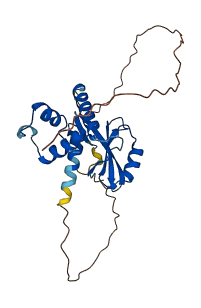
Autoinhibited structure

Activated structure
1 structures for O70512
| Entry ID | Method | Resolution | Chain | Position | Source |
|---|---|---|---|---|---|
| AF-O70512-F1 | Predicted | AlphaFoldDB |
No variants for O70512
| Variant ID(s) | Position | Change | Description | Diseaes Association | Provenance |
|---|---|---|---|---|---|
| No variants for O70512 | |||||
No associated diseases with O70512
2 GO annotations of cellular component
| Name | Definition |
|---|---|
| phosphatidylinositol 3-kinase complex | A protein complex capable of phosphatidylinositol 3-kinase activity and containing subunits of any phosphatidylinositol 3-kinase (PI3K) enzyme. These complexes are divided in three classes (called I, II and III) that differ for their presence across taxonomic groups and for the type of their constituents. Catalytic subunits of phosphatidylinositol 3-kinase enzymes are present in all 3 classes; regulatory subunits of phosphatidylinositol 3-kinase enzymes are present in classes I and III; adaptor proteins have been observed in class II complexes and may be present in other classes too. |
| plasma membrane | The membrane surrounding a cell that separates the cell from its external environment. It consists of a phospholipid bilayer and associated proteins. |
1 GO annotations of molecular function
| Name | Definition |
|---|---|
| 1-phosphatidylinositol-3-kinase regulator activity | Modulates the activity of the enzyme 1-phosphatidylinositol-3-kinase activity. |
6 GO annotations of biological process
| Name | Definition |
|---|---|
| cytokine-mediated signaling pathway | The series of molecular signals initiated by the binding of a cytokine to a receptor on the surface of a cell, and ending with the regulation of a downstream cellular process, e.g. transcription. |
| intracellular signal transduction | The process in which a signal is passed on to downstream components within the cell, which become activated themselves to further propagate the signal and finally trigger a change in the function or state of the cell. |
| negative regulation of signal transduction | Any process that stops, prevents, or reduces the frequency, rate or extent of signal transduction. |
| phosphatidylinositol phosphate biosynthetic process | The chemical reactions and pathways resulting in the formation of phosphatidylinositol phosphate. |
| protein kinase C-activating G protein-coupled receptor signaling pathway | The series of molecular signals generated as a consequence of a G protein-coupled receptor binding to its physiological ligand, where the pathway proceeds with activation of protein kinase C (PKC). PKC is activated by second messengers including diacylglycerol (DAG). |
| protein ubiquitination | The process in which one or more ubiquitin groups are added to a protein. |
4 homologous proteins in AiPD
| UniProt AC | Gene Name | Protein Name | Species | Evidence Code |
|---|---|---|---|---|
| Q2HJ53 | CISH | Cytokine-inducible SH2-containing protein | Bos taurus (Bovine) | PR |
| Q9PW70 | CISH | Cytokine-inducible SH2-containing protein | Gallus gallus (Chicken) | PR |
| Q9NSE2 | CISH | Cytokine-inducible SH2-containing protein | Homo sapiens (Human) | PR |
| Q62225 | Cish | Cytokine-inducible SH2-containing protein | Mus musculus (Mouse) | PR |
| 10 | 20 | 30 | 40 | 50 | 60 |
| VLCVQGSCPL | LVVEQIGQRP | LWAQSLELPG | PAMQPLPTGA | FPEEVTEETP | VQSENEPKVL |
| 70 | 80 | 90 | 100 | 110 | 120 |
| DPEGDLLCIA | KTFSYLRESG | WYWGSITASE | ARQHLQKMPE | GTFLVRDSTH | PSYLFTLSVK |
| 130 | 140 | 150 | 160 | 170 | 180 |
| TTRGPTNVRI | EYADSSFRLD | SNCLSRPRIL | AFPDVVSLVQ | HYVASCTADT | RSDSPDPAPT |
| 190 | 200 | 210 | 220 | 230 | 240 |
| PALPVSKPDA | PGDPVLPIPV | ATAVHLKLVQ | PFVRRSSARS | LQHLCRLVIN | RLVTDVDCLP |
| 250 | |||||
| LPRRMADYLR | QYPFQL |