O35310
Gene name |
Hs3st1 (3ost, 3ost1) |
Protein name |
Heparan sulfate glucosamine 3-O-sulfotransferase 1 |
Names |
Heparan sulfate D-glucosaminyl 3-O-sulfotransferase 1, Heparan sulfate 3-O-sulfotransferase 1 |
Species |
Mus musculus (Mouse) |
KEGG Pathway |
mmu:15476 |
EC number |
2.8.2.23: Sulfotransferases |
Protein Class |
|
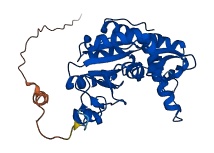
Descriptions
The autoinhibited protein was predicted that may have potential autoinhibitory elements via cis-regPred.
Autoinhibitory domains (AIDs)
Target domain |
|
Relief mechanism |
|
Assay |
cis-regPred |
Accessory elements
No accessory elements
Autoinhibited structure

Activated structure
3 structures for O35310
| Entry ID | Method | Resolution | Chain | Position | Source |
|---|---|---|---|---|---|
| 1VKJ | X-ray | 250 A | A/B/C | 48-311 | PDB |
| 3UAN | X-ray | 184 A | A/B | 48-311 | PDB |
| AF-O35310-F1 | Predicted | AlphaFoldDB |
14 variants for O35310
| Variant ID(s) | Position | Change | Description | Diseaes Association | Provenance |
|---|---|---|---|---|---|
| rs3388756470 | 45 | T>I | No | EVA | |
| rs3388756815 | 68 | K>* | No | EVA | |
| rs3388744896 | 84 | V>L | No | EVA | |
| rs3388751763 | 102 | Q>L | No | EVA | |
| rs3388744974 | 174 | P>S | No | EVA | |
| rs3395415298 | 196 | N>K | No | EVA | |
| rs3395091424 | 199 | L>Q | No | EVA | |
| rs3395413828 | 200 | Y>F | No | EVA | |
| rs3395091440 | 205 | L>V | No | EVA | |
| rs3395359801 | 207 | W>R | No | EVA | |
| rs3395103862 | 218 | I>N | No | EVA | |
| rs3388756459 | 219 | V>M | No | EVA | |
| rs3388752154 | 231 | E>K | No | EVA | |
| rs3388762678 | 263 | D>E | No | EVA |
No associated diseases with O35310
1 regional properties for O35310
| Type | Name | Position | InterPro Accession |
|---|---|---|---|
| domain | Sulfotransferase domain | 59 - 298 | IPR000863 |
Functions
| Description | ||
|---|---|---|
| EC Number | 2.8.2.23 | Sulfotransferases |
| Subcellular Localization |
|
|
| PANTHER Family | ||
| PANTHER Subfamily | ||
| PANTHER Protein Class | ||
| PANTHER Pathway Category | No pathway information available | |
2 GO annotations of cellular component
| Name | Definition |
|---|---|
| Golgi apparatus | A membrane-bound cytoplasmic organelle of the endomembrane system that further processes the core oligosaccharides (e.g. N-glycans) added to proteins in the endoplasmic reticulum and packages them into membrane-bound vesicles. The Golgi apparatus operates at the intersection of the secretory, lysosomal, and endocytic pathways. |
| Golgi lumen | The volume enclosed by the membranes of any cisterna or subcompartment of the Golgi apparatus, including the cis- and trans-Golgi networks. |
1 GO annotations of molecular function
| Name | Definition |
|---|---|
| [heparan sulfate]-glucosamine 3-sulfotransferase 1 activity | Catalysis of the reaction: 3'-phosphoadenylyl sulfate + -glucosamine 3-sulfate has a substrate consensus sequence of Glc(N2S>NAc)+/-6S GlcA GlcN2S*+/-6S GlcA>IdoA+/-2S Glc(N2S/NAc)+/-6S. |
2 GO annotations of biological process
| Name | Definition |
|---|---|
| glycosaminoglycan biosynthetic process | The chemical reactions and pathways resulting in the formation of glycosaminoglycans, any of a group of polysaccharides that contain amino sugars. |
| heparan sulfate proteoglycan biosynthetic process | The chemical reactions and pathways resulting in the formation of the heparan sulfate proteoglycan, a glycosaminoglycan with repeat unit consisting of alternating alpha-(1->4)-linked hexuronic acid and glucosamine residues; the former are a mixture of sulfated and nonsulfated D-glucuronic acid and L-iduronic acid; the L-iduronic acid is either sulfated or acetylated on its amino group as well as being sulfated on one of its hydroxyl groups; heparan sulfate chains are covalently linked to peptidyl-serine by a glycosidic attachment through the trisaccharide galactosyl-galactosyl-xylosyl to serine residues. |
3 homologous proteins in AiPD
| UniProt AC | Gene Name | Protein Name | Species | Evidence Code |
|---|---|---|---|---|
| Q8IZT8 | HS3ST5 | Heparan sulfate glucosamine 3-O-sulfotransferase 5 | Homo sapiens (Human) | PR |
| Q8BSL4 | Hs3st5 | Heparan sulfate glucosamine 3-O-sulfotransferase 5 | Mus musculus (Mouse) | PR |
| Q9ESG5 | Hs3st1 | Heparan sulfate glucosamine 3-O-sulfotransferase 1 | Rattus norvegicus (Rat) | PR |
| 10 | 20 | 30 | 40 | 50 | 60 |
| MTLLLLGAVL | LVAQPQLVHS | HPAAPGPGLK | QQELLRKVII | LPEDTGEGTA | SNGSTQQLPQ |
| 70 | 80 | 90 | 100 | 110 | 120 |
| TIIIGVRKGG | TRALLEMLSL | HPDVAAAENE | VHFFDWEEHY | SQGLGWYLTQ | MPFSSPHQLT |
| 130 | 140 | 150 | 160 | 170 | 180 |
| VEKTPAYFTS | PKVPERIHSM | NPTIRLLLIL | RDPSERVLSD | YTQVLYNHLQ | KHKPYPPIED |
| 190 | 200 | 210 | 220 | 230 | 240 |
| LLMRDGRLNL | DYKALNRSLY | HAHMLNWLRF | FPLGHIHIVD | GDRLIRDPFP | EIQKVERFLK |
| 250 | 260 | 270 | 280 | 290 | 300 |
| LSPQINASNF | YFNKTKGFYC | LRDSGKDRCL | HESKGRAHPQ | VDPKLLDKLH | EYFHEPNKKF |
| 310 | |||||
| FKLVGRTFDW | H |