O16785
Gene name |
pat-6 |
Protein name |
Paralyzed arrest at two-fold protein 6 |
Names |
Actopaxin homolog, Parvin-like protein |
Species |
Caenorhabditis elegans |
KEGG Pathway |
cel:CELE_T21D12.4 |
EC number |
|
Protein Class |
|
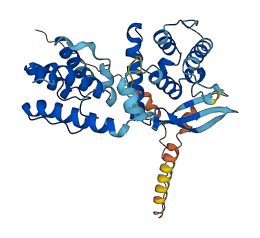
Descriptions
The autoinhibited protein was predicted that may have potential autoinhibitory elements via cis-regPred.
Autoinhibitory domains (AIDs)
Target domain |
|
Relief mechanism |
|
Assay |
cis-regPred |
Accessory elements
No accessory elements
Autoinhibited structure

Activated structure
1 structures for O16785
| Entry ID | Method | Resolution | Chain | Position | Source |
|---|---|---|---|---|---|
| AF-O16785-F1 | Predicted | AlphaFoldDB |
No variants for O16785
| Variant ID(s) | Position | Change | Description | Diseaes Association | Provenance |
|---|---|---|---|---|---|
| No variants for O16785 | |||||
No associated diseases with O16785
2 regional properties for O16785
| Type | Name | Position | InterPro Accession |
|---|---|---|---|
| domain | Calponin homology domain | 99 - 206 | IPR001715-1 |
| domain | Calponin homology domain | 266 - 373 | IPR001715-2 |
Functions
8 GO annotations of cellular component
| Name | Definition |
|---|---|
| actin cytoskeleton | The part of the cytoskeleton (the internal framework of a cell) composed of actin and associated proteins. Includes actin cytoskeleton-associated complexes. |
| axon | The long process of a neuron that conducts nerve impulses, usually away from the cell body to the terminals and varicosities, which are sites of storage and release of neurotransmitter. |
| basal plasma membrane | The region of the plasma membrane located at the basal end of the cell. Often used in reference to animal polarized epithelial membranes, where the basal membrane is the part attached to the extracellular matrix, or in plant cells, where the basal membrane is defined with respect to the zygotic axis. |
| cytoplasm | The contents of a cell excluding the plasma membrane and nucleus, but including other subcellular structures. |
| focal adhesion | A cell-substrate junction that anchors the cell to the extracellular matrix and that forms a point of termination of actin filaments. In insects focal adhesion has also been referred to as hemi-adherens junction (HAJ). |
| M band | The midline of aligned thick filaments in a sarcomere; location of specific proteins that link thick filaments. Depending on muscle type the M band consists of different numbers of M lines. |
| perikaryon | The portion of the cell soma (neuronal cell body) that excludes the nucleus. |
| striated muscle dense body | A vinculin-containing myofibril attachment structure of striated muscle that connects sarcomeres to the extracellular matrix. In nematode body wall muscle, the dense body performs the dual role of Z-disk and costamere. |
1 GO annotations of molecular function
| Name | Definition |
|---|---|
| actin binding | Binding to monomeric or multimeric forms of actin, including actin filaments. |
9 GO annotations of biological process
| Name | Definition |
|---|---|
| actin cytoskeleton reorganization | A process that is carried out at the cellular level which results in dynamic structural changes to the arrangement of constituent parts of cytoskeletal structures comprising actin filaments and their associated proteins. |
| cell projection assembly | Formation of a prolongation or process extending from a cell, e.g. a flagellum or axon. |
| establishment or maintenance of cell polarity | Any cellular process that results in the specification, formation or maintenance of anisotropic intracellular organization or cell growth patterns. |
| mitochondrion organization | A process that is carried out at the cellular level which results in the assembly, arrangement of constituent parts, or disassembly of a mitochondrion; includes mitochondrial morphogenesis and distribution, and replication of the mitochondrial genome as well as synthesis of new mitochondrial components. |
| muscle cell cellular homeostasis | The cellular homeostatic process that preserves a muscle cell in a stable functional or structural state. |
| positive regulation of locomotion | Any process that activates or increases the frequency, rate or extent of locomotion of a cell or organism. |
| positive regulation of sarcomere organization | Any process that increases the rate, frequency or extent of myofibril assembly by organization of muscle actomyosin into sarcomeres. The sarcomere is the repeating unit of a myofibril in a muscle cell, composed of an array of overlapping thick and thin filaments between two adjacent Z discs. |
| striated muscle cell development | The process whose specific outcome is the progression of a striated muscle cell over time, from its formation to the mature structure. Striated muscle cells contain fibers that are divided by transverse bands into striations, and cardiac and skeletal muscle are types of striated muscle. |
| substrate adhesion-dependent cell spreading | The morphogenetic process that results in flattening of a cell as a consequence of its adhesion to a substrate. |
| 10 | 20 | 30 | 40 | 50 | 60 |
| MSTLGRSKTP | SRDEPKKPGV | FEKLSGTLSR | KKKAPEDEHG | NQGGAHHATD | EDEVLELELE |
| 70 | 80 | 90 | 100 | 110 | 120 |
| GREALDQSLV | PVLARNIWLE | EGEIRRYLTK | ETARDQKLAQ | VVDLLIYWLN | EELADQRIVV |
| 130 | 140 | 150 | 160 | 170 | 180 |
| RHLQEDLFDG | QIIQKLLEKL | EQIRIEVPEV | SQSEEGQRQK | LQIVVQTANR | ILGQPREQEK |
| 190 | 200 | 210 | 220 | 230 | 240 |
| WSADLIHQKD | FTAIIQLLVL | LALHYRAPVR | FPDNVVANVV | VAQKEHGQVK | THRITEQITT |
| 250 | 260 | 270 | 280 | 290 | 300 |
| VQTELAPKGT | RDAFDTLFDY | GPDKLAHVKT | SLLAFCNKHL | NKINLEVSDL | DNQFQDGVFL |
| 310 | 320 | 330 | 340 | 350 | 360 |
| VLLVGLLEGY | FVPLYHFNLQ | VQSHEEKVKN | VQFAFKLMED | TGLEKPRSRV | QDIANGDVKS |
| 370 | |||||
| TLRLLHLLFT | KYKHI |