O08539
Gene name |
Bin1 (Amphl, Sh3p9) |
Protein name |
Myc box-dependent-interacting protein 1 |
Names |
Amphiphysin II, Amphiphysin-like protein, Bridging integrator 1, SH3 domain-containing protein 9 |
Species |
Mus musculus (Mouse) |
KEGG Pathway |
mmu:30948 |
EC number |
|
Protein Class |
|
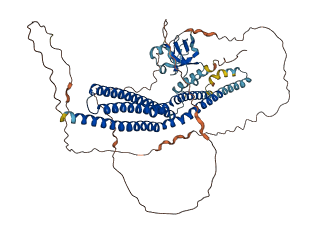
Descriptions
The autoinhibited protein was predicted that may have potential autoinhibitory elements via cis-regPred.
Autoinhibitory domains (AIDs)
Target domain |
|
Relief mechanism |
|
Assay |
cis-regPred |
Accessory elements
No accessory elements
Autoinhibited structure

Activated structure
1 structures for O08539
| Entry ID | Method | Resolution | Chain | Position | Source |
|---|---|---|---|---|---|
| AF-O08539-F1 | Predicted | AlphaFoldDB |
35 variants for O08539
| Variant ID(s) | Position | Change | Description | Diseaes Association | Provenance |
|---|---|---|---|---|---|
| rs3389492979 | 17 | N>D | No | EVA | |
| rs3408025019 | 37 | D>H | No | EVA | |
| rs3389440928 | 63 | K>E | No | EVA | |
| rs3389493031 | 79 | S>P | No | EVA | |
| rs3389501085 | 81 | K>M | No | EVA | |
| rs3389491010 | 99 | E>K | No | EVA | |
| rs3389497247 | 127 | D>E | No | EVA | |
| rs3389402530 | 155 | H>D | No | EVA | |
| rs3389471915 | 156 | H>Q | No | EVA | |
| rs3389402541 | 156 | H>Y | No | EVA | |
| rs3408291010 | 167 | D>V | No | EVA | |
| rs3389491073 | 169 | A>S | No | EVA | |
| rs3389492445 | 183 | P>L | No | EVA | |
| rs3408434735 | 184 | Q>L | No | EVA | |
| rs3413105005 | 185 | W>G | No | EVA | |
| rs3389440942 | 255 | E>K | No | EVA | |
| rs3389458839 | 298 | S>T | No | EVA | |
| rs3389450077 | 316 | E>D | No | EVA | |
| rs3389501063 | 319 | P>S | No | EVA | |
| rs3389458785 | 322 | G>E | No | EVA | |
| rs3389486254 | 328 | T>A | No | EVA | |
| rs3389440892 | 329 | I>F | No | EVA | |
| rs3389440892 | 329 | I>V | No | EVA | |
| rs3389503445 | 367 | F>Y | No | EVA | |
| rs3389471851 | 387 | E>* | No | EVA | |
| rs3389507933 | 410 | T>I | No | EVA | |
| rs3389458810 | 411 | P>S | No | EVA | |
| rs3389440940 | 416 | I>N | No | EVA | |
| rs3389503402 | 426 | S>C | No | EVA | |
| rs3389497195 | 444 | A>P | No | EVA | |
| rs30009182 | 451 | T>I | No | EVA | |
| rs3389497234 | 476 | A>T | No | EVA | |
| rs3389493047 | 520 | V>F | No | EVA | |
| rs3389484491 | 531 | T>S | No | EVA | |
| rs3389497227 | 549 | N>I | No | EVA |
No associated diseases with O08539
2 regional properties for O08539
| Type | Name | Position | InterPro Accession |
|---|---|---|---|
| domain | APO domain | 61 - 259 | IPR023342-1 |
| domain | APO domain | 302 - 414 | IPR023342-2 |
26 GO annotations of cellular component
| Name | Definition |
|---|---|
| axon | The long process of a neuron that conducts nerve impulses, usually away from the cell body to the terminals and varicosities, which are sites of storage and release of neurotransmitter. |
| axon initial segment | Portion of the axon proximal to the neuronal cell body, at the level of the axon hillock. The action potentials that propagate along the axon are generated at the level of this initial segment. |
| axon terminus | Terminal inflated portion of the axon, containing the specialized apparatus necessary to release neurotransmitters. The axon terminus is considered to be the whole region of thickening and the terminal button is a specialized region of it. |
| cerebellar mossy fiber | An axon arising from cerebellar projecting cells in the cochlea, vestibular nuclei, spinal cord, reticular formation, cerebellar nuclei and basilar pontine nuclei. Mossy fibers enter through all three cerebellar peduncles and send collaterals to the deep cerebellar nuclei, then branch in the white matter and terminate in the granule cell layer. Through this branching, a given mossy fiber can innervate several folia. Mossy fibers synapse on granule cells. The synaptic contacts are made at enlargements along the length of the mossy fiber called mossy fiber rosettes. The enlargements of the rosettes give the axons a mossy-looking appearance in Golgi stained preparations. |
| cytoplasm | The contents of a cell excluding the plasma membrane and nucleus, but including other subcellular structures. |
| cytoskeleton | A cellular structure that forms the internal framework of eukaryotic and prokaryotic cells. The cytoskeleton includes intermediate filaments, microfilaments, microtubules, the microtrabecular lattice, and other structures characterized by a polymeric filamentous nature and long-range order within the cell. The various elements of the cytoskeleton not only serve in the maintenance of cellular shape but also have roles in other cellular functions, including cellular movement, cell division, endocytosis, and movement of organelles. |
| cytosol | The part of the cytoplasm that does not contain organelles but which does contain other particulate matter, such as protein complexes. |
| dendrite | A neuron projection that has a short, tapering, morphology. Dendrites receive and integrate signals from other neurons or from sensory stimuli, and conduct nerve impulses towards the axon or the cell body. In most neurons, the impulse is conveyed from dendrites to axon via the cell body, but in some types of unipolar neuron, the impulse does not travel via the cell body. |
| endosome | A vacuole to which materials ingested by endocytosis are delivered. |
| extrinsic component of synaptic vesicle membrane | The component of the synaptic vesicle membrane consisting of gene products and protein complexes that are loosely bound to one of its surfaces, but not integrated into the hydrophobic region. |
| glutamatergic synapse | A synapse that uses glutamate as a neurotransmitter. |
| I band | A region of a sarcomere that appears as a light band on each side of the Z disc, comprising a region of the sarcomere where thin (actin) filaments are not overlapped by thick (myosin) filaments; contains actin, troponin, and tropomyosin; each sarcomere includes half of an I band at each end. |
| lipid tube | A macromolecular complex that contains a tube of lipid surrounded by a protein coat. |
| membrane | A lipid bilayer along with all the proteins and protein complexes embedded in it an attached to it. |
| microtubule | Any of the long, generally straight, hollow tubes of internal diameter 12-15 nm and external diameter 24 nm found in a wide variety of eukaryotic cells; each consists (usually) of 13 protofilaments of polymeric tubulin, staggered in such a manner that the tubulin monomers are arranged in a helical pattern on the microtubular surface, and with the alpha/beta axes of the tubulin subunits parallel to the long axis of the tubule; exist in equilibrium with pool of tubulin monomers and can be rapidly assembled or disassembled in response to physiological stimuli; concerned with force generation, e.g. in the spindle. |
| node of Ranvier | An axon part that is a gap in the myelin where voltage-gated sodium channels cluster and saltatory conduction is executed. |
| nuclear envelope | The double lipid bilayer enclosing the nucleus and separating its contents from the rest of the cytoplasm; includes the intermembrane space, a gap of width 20-40 nm (also called the perinuclear space). |
| nucleus | A membrane-bounded organelle of eukaryotic cells in which chromosomes are housed and replicated. In most cells, the nucleus contains all of the cell's chromosomes except the organellar chromosomes, and is the site of RNA synthesis and processing. In some species, or in specialized cell types, RNA metabolism or DNA replication may be absent. |
| plasma membrane | The membrane surrounding a cell that separates the cell from its external environment. It consists of a phospholipid bilayer and associated proteins. |
| RNA polymerase II transcription repressor complex | A protein complex, located in the nucleus, that possesses activity that prevents or downregulates transcription from a RNA polymerase II promoter. |
| synapse | The junction between an axon of one neuron and a dendrite of another neuron, a muscle fiber or a glial cell. As the axon approaches the synapse it enlarges into a specialized structure, the presynaptic terminal bouton, which contains mitochondria and synaptic vesicles. At the tip of the terminal bouton is the presynaptic membrane; facing it, and separated from it by a minute cleft (the synaptic cleft) is a specialized area of membrane on the receiving cell, known as the postsynaptic membrane. In response to the arrival of nerve impulses, the presynaptic terminal bouton secretes molecules of neurotransmitters into the synaptic cleft. These diffuse across the cleft and transmit the signal to the postsynaptic membrane. |
| synaptic vesicle | A secretory organelle, typically 50 nm in diameter, of presynaptic nerve terminals; accumulates in high concentrations of neurotransmitters and secretes these into the synaptic cleft by fusion with the 'active zone' of the presynaptic plasma membrane. |
| T-tubule | Invagination of the plasma membrane of a muscle cell that extends inward from the cell surface around each myofibril. The ends of T-tubules make contact with the sarcoplasmic reticulum membrane. |
| varicosity | Non-terminal inflated portion of the axon, containing the specialized apparatus necessary to release neurotransmitters. |
| vesicle | Any small, fluid-filled, spherical organelle enclosed by membrane. |
| Z disc | Platelike region of a muscle sarcomere to which the plus ends of actin filaments are attached. |
10 GO annotations of molecular function
| Name | Definition |
|---|---|
| actin filament binding | Binding to an actin filament, also known as F-actin, a helical filamentous polymer of globular G-actin subunits. |
| aspartic-type endopeptidase inhibitor activity | Binds to and stops, prevents or reduces the activity of aspartic-type endopeptidases, enzymes that catalyze the hydrolysis of nonterminal peptide bonds in a polypeptide chain; the optimum reaction pH is below 5 due to an aspartic residue involved in the catalytic process. |
| chaperone binding | Binding to a chaperone protein, a class of proteins that bind to nascent or unfolded polypeptides and ensure correct folding or transport. |
| GTPase binding | Binding to a GTPase, any enzyme that catalyzes the hydrolysis of GTP. |
| identical protein binding | Binding to an identical protein or proteins. |
| phospholipid binding | Binding to a phospholipid, a class of lipids containing phosphoric acid as a mono- or diester. |
| protease binding | Binding to a protease or a peptidase. |
| protein-containing complex binding | Binding to a macromolecular complex. |
| RNA polymerase binding | Binding to an RNA polymerase molecule or complex. |
| tau protein binding | Binding to tau protein. tau is a microtubule-associated protein, implicated in Alzheimer's disease, Down Syndrome and ALS. |
21 GO annotations of biological process
| Name | Definition |
|---|---|
| endosome to lysosome transport | The directed movement of substances from endosomes to lysosomes. |
| lipid tube assembly | The aggregation, arrangement and bonding together of a set of macromolecules to form a macromolecular complex that contains a tube of lipid surrounded by a protein coat involved in membrane shaping of vesicle membranes as they fuse or undergo fission. |
| muscle cell differentiation | The process in which a relatively unspecialized cell acquires specialized features of a muscle cell. |
| negative regulation of amyloid-beta formation | Any process that stops, prevents or reduces the frequency, rate or extent of amyloid-beta formation. |
| negative regulation of aspartic-type endopeptidase activity involved in amyloid precursor protein catabolic process | Any process that stops, prevents or reduces the frequency, rate or extent of aspartic-type endopeptidase activity involved in amyloid precursor protein catabolic process. |
| negative regulation of calcium ion transmembrane transport via high voltage-gated calcium channel | Any process that stops, prevents or reduces the frequency, rate or extent of calcium ion transmembrane transport via high voltage-gated calcium channel. |
| negative regulation of potassium ion transmembrane transport | Any process that stops, prevents or reduces the frequency, rate or extent of potassium ion transmembrane transport. |
| negative regulation of transcription by RNA polymerase II | Any process that stops, prevents, or reduces the frequency, rate or extent of transcription mediated by RNA polymerase II. |
| negative regulation of ventricular cardiac muscle cell action potential | Any process that stops, prevents or reduces the frequency, rate or extent of ventricular cardiac muscle cell action potential. |
| nucleus localization | Any process in which the nucleus is transported to, and/or maintained in, a specific location within the cell. |
| nucleus organization | A process that is carried out at the cellular level which results in the assembly, arrangement of constituent parts, or disassembly of the nucleus. |
| positive regulation of actin filament polymerization | Any process that activates or increases the frequency, rate or extent of actin polymerization. |
| positive regulation of apoptotic process | Any process that activates or increases the frequency, rate or extent of cell death by apoptotic process. |
| positive regulation of astrocyte differentiation | Any process that activates or increases the frequency, rate or extent of astrocyte differentiation. |
| positive regulation of endocytosis | Any process that activates or increases the frequency, rate or extent of endocytosis. |
| positive regulation of GTPase activity | Any process that activates or increases the activity of a GTPase. |
| regulation of cell cycle process | Any process that modulates a cellular process that is involved in the progression of biochemical and morphological phases and events that occur in a cell during successive cell replication or nuclear replication events. |
| regulation of heart rate by cardiac conduction | A cardiac conduction process that modulates the frequency or rate of heart contraction. |
| regulation of neuron differentiation | Any process that modulates the frequency, rate or extent of neuron differentiation. |
| synaptic vesicle endocytosis | A vesicle-mediated transport process, in which the synaptic vesicle membrane constituents are retrieved from the presynaptic membrane on the axon terminal after neurotransmitter secretion by exocytosis. Synaptic vesicle endocytosis can occur via clathrin-dependent and clathrin-independent mechanisms. |
| T-tubule organization | A process that is carried out at the cellular level that results in the assembly, arrangement of constituent parts, or disassembly of the T-tubule. A T-tubule is an invagination of the plasma membrane of a muscle cell that extends inward from the cell surface around each myofibril. |
7 homologous proteins in AiPD
| UniProt AC | Gene Name | Protein Name | Species | Evidence Code |
|---|---|---|---|---|
| P50478 | AMPH | Amphiphysin | Gallus gallus (Chicken) | PR |
| P49418 | AMPH | Amphiphysin | Homo sapiens (Human) | PR |
| Q9UBW5 | BIN2 | Bridging integrator 2 | Homo sapiens (Human) | PR |
| O00499 | BIN1 | Myc box-dependent-interacting protein 1 | Homo sapiens (Human) | PR |
| Q7TQF7 | Amph | Amphiphysin | Mus musculus (Mouse) | PR |
| O08838 | Amph | Amphiphysin | Rattus norvegicus (Rat) | PR |
| O08839 | Bin1 | Myc box-dependent-interacting protein 1 | Rattus norvegicus (Rat) | PR |
| 10 | 20 | 30 | 40 | 50 | 60 |
| MAEMGSKGVT | AGKIASNVQK | KLTRAQEKVL | QKLGKADETK | DEQFEQCVQN | FNKQLTEGTR |
| 70 | 80 | 90 | 100 | 110 | 120 |
| LQKDLRTYLA | SVKAMHEASK | KLSECLQEVY | EPEWPGRDEA | NKIAENNDLL | WMDYHQKLVD |
| 130 | 140 | 150 | 160 | 170 | 180 |
| QALLTMDTYL | GQFPDIKSRI | AKRGRKLVDY | DSARHHYESL | QTAKKKDEAK | IAKPVSLLEK |
| 190 | 200 | 210 | 220 | 230 | 240 |
| AAPQWCQGKL | QAHLVAQTNL | LRNQAEEELI | KAQKVFEEMN | VDLQEELPSL | WNSRVGFYVN |
| 250 | 260 | 270 | 280 | 290 | 300 |
| TFQSIAGLEE | NFHKEMSKLN | QNLNDVLVSL | EKQHGSNTFT | VKAQPSDNAP | EKGNKSPSPP |
| 310 | 320 | 330 | 340 | 350 | 360 |
| PDGSPAATPE | IRVNHEPEPA | SGASPGATIP | KSPSQLRKGP | PVPPPPKHTP | SKEMKQEQIL |
| 370 | 380 | 390 | 400 | 410 | 420 |
| SLFDDAFVPE | ISVTTPSQFE | APGPFSEQAS | LLDLDFEPLP | PVASPVKAPT | PSGQSIPWDL |
| 430 | 440 | 450 | 460 | 470 | 480 |
| WEPTESQAGI | LPSGEPSSAE | GSFAVAWPSQ | TAEPGPAQPA | EASEVVGGAQ | EPGETAASEA |
| 490 | 500 | 510 | 520 | 530 | 540 |
| TSSSLPAVVV | ETFSATVNGA | VEGSAGTGRL | DLPPGFMFKV | QAQHDYTATD | TDELQLKAGD |
| 550 | 560 | 570 | 580 | ||
| VVLVIPFQNP | EEQDEGWLMG | VKESDWNQHK | ELEKCRGVFP | ENFTERVQ |