F1R777
Gene name |
mettl3 |
Protein name |
N6-adenosine-methyltransferase subunit METTL3 |
Names |
N6-adenosine-methyltransferase 70 kDa subunit, MT-A70 |
Species |
Danio rerio (Zebrafish) (Brachydanio rerio) |
KEGG Pathway |
dre:100004398 |
EC number |
2.1.1.348: Methyltransferases |
Protein Class |
|
Descriptions
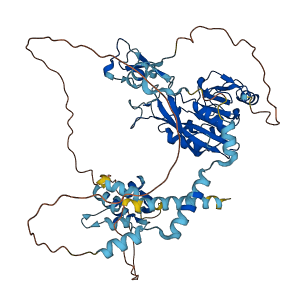
The autoinhibited protein was predicted that may have potential autoinhibitory elements via cis-regPred.
Autoinhibitory domains (AIDs)
Target domain |
|
Relief mechanism |
|
Assay |
cis-regPred |
Accessory elements
No accessory elements
Autoinhibited structure

Activated structure
1 structures for F1R777
| Entry ID | Method | Resolution | Chain | Position | Source |
|---|---|---|---|---|---|
| AF-F1R777-F1 | Predicted | AlphaFoldDB |
No variants for F1R777
| Variant ID(s) | Position | Change | Description | Diseaes Association | Provenance |
|---|---|---|---|---|---|
| No variants for F1R777 | |||||
No associated diseases with F1R777
10 regional properties for F1R777
| Type | Name | Position | InterPro Accession |
|---|---|---|---|
| domain | Zinc finger, PHD-type | 89 - 140 | IPR001965-1 |
| domain | Zinc finger, PHD-type | 188 - 238 | IPR001965-2 |
| domain | Tudor domain | 29 - 86 | IPR002999 |
| conserved_site | Zinc finger, PHD-type, conserved site | 90 - 139 | IPR019786 |
| domain | Zinc finger, PHD-finger | 87 - 142 | IPR019787 |
| domain | Polycomb-like MTF2 factor 2, C-terminal domain | 531 - 564 | IPR025894 |
| domain | PHD finger protein 1, PHD finger 1 | 89 - 139 | IPR031202 |
| domain | Lysine-specific demethylase 4-like, Tudor domain | 34 - 69 | IPR040477 |
| domain | PHD finger protein 1, PHD finger 2 | 188 - 239 | IPR047010 |
| domain | PHD finger protein 1, Tudor domain | 30 - 82 | IPR047399 |
Functions
| Description | ||
|---|---|---|
| EC Number | 2.1.1.348 | Methyltransferases |
| Subcellular Localization |
|
|
| PANTHER Family | ||
| PANTHER Subfamily | ||
| PANTHER Protein Class | ||
| PANTHER Pathway Category | No pathway information available | |
4 GO annotations of cellular component
| Name | Definition |
|---|---|
| cytoplasm | The contents of a cell excluding the plasma membrane and nucleus, but including other subcellular structures. |
| nuclear speck | A discrete extra-nucleolar subnuclear domain, 20-50 in number, in which splicing factors are seen to be localized by immunofluorescence microscopy. |
| nucleus | A membrane-bounded organelle of eukaryotic cells in which chromosomes are housed and replicated. In most cells, the nucleus contains all of the cell's chromosomes except the organellar chromosomes, and is the site of RNA synthesis and processing. In some species, or in specialized cell types, RNA metabolism or DNA replication may be absent. |
| RNA N6-methyladenosine methyltransferase complex | A RNA methyltransferase complex that catalyzes the post-transcriptional methylation of adenosine to form N6-methyladenosine (m6A). In budding yeast, the MIS complex consists of Mum2p, Ime4p and Slz1p. In vertebrates, the complex consists of METTL3, METTL14 and associated components WTAP, ZC3H13, VIRMA, CBLL1/HAKAI and in some cases of RBM15 (RBM15 or RBM15B). |
7 GO annotations of molecular function
| Name | Definition |
|---|---|
| methyltransferase activity | Catalysis of the transfer of a methyl group to an acceptor molecule. |
| mRNA (2'-O-methyladenosine-N6-)-methyltransferase activity | Catalysis of the reaction: S-adenosyl-L-methionine + m(7)G(5')pppAm = S-adenosyl-L-homocysteine + m(7)G(5')pppm(6)Am. |
| mRNA (N6-adenosine)-methyltransferase activity | Catalysis of the reaction: S-adenosyl-L-methionine + RRACH = S-adenosyl-L-homocysteine + RRm6ACH; R is a purine, and H is C, A, or U. |
| mRNA binding | Binding to messenger RNA (mRNA), an intermediate molecule between DNA and protein. mRNA includes UTR and coding sequences, but does not contain introns. |
| protein heterodimerization activity | Binding to a nonidentical protein to form a heterodimer. |
| RNA methyltransferase activity | Catalysis of the transfer of a methyl group from a donor to a nucleoside residue in an RNA molecule. |
| S-adenosyl-L-methionine binding | Binding to S-adenosyl-L-methionine. |
28 GO annotations of biological process
| Name | Definition |
|---|---|
| adenosine to inosine editing | The conversion of an adenosine residue to inosine in an RNA molecule by deamination. |
| cellular response to DNA damage stimulus | Any process that results in a change in state or activity of a cell (in terms of movement, secretion, enzyme production, gene expression, etc.) as a result of a stimulus indicating damage to its DNA from environmental insults or errors during metabolism. |
| cellular response to UV | Any process that results in a change in state or activity of a cell (in terms of movement, secretion, enzyme production, gene expression, etc.) as a result of an ultraviolet radiation (UV light) stimulus. Ultraviolet radiation is electromagnetic radiation with a wavelength in the range of 10 to 380 nanometers. |
| endothelial to hematopoietic transition | The generation of hematopoietic stem cells from hemogenic endothelial cells by a process that includes tight-junction dissolution and loss of cell polarity followed by delamination from the endothelium. |
| flagellated sperm motility | The directed, self-propelled movement of a cilium (aka flagellum) that contributes to the movement of a flagellated sperm. |
| forebrain radial glial cell differentiation | The process in which neuroepithelial cells of the neural tube give rise to radial glial cells, specialized bipotential progenitors cells of the forebrain. Differentiation includes the processes involved in commitment of a cell to a specific fate. |
| gliogenesis | The process that results in the generation of glial cells. This includes the production of glial progenitors and their differentiation into mature glia. |
| hematopoietic stem cell proliferation | The expansion of a hematopoietic stem cell population by cell division. A hematopoietic stem cell is a stem cell from which all cells of the lymphoid and myeloid lineages develop. |
| mRNA catabolic process | The chemical reactions and pathways resulting in the breakdown of mRNA, messenger RNA, which is responsible for carrying the coded genetic 'message', transcribed from DNA, to sites of protein assembly at the ribosomes. |
| mRNA destabilization | Any process that decreases the stability of an mRNA molecule, making it more vulnerable to degradative processes. Messenger RNA is the intermediate molecule between DNA and protein. It includes UTR and coding sequences. It does not contain introns. |
| mRNA methylation | The posttranscriptional addition of methyl groups to specific residues in an mRNA molecule. |
| mRNA splicing, via spliceosome | The joining together of exons from one or more primary transcripts of messenger RNA (mRNA) and the excision of intron sequences, via a spliceosomal mechanism, so that mRNA consisting only of the joined exons is produced. |
| negative regulation of Notch signaling pathway | Any process that stops, prevents, or reduces the frequency, rate or extent of the Notch signaling pathway. |
| negative regulation of type I interferon-mediated signaling pathway | Any process that decreases the rate, frequency or extent of a type I interferon-mediated signaling pathway. |
| Notch signaling pathway involved in arterial endothelial cell fate commitment | The series of molecular signals initiated by binding of an extracellular ligand to a Notch receptor on the surface of the target cell and contributing to the commitment of a cell to an arterial endothelial cell fate. |
| oocyte maturation | A developmental process, independent of morphogenetic (shape) change, that is required for an oocyte to attain its fully functional state. Oocyte maturation commences after reinitiation of meiosis commonly starting with germinal vesicle breakdown, and continues up to the second meiotic arrest prior to fertilization. |
| oogenesis | The complete process of formation and maturation of an ovum or female gamete from a primordial female germ cell. Examples of this process are found in Mus musculus and Drosophila melanogaster. |
| positive regulation of cap-independent translational initiation | Any process that activates or increases the frequency, rate or extent of cap-independent translational initiation. |
| positive regulation of translation | Any process that activates or increases the frequency, rate or extent of the chemical reactions and pathways resulting in the formation of proteins by the translation of mRNA or circRNA. |
| primary miRNA processing | A process involved in the conversion of a primary microRNA transcript into a pre-microRNA molecule. |
| regulation of apoptotic process | Any process that modulates the occurrence or rate of cell death by apoptotic process. |
| regulation of hematopoietic stem cell differentiation | Any process that modulates the frequency, rate or extent of hematopoietic stem cell differentiation. |
| regulation of meiotic cell cycle | Any process that modulates the rate or extent of progression through the meiotic cell cycle. |
| regulation of mRNA modification | Any process that modulates the rate, frequency, or extent of the covalent alteration of one or more nucleotides within an mRNA molecule to produce an mRNA molecule with a sequence that differs from that coded genetically. |
| regulation of T cell differentiation | Any process that modulates the frequency, rate or extent of T cell differentiation. |
| sex determination | Any process that establishes and transmits the specification of sexual status of an individual organism. |
| spermatogenesis | The developmental process by which male germ line stem cells self renew or give rise to successive cell types resulting in the development of a spermatozoa. |
| stem cell population maintenance | The process by which an organism or tissue maintains a population of stem cells of a single type. This can be achieved by a number of mechanisms: stem cell asymmetric division maintains stem cell numbers; stem cell symmetric division increases them; maintenance of a stem cell niche maintains the conditions for commitment to the stem cell fate for some types of stem cell; stem cells may arise de novo from other cell types. |
4 homologous proteins in AiPD
| UniProt AC | Gene Name | Protein Name | Species | Evidence Code |
|---|---|---|---|---|
| Q9VCE6 | Mettl3 | N6-adenosine-methyltransferase MT-A70-like protein | Drosophila melanogaster (Fruit fly) | PR |
| Q86U44 | METTL3 | N6-adenosine-methyltransferase catalytic subunit | Homo sapiens (Human) | PR |
| Q8C3P7 | Mettl3 | N6-adenosine-methyltransferase subunit METTL3 | Mus musculus (Mouse) | PR |
| O82486 | MTA | N6-adenosine-methyltransferase MT-A70-like | Arabidopsis thaliana (Mouse-ear cress) | PR |
| 10 | 20 | 30 | 40 | 50 | 60 |
| MSDTWSHIQA | HKKQLDSLRE | RLQRRRKDPT | QLGTEVGSVE | SGSARSDSPG | PAIQSPPQVE |
| 70 | 80 | 90 | 100 | 110 | 120 |
| VEHPPDPELE | KRLLGYLSEL | SLSLPTDSLT | ITNQLNTSES | PVSHSCIQSL | LLKFSAQELI |
| 130 | 140 | 150 | 160 | 170 | 180 |
| EVRQPSITSS | SSSTLVTSVD | HTKLWAMIGS | AGQSQRTAVK | RKADDITHQK | RALGSSPSIQ |
| 190 | 200 | 210 | 220 | 230 | 240 |
| APPSPPRKSS | VSLATASISQ | LTASSGGGGG | GADKKGRSNK | VQASHLDMEI | ESLLSQQSTK |
| 250 | 260 | 270 | 280 | 290 | 300 |
| EQQSKKVSQE | ILELLNTSSA | KEQSIVEKFR | SRGRAQVQEF | CDYGTKEECV | QSGDTPQPCT |
| 310 | 320 | 330 | 340 | 350 | 360 |
| KLHFRRIINK | HTDESLGDCS | FLNTCFHMDT | CKYVHYEIDS | PPEAEGDALG | PQAGAAELGL |
| 370 | 380 | 390 | 400 | 410 | 420 |
| HSTVGDSNVG | KLFPSQWICC | DIRYLDVSIL | GKFAVVMADP | PWDIHMELPY | GTLTDDEMRK |
| 430 | 440 | 450 | 460 | 470 | 480 |
| LNIPILQDDG | FLFLWVTGRA | MELGRECLSL | WGYDRVDEII | WVKTNQLQRI | IRTGRTGHWL |
| 490 | 500 | 510 | 520 | 530 | 540 |
| NHGKEHCLVG | VKGNPQGFNR | GLDCDVIVAE | VRSTSHKPDE | IYGMIERLSP | GTRKIELFGR |
| 550 | 560 | 570 | 580 | ||
| PHNVQPNWIT | LGNQLDGIHL | LDPEVVARFK | KRYPDGVISK | PKNM |