Descriptions
The autoinhibited protein was predicted that may have potential autoinhibitory elements via cis-regPred.
Autoinhibitory domains (AIDs)
Target domain |
|
Relief mechanism |
|
Assay |
cis-regPred |
Accessory elements
No accessory elements
Autoinhibited structure

Activated structure
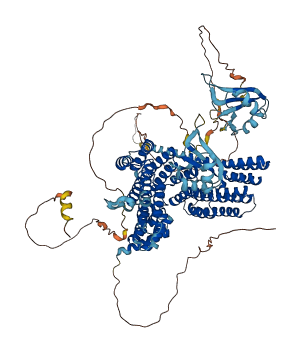
1 structures for B3DJT0
| Entry ID | Method | Resolution | Chain | Position | Source |
|---|---|---|---|---|---|
| AF-B3DJT0-F1 | Predicted | AlphaFoldDB |
No variants for B3DJT0
| Variant ID(s) | Position | Change | Description | Diseaes Association | Provenance |
|---|---|---|---|---|---|
| No variants for B3DJT0 | |||||
No associated diseases with B3DJT0
11 regional properties for B3DJT0
| Type | Name | Position | InterPro Accession |
|---|---|---|---|
| domain | RNA recognition motif domain | 688 - 766 | IPR000504-1 |
| domain | RNA recognition motif domain | 785 - 862 | IPR000504-2 |
| repeat | HAT (Half-A-TPR) repeat | 88 - 120 | IPR003107-1 |
| repeat | HAT (Half-A-TPR) repeat | 126 - 157 | IPR003107-2 |
| repeat | HAT (Half-A-TPR) repeat | 163 - 199 | IPR003107-3 |
| repeat | HAT (Half-A-TPR) repeat | 304 - 336 | IPR003107-4 |
| repeat | HAT (Half-A-TPR) repeat | 339 - 371 | IPR003107-5 |
| repeat | HAT (Half-A-TPR) repeat | 374 - 410 | IPR003107-6 |
| repeat | HAT (Half-A-TPR) repeat | 467 - 500 | IPR003107-7 |
| domain | SART3, RNA recognition motif 1 | 689 - 762 | IPR034217 |
| domain | SART3, RNA recognition motif 2 | 783 - 863 | IPR034218 |
6 GO annotations of cellular component
| Name | Definition |
|---|---|
| ASAP complex | A protein complex involved in regulation of mRNA processing and apoptosis. It binds to RNA in a sequence-independent manner and is recruited to the EJC prior to or during the splicing process. In humans the core proteins are RNPS1, SAP18 and ACIN1. |
| Cajal body | A class of nuclear body, first seen after silver staining by Ramon y Cajal in 1903, enriched in small nuclear ribonucleoproteins, and certain general RNA polymerase II transcription factors; ultrastructurally, they appear as a tangle of coiled, electron-dense threads roughly 0.5 micrometers in diameter; involved in aspects of snRNP biogenesis; the protein coilin serves as a marker for Cajal bodies. Some argue that Cajal bodies are the sites for preassembly of transcriptosomes, unitary particles involved in transcription and processing of RNA. |
| cytoplasm | The contents of a cell excluding the plasma membrane and nucleus, but including other subcellular structures. |
| nuclear speck | A discrete extra-nucleolar subnuclear domain, 20-50 in number, in which splicing factors are seen to be localized by immunofluorescence microscopy. |
| nucleoplasm | That part of the nuclear content other than the chromosomes or the nucleolus. |
| nucleus | A membrane-bounded organelle of eukaryotic cells in which chromosomes are housed and replicated. In most cells, the nucleus contains all of the cell's chromosomes except the organellar chromosomes, and is the site of RNA synthesis and processing. In some species, or in specialized cell types, RNA metabolism or DNA replication may be absent. |
2 GO annotations of molecular function
| Name | Definition |
|---|---|
| histone binding | Binding to a histone, any of a group of water-soluble proteins found in association with the DNA of eukaryotic or archaeal chromosomes. They are involved in the condensation and coiling of chromosomes during cell division and have also been implicated in gene regulation and DNA replication. They may be chemically modified (methylated, acetlyated and others) to regulate gene transcription. |
| U6 snRNA binding | Binding to a U6 small nuclear RNA (U6 snRNA). |
8 GO annotations of biological process
| Name | Definition |
|---|---|
| exocrine pancreas development | The process whose specific outcome is the progression of the exocrine pancreas over time, from its formation to the mature structure. The exocrine pancreas produces and store zymogens of digestive enzymes, such as chymotrypsinogen and trypsinogen in the acinar cells. |
| lymphocyte differentiation | The process in which a relatively unspecialized precursor cell acquires specialized features of a lymphocyte. A lymphocyte is a leukocyte commonly found in the blood and lymph that has the characteristics of a large nucleus, a neutral staining cytoplasm, and prominent heterochromatin. |
| mRNA splicing, via spliceosome | The joining together of exons from one or more primary transcripts of messenger RNA (mRNA) and the excision of intron sequences, via a spliceosomal mechanism, so that mRNA consisting only of the joined exons is produced. |
| nucleosome assembly | The aggregation, arrangement and bonding together of a nucleosome, the beadlike structural units of eukaryotic chromatin composed of histones and DNA. |
| positive regulation of histone deubiquitination | Any process that activates or increases the frequency, rate or extent of histone deubiquitination. |
| spliceosomal complex assembly | The aggregation, arrangement and bonding together of a spliceosomal complex, a ribonucleoprotein apparatus that catalyzes nuclear mRNA splicing via transesterification reactions. |
| spliceosomal snRNP assembly | The aggregation, arrangement and bonding together of one or more snRNA and multiple protein components to form a ribonucleoprotein complex that is involved in formation of the spliceosome. |
| thymus development | The process whose specific outcome is the progression of the thymus over time, from its formation to the mature structure. The thymus is a symmetric bi-lobed organ involved primarily in the differentiation of immature to mature T cells, with unique vascular, nervous, epithelial, and lymphoid cell components. |
3 homologous proteins in AiPD
| UniProt AC | Gene Name | Protein Name | Species | Evidence Code |
|---|---|---|---|---|
| Q9W4D2 | Rnp4F | RNA-binding protein 4F | Drosophila melanogaster (Fruit fly) | PR |
| Q15020 | SART3 | Squamous cell carcinoma antigen recognized by T-cells 3 | Homo sapiens (Human) | PR |
| Q9JLI8 | Sart3 | Squamous cell carcinoma antigen recognized by T-cells 3 | Mus musculus (Mouse) | PR |
| 10 | 20 | 30 | 40 | 50 | 60 |
| MAATGNEEQT | LLPDIEEEAE | GMEREMESED | DEEEGMGVEH | SEEEDEEDTS | EDERENEAEI |
| 70 | 80 | 90 | 100 | 110 | 120 |
| QRLEEQLSIN | AFDYNCHVDL | IKLLRQEGKL | HRLRKARQKM | SELFPLTEEI | WLDWLKDEIR |
| 130 | 140 | 150 | 160 | 170 | 180 |
| ITEDESDREK | VYELFERAIK | DYVCPEIWLE | YVQYSIGGMG | AQGGIERVRS | IFERALTAVG |
| 190 | 200 | 210 | 220 | 230 | 240 |
| LHMTKGASIW | EAYREFEIVI | LSTVQPPPGT | VPSQEQQELL | SAQLERIHTL | FRRQLAVPLM |
| 250 | 260 | 270 | 280 | 290 | 300 |
| DMEGTYAEYS | DWADDGVPET | VTHQYRRALQ | QMEKGKPYEE | ALLVSEPPKL | AEYQSYIDFE |
| 310 | 320 | 330 | 340 | 350 | 360 |
| IKEGDPARVQ | IIFERALAEN | CLVPDLWIKY | TTYLDRQLKI | KDLVLSAHER | AVRNCPWTMG |
| 370 | 380 | 390 | 400 | 410 | 420 |
| LWKSYLLALE | RHGADHQTVK | DVFEKALNAG | FIQATDYVEI | WQSYLDYLRR | RVDFSKEWSR |
| 430 | 440 | 450 | 460 | 470 | 480 |
| ELDELRAAFS | RSLEYLKQDV | EERFSESGDL | SCTLMQIWAR | IEALHCKNMQ | KARELWDSIM |
| 490 | 500 | 510 | 520 | 530 | 540 |
| TKGNAKYANM | WLEYYNLERS | YGDAAHCRKA | LHRAVQCTSD | YPEHVCDVLL | NFERVEGSLE |
| 550 | 560 | 570 | 580 | 590 | 600 |
| DWDAAVQKTE | TKLNRVCEQR | ARVAEKEALH | ARQEEEKAEQ | RRKVKADKKA | QKKGQKANRT |
| 610 | 620 | 630 | 640 | 650 | 660 |
| GDKRKAEDDD | EEEWGEEAEL | PSKRLRGEDD | FDSTVTEELM | ETESGLFGRR | APPARKTEPP |
| 670 | 680 | 690 | 700 | 710 | 720 |
| GFRKNQQGAP | EPQRQPHDMP | KEQRKDENCV | FVSNLTFNME | DPEGKLRTLF | QGCGTIQQVR |
| 730 | 740 | 750 | 760 | 770 | 780 |
| PVFTAKGTFR | GYCYVQFEDR | LAVPEALKMD | RQEVDGRPMY | VSPCVDKNKN | PDFKVFKYKT |
| 790 | 800 | 810 | 820 | 830 | 840 |
| SMEKHKIFIS | GLPYSATKET | LEDLCKEHGT | IRAIRIVTNR | SGKSKGLAYV | EFEDEAQASQ |
| 850 | 860 | 870 | 880 | 890 | 900 |
| AVLKMDGTML | ENFTLSVAIS | NPPGRRMKDE | AAPSRFLGAA | MPRQLQGARG | KGRTQISLLP |
| 910 | 920 | 930 | 940 | 950 | |
| RSLYRQSTPD | AKAENGTISA | PHATVTDGET | SLDTQTKSLS | NEDFARMLLK | K |