A2CEH0
Gene name |
poc1b |
Protein name |
POC1 centriolar protein homolog B |
Names |
WD repeat domain 51B |
Species |
Danio rerio (Zebrafish) (Brachydanio rerio) |
KEGG Pathway |
dre:386932 |
EC number |
|
Protein Class |
|
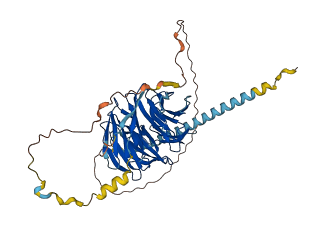
Descriptions
The autoinhibited protein was predicted that may have potential autoinhibitory elements via cis-regPred.
Autoinhibitory domains (AIDs)
Target domain |
|
Relief mechanism |
|
Assay |
cis-regPred |
Accessory elements
No accessory elements
Autoinhibited structure

Activated structure
1 structures for A2CEH0
| Entry ID | Method | Resolution | Chain | Position | Source |
|---|---|---|---|---|---|
| AF-A2CEH0-F1 | Predicted | AlphaFoldDB |
No variants for A2CEH0
| Variant ID(s) | Position | Change | Description | Diseaes Association | Provenance |
|---|---|---|---|---|---|
| No variants for A2CEH0 | |||||
No associated diseases with A2CEH0
No regional properties for A2CEH0
| Type | Name | Position | InterPro Accession |
|---|---|---|---|
| No domain, repeats, and functional sites for A2CEH0 | |||
4 GO annotations of cellular component
| Name | Definition |
|---|---|
| centriole | A cellular organelle, found close to the nucleus in many eukaryotic cells, consisting of a small cylinder with microtubular walls, 300-500 nm long and 150-250 nm in diameter. It contains nine short, parallel, peripheral microtubular fibrils, each fibril consisting of one complete microtubule fused to two incomplete microtubules. Cells usually have two centrioles, lying at right angles to each other. At division, each pair of centrioles generates another pair and the twin pairs form the pole of the mitotic spindle. |
| ciliary basal body | A membrane-tethered, short cylindrical array of microtubules and associated proteins found at the base of a eukaryotic cilium (also called flagellum) that is similar in structure to a centriole and derives from it. The cilium basal body is the site of assembly and remodelling of the cilium and serves as a nucleation site for axoneme growth. As well as anchoring the cilium, it is thought to provide a selective gateway regulating the entry of ciliary proteins and vesicles by intraflagellar transport. |
| cytoplasm | The contents of a cell excluding the plasma membrane and nucleus, but including other subcellular structures. |
| extracellular region | The space external to the outermost structure of a cell. For cells without external protective or external encapsulating structures this refers to space outside of the plasma membrane. This term covers the host cell environment outside an intracellular parasite. |
No GO annotations of molecular function
| Name | Definition |
|---|---|
| No GO annotations for molecular function |
8 GO annotations of biological process
| Name | Definition |
|---|---|
| centriole replication | The cell cycle process in which a daughter centriole is formed perpendicular to an existing centriole. An immature centriole contains a ninefold radially symmetric array of single microtubules; mature centrioles consist of a radial array of nine microtubule triplets, doublets, or singlets depending upon the species and cell type. Duplicated centrioles also become the ciliary basal body in cells that form cilia during G0. |
| cilium assembly | The assembly of a cilium, a specialized eukaryotic organelle that consists of a filiform extrusion of the cell surface. Each cilium is bounded by an extrusion of the cytoplasmic membrane, and contains a regular longitudinal array of microtubules, anchored basally in a centriole. |
| epithelial cilium movement involved in determination of left/right asymmetry | The movement of cilia of epithelial cells of the Left Right Organizer (LRO), also referred to as the node in mouse or the Kupffer's vesicle in zebrafish, resulting in the leftward fluid flow across the LRO and generation or transport of a signal which determines asymmetry in an organism's body plan with respect to the left and right halves. |
| heart development | The process whose specific outcome is the progression of the heart over time, from its formation to the mature structure. The heart is a hollow, muscular organ, which, by contracting rhythmically, keeps up the circulation of the blood. |
| optokinetic behavior | The behavior of an organism pertaining to movement of the eyes and of objects in the visual field, as in nystagmus. |
| renal system process | A organ system process carried out by any of the organs or tissues of the renal system. The renal system maintains fluid balance, and contributes to electrolyte balance, acid/base balance, and disposal of nitrogenous waste products. In humans, the renal system comprises a pair of kidneys, a pair of ureters, urinary bladder, urethra, sphincter muscle and associated blood vessels; in other species, the renal system may comprise related structures (e.g., nephrocytes and malpighian tubules in Drosophila). |
| retina homeostasis | A tissue homeostatic process involved in the maintenance of an internal equilibrium within the retina of the eye, including control of cellular proliferation and death and control of metabolic function. |
| retina layer formation | The process in which the vertebrate retina is organized into three laminae: the outer nuclear layer (ONL), which contains photoreceptor nuclei; the inner nuclear layer (INL), which contains amacrine, bipolar and horizontal cells; and the retinal ganglion cell (RGC) layer. Between the inner and outer nuclear layers, the outer plexiform layer (OPL) contains connections between the photoreceptors and bipolar and horizontal cells. The inner plexiform layer (IPL) is positioned between the INL and the ganglion cell layer and contains the dendrites of RGCs and processes of bipolar and amacrine cells. Spanning all layers of the retina are the radially oriented Mueller glia. |
4 homologous proteins in AiPD
| UniProt AC | Gene Name | Protein Name | Species | Evidence Code |
|---|---|---|---|---|
| Q8N3Y1 | FBXW8 | F-box/WD repeat-containing protein 8 | Homo sapiens (Human) | PR |
| Q8TC44 | POC1B | POC1 centriolar protein homolog B | Homo sapiens (Human) | PR |
| D3ZW91 | Poc1b | POC1 centriolar protein homolog B | Rattus norvegicus (Rat) | PR |
| Q6DRF9 | wdr55 | WD repeat-containing protein 55 | Danio rerio (Zebrafish) (Brachydanio rerio) | PR |
| 10 | 20 | 30 | 40 | 50 | 60 |
| MASVMEDPTL | ERHFKGHKDV | ISCADFNPNN | KQLATGSCDK | SLMIWNLAPK | ARAFRFVGHT |
| 70 | 80 | 90 | 100 | 110 | 120 |
| DVITGVNFAP | SGSLVASSSR | DQTVRLWTPS | IKGESTVFKA | HTASVRSVHF | SRDGQRLVTA |
| 130 | 140 | 150 | 160 | 170 | 180 |
| SDDKSVKVWG | VERKKFLYSL | NRHTNWVRCA | RFSPDGRLIA | SCGDDRTVRL | WDTSSHQCIN |
| 190 | 200 | 210 | 220 | 230 | 240 |
| IFTDYGGSAT | FVDFNSSGTC | IASSGADNTI | KIWDIRTNKL | IQHYKVHNAG | VNCFSFHPSG |
| 250 | 260 | 270 | 280 | 290 | 300 |
| NYLISGSSDS | TIKILDLLEG | RLIYTLHGHK | GPVLTVTFSR | DGDLFASGGA | DSQVLMWKTN |
| 310 | 320 | 330 | 340 | 350 | 360 |
| FDSLNYRELL | SKHSKRVTPD | PPPHLMDIYP | RSHHRHHPQN | GTVEINPVAD | TQSTDPQVVE |
| 370 | 380 | 390 | 400 | 410 | 420 |
| VGRVVFSTTD | ARNYDGASSS | RAQFTSGMDS | GPFRTHTQAR | EEEDENQEER | FAGGMTASPA |
| 430 | 440 | 450 | 460 | 470 | 480 |
| ERSGIPSSLT | STLENIVQQL | DILTQTVAVL | EERLTLTEDK | LRTCLDNQVL | LMQQNQQLDR |
| SDEESEGPPL |