A2APC3
Gene name |
Ttll9 |
Protein name |
Probable tubulin polyglutamylase TTLL9 |
Names |
Tubulin--tyrosine ligase-like protein 9 |
Species |
Mus musculus (Mouse) |
KEGG Pathway |
mmu:74711 |
EC number |
|
Protein Class |
|
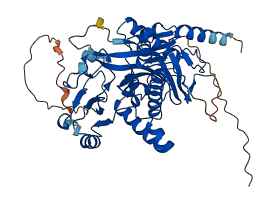
Descriptions
The autoinhibited protein was predicted that may have potential autoinhibitory elements via cis-regPred.
Autoinhibitory domains (AIDs)
Target domain |
|
Relief mechanism |
|
Assay |
cis-regPred |
Accessory elements
No accessory elements
Autoinhibited structure

Activated structure
1 structures for A2APC3
| Entry ID | Method | Resolution | Chain | Position | Source |
|---|---|---|---|---|---|
| AF-A2APC3-F1 | Predicted | AlphaFoldDB |
32 variants for A2APC3
| Variant ID(s) | Position | Change | Description | Diseaes Association | Provenance |
|---|---|---|---|---|---|
| rs3388592624 | 5 | K>N | No | EVA | |
| rs27387591 | 11 | G>S | No | EVA | |
| rs3388592115 | 22 | Q>* | No | EVA | |
| rs3388601827 | 33 | M>V | No | EVA | |
| rs3388586548 | 34 | N>S | No | EVA | |
| rs3388602654 | 69 | F>Y | No | EVA | |
| rs3388593284 | 110 | S>L | No | EVA | |
| rs3388586600 | 124 | T>I | No | EVA | |
| rs3388601264 | 177 | G>W | No | EVA | |
| rs3388603415 | 180 | P>L | No | EVA | |
| rs261877142 | 188 | A>T | No | EVA | |
| rs27387527 | 192 | M>V | No | EVA | |
| rs253567573 | 200 | T>S | No | EVA | |
| rs3388599124 | 201 | R>G | No | EVA | |
| rs3388597760 | 218 | Q>* | No | EVA | |
| rs3392469514 | 238 | V>A | No | EVA | |
| rs3392395877 | 239 | L>Q | No | EVA | |
| rs3392308750 | 255 | F>I | No | EVA | |
| rs3392387131 | 255 | F>L | No | EVA | |
| rs3392469506 | 255 | F>Y | No | EVA | |
| rs224514252 | 286 | D>H | No | EVA | |
| rs3388601243 | 291 | K>Q | No | EVA | |
| rs3392395899 | 309 | G>K | No | EVA | |
| rs3392389239 | 372 | S>R | No | EVA | |
| rs3392108243 | 380 | T>S | No | EVA | |
| rs3388592654 | 381 | C>W | No | EVA | |
| rs3388597792 | 383 | L>R | No | EVA | |
| rs3388603380 | 427 | M>I | No | EVA | |
| rs3388603484 | 432 | T>S | No | EVA | |
| rs3392248032 | 451 | R>L | No | EVA | |
| rs218634172 | 451 | R>Q | No | EVA | |
| rs237094414 | 457 | R>K | No | EVA |
No associated diseases with A2APC3
No regional properties for A2APC3
| Type | Name | Position | InterPro Accession |
|---|---|---|---|
| No domain, repeats, and functional sites for A2APC3 | |||
5 GO annotations of cellular component
| Name | Definition |
|---|---|
| ciliary basal body | A membrane-tethered, short cylindrical array of microtubules and associated proteins found at the base of a eukaryotic cilium (also called flagellum) that is similar in structure to a centriole and derives from it. The cilium basal body is the site of assembly and remodelling of the cilium and serves as a nucleation site for axoneme growth. As well as anchoring the cilium, it is thought to provide a selective gateway regulating the entry of ciliary proteins and vesicles by intraflagellar transport. |
| cilium | A specialized eukaryotic organelle that consists of a filiform extrusion of the cell surface and of some cytoplasmic parts. Each cilium is largely bounded by an extrusion of the cytoplasmic (plasma) membrane, and contains a regular longitudinal array of microtubules, anchored to a basal body. |
| cytoplasm | The contents of a cell excluding the plasma membrane and nucleus, but including other subcellular structures. |
| microtubule | Any of the long, generally straight, hollow tubes of internal diameter 12-15 nm and external diameter 24 nm found in a wide variety of eukaryotic cells; each consists (usually) of 13 protofilaments of polymeric tubulin, staggered in such a manner that the tubulin monomers are arranged in a helical pattern on the microtubular surface, and with the alpha/beta axes of the tubulin subunits parallel to the long axis of the tubule; exist in equilibrium with pool of tubulin monomers and can be rapidly assembled or disassembled in response to physiological stimuli; concerned with force generation, e.g. in the spindle. |
| motile cilium | A cilium which may have a variable arrangement of axonemal microtubules and also contains molecular motors. It may beat with a whip-like pattern that promotes cell motility or transport of fluids and other cells across a cell surface, such as on epithelial cells that line the lumenal ducts of various tissues; or they may display a distinct twirling motion that directs fluid flow asymmetrically across the cellular surface to affect asymmetric body plan organization. Motile cilia can be found in single as well as multiple copies per cell. |
4 GO annotations of molecular function
| Name | Definition |
|---|---|
| ATP binding | Binding to ATP, adenosine 5'-triphosphate, a universally important coenzyme and enzyme regulator. |
| metal ion binding | Binding to a metal ion. |
| tubulin binding | Binding to monomeric or multimeric forms of tubulin, including microtubules. |
| tubulin-glutamic acid ligase activity | Catalysis of the posttranslational transfer of one or more glutamate residues to the gamma-carboxyl group(s) of one or more specific glutamate residues on a tubulin molecule. |
3 GO annotations of biological process
| Name | Definition |
|---|---|
| flagellated sperm motility | The directed, self-propelled movement of a cilium (aka flagellum) that contributes to the movement of a flagellated sperm. |
| microtubule cytoskeleton organization | A process that is carried out at the cellular level which results in the assembly, arrangement of constituent parts, or disassembly of cytoskeletal structures comprising microtubules and their associated proteins. |
| protein polyglutamylation | The addition of one or more alpha-linked glutamyl units to the gamma carboxyl group of peptidyl-glutamic acid. |
5 homologous proteins in AiPD
| UniProt AC | Gene Name | Protein Name | Species | Evidence Code |
|---|---|---|---|---|
| Q3SZH6 | TTLL9 | Probable tubulin polyglutamylase TTLL9 | Bos taurus (Bovine) | PR |
| Q9BWV7 | TTLL2 | Probable tubulin polyglutamylase TTLL2 | Homo sapiens (Human) | PR |
| Q3SXZ7 | TTLL9 | Probable tubulin polyglutamylase TTLL9 | Homo sapiens (Human) | PR |
| A4Q9F4 | Ttll11 | Tubulin polyglutamylase TTLL11 | Mus musculus (Mouse) | PR |
| A4Q9F0 | Ttll7 | Tubulin polyglutamylase TTLL7 | Mus musculus (Mouse) | PR |
| 10 | 20 | 30 | 40 | 50 | 60 |
| MSRQKNQNSK | GHGVSKGKER | EQRTLIRFKT | TLMNTLMDVL | RHRPGWVEVK | DEGEWDFYWC |
| 70 | 80 | 90 | 100 | 110 | 120 |
| DVSWLRENFD | HTYMDEHVRI | SHFRNHYELT | RKNYMVKNLK | RFRKYLERES | GKTEAAKCDF |
| 130 | 140 | 150 | 160 | 170 | 180 |
| FPKTFEMPCE | YHLFVEEFRK | NPGITWIMKP | VARSQGKGIF | LFRRLKDIMD | WRKGTSGKKP |
| 190 | 200 | 210 | 220 | 230 | 240 |
| TGVETQPARA | NMNPSGSHDT | RSSDDQKDDL | PVENYVAQRY | VENPYLIGGR | KFDLRVYVLV |
| 250 | 260 | 270 | 280 | 290 | 300 |
| MSYIPLRAWL | YRDGFARFSN | TRFTLNSIDD | HYVHLTNVAV | QKTSPDYHLK | KGCKWMLQRF |
| 310 | 320 | 330 | 340 | 350 | 360 |
| RQYLASKHGP | KAVETLFSDM | DNIFIKSLQS | VQKVIISDKH | CFELYGYDIL | IDQDLKPWLL |
| 370 | 380 | 390 | 400 | 410 | 420 |
| EVNASPSLTA | SSQEDYELKT | CLLEDTLHVV | DMEARLTGKE | KRVGGFDLMW | NDGPVSREDG |
| 430 | 440 | 450 | 460 | ||
| PSDLSGMGNF | VTNTHLGCVN | DRKEQLRQLF | RSLQAQRKAP | S |