Q9ZRP7
Gene name |
SLD1 (At3g61580, F2A19.180) |
Protein name |
Delta(8)-fatty-acid desaturase 1 |
Names |
Delta(8)-sphingolipid desaturase 1, Sphingoid long-chain base desaturase 1, Sphingoid LCB desaturase 1, Sphingolipid 8-(E/Z)-desaturase 1 |
Species |
Arabidopsis thaliana (Mouse-ear cress) |
KEGG Pathway |
ath:AT3G61580 |
EC number |
1.14.19.29: With oxidation of a pair of donors resulting in the reduction of molecular oxygen to two molecules of water |
Protein Class |
|
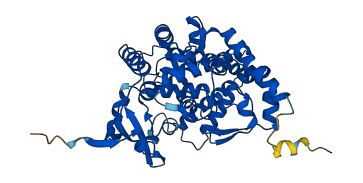
Descriptions
The autoinhibited protein was predicted that may have potential autoinhibitory elements via cis-regPred.
Autoinhibitory domains (AIDs)
Target domain |
|
Relief mechanism |
|
Assay |
cis-regPred |
Accessory elements
No accessory elements
Autoinhibited structure

Activated structure
1 structures for Q9ZRP7
| Entry ID | Method | Resolution | Chain | Position | Source |
|---|---|---|---|---|---|
| AF-Q9ZRP7-F1 | Predicted | AlphaFoldDB |
14 variants for Q9ZRP7
| Variant ID(s) | Position | Change | Description | Diseaes Association | Provenance |
|---|---|---|---|---|---|
| ENSVATH06356060 | 16 | K>N | No | 1000Genomes | |
| ENSVATH06356061 | 37 | D>N | No | 1000Genomes | |
| ENSVATH14466401 | 68 | T>I | No | 1000Genomes | |
| tmp_3_22786496_A_G | 82 | I>V | No | 1000Genomes | |
| ENSVATH14466402 | 130 | Y>F | No | 1000Genomes | |
| tmp_3_22786679_A_T | 143 | I>F | No | 1000Genomes | |
| ENSVATH06356062 | 171 | K>E | No | 1000Genomes | |
| tmp_3_22786794_C_T | 181 | S>F | No | 1000Genomes | |
| tmp_3_22787114_G_A | 288 | A>T | No | 1000Genomes | |
| ENSVATH06356065 | 308 | P>S | No | 1000Genomes | |
| ENSVATH02534905 | 317 | S>G | No | 1000Genomes | |
| tmp_3_22787349_G_T | 366 | W>L | No | 1000Genomes | |
| ENSVATH06356067 | 431 | D>N | No | 1000Genomes | |
| ENSVATH12872188 | 438 | K>E | No | 1000Genomes |
No associated diseases with Q9ZRP7
Functions
| Description | ||
|---|---|---|
| EC Number | 1.14.19.29 | With oxidation of a pair of donors resulting in the reduction of molecular oxygen to two molecules of water |
| Subcellular Localization |
|
|
| PANTHER Family | ||
| PANTHER Subfamily | ||
| PANTHER Protein Class | ||
| PANTHER Pathway Category | No pathway information available | |
3 GO annotations of cellular component
| Name | Definition |
|---|---|
| endoplasmic reticulum | The irregular network of unit membranes, visible only by electron microscopy, that occurs in the cytoplasm of many eukaryotic cells. The membranes form a complex meshwork of tubular channels, which are often expanded into slitlike cavities called cisternae. The ER takes two forms, rough (or granular), with ribosomes adhering to the outer surface, and smooth (with no ribosomes attached). |
| endoplasmic reticulum membrane | The lipid bilayer surrounding the endoplasmic reticulum. |
| integral component of membrane | The component of a membrane consisting of the gene products and protein complexes having at least some part of their peptide sequence embedded in the hydrophobic region of the membrane. |
3 GO annotations of molecular function
| Name | Definition |
|---|---|
| metal ion binding | Binding to a metal ion. |
| oxidoreductase activity, acting on paired donors, with oxidation of a pair of donors resulting in the reduction of molecular oxygen to two molecules of water | Catalysis of an oxidation-reduction (redox) reaction in which hydrogen or electrons are transferred from each of two donors, and molecular oxygen is reduced to two molecules of water. |
| sphingolipid delta-8 desaturase activity | Catalysis of the formation of a double bond between C8 and C9 of the long chain base of a sphingolipid. For example, sphinganine (d18:0) = 8-sphingenine (d18:1delta8); phytosphinganine (t18:0) = 8-phytosphingenine (t18:1delta8); and 4-sphingenine (18:1delta4) = 4,8-sphingadienine (d18:2delta4,8). |
3 GO annotations of biological process
| Name | Definition |
|---|---|
| cellular response to cold | Any process that results in a change in state or activity of a cell (in terms of movement, secretion, enzyme production, gene expression, etc.) as a result of a cold stimulus, a temperature stimulus below the optimal temperature for that organism. |
| lipid metabolic process | The chemical reactions and pathways involving lipids, compounds soluble in an organic solvent but not, or sparingly, in an aqueous solvent. Includes fatty acids; neutral fats, other fatty-acid esters, and soaps; long-chain (fatty) alcohols and waxes; sphingoids and other long-chain bases; glycolipids, phospholipids and sphingolipids; and carotenes, polyprenols, sterols, terpenes and other isoprenoids. |
| sphingolipid biosynthetic process | The chemical reactions and pathways resulting in the formation of sphingolipids, any of a class of lipids containing the long-chain amine diol sphingosine or a closely related base (a sphingoid). |
| 10 | 20 | 30 | 40 | 50 | 60 |
| MAEETEKKYI | TNEDLKKHNK | SGDLWIAIQG | KVYNVSDWIK | THPGGDTVIL | NLVGQDVTDA |
| 70 | 80 | 90 | 100 | 110 | 120 |
| FIAFHPGTAW | HHLDHLFTGY | HIRDFQVSEV | SRDYRRMAAE | FRKLGLFENK | GHVTLYTLAF |
| 130 | 140 | 150 | 160 | 170 | 180 |
| VAAMFLGVLY | GVLACTSVFA | HQIAAALLGL | LWIQSAYIGH | DSGHYVIMSN | KSYNRFAQLL |
| 190 | 200 | 210 | 220 | 230 | 240 |
| SGNCLTGISI | AWWKWTHNAH | HLACNSLDYD | PDLQHIPVFA | VSTKFFSSLT | SRFYDRKLTF |
| 250 | 260 | 270 | 280 | 290 | 300 |
| DPVARFLVSY | QHFTYYPVMC | FGRINLFIQT | FLLLFSKREV | PDRALNFAGI | LVFWTWFPLL |
| 310 | 320 | 330 | 340 | 350 | 360 |
| VSCLPNWPER | FFFVFTSFTV | TALQHIQFTL | NHFAADVYVG | PPTGSDWFEK | QAAGTIDISC |
| 370 | 380 | 390 | 400 | 410 | 420 |
| RSYMDWFFGG | LQFQLEHHLF | PRLPRCHLRK | VSPVVQELCK | KHNLPYRSMS | WFEANVLTIN |
| 430 | 440 | ||||
| TLKTAAYQAR | DVANPVVKNL | VWEALNTHG |