Q9Z2J6
Gene name |
Ptgdr2 (Crth2, Gpr44) |
Protein name |
Prostaglandin D2 receptor 2 |
Names |
|
Species |
Mus musculus (Mouse) |
KEGG Pathway |
mmu:14764 |
EC number |
|
Protein Class |
|
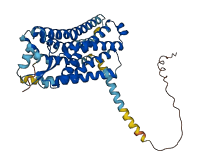
Descriptions
The autoinhibited protein was predicted that may have potential autoinhibitory elements via cis-regPred.
Autoinhibitory domains (AIDs)
Target domain |
|
Relief mechanism |
|
Assay |
cis-regPred |
Accessory elements
No accessory elements
Autoinhibited structure

Activated structure
1 structures for Q9Z2J6
| Entry ID | Method | Resolution | Chain | Position | Source |
|---|---|---|---|---|---|
| AF-Q9Z2J6-F1 | Predicted | AlphaFoldDB |
24 variants for Q9Z2J6
| Variant ID(s) | Position | Change | Description | Diseaes Association | Provenance |
|---|---|---|---|---|---|
| rs3389434200 | 30 | I>M | No | EVA | |
| rs3389527027 | 33 | V>E | No | EVA | |
| rs3389493536 | 51 | L>I | No | EVA | |
| rs3389531660 | 80 | A>P | No | EVA | |
| rs3389527178 | 100 | T>I | No | EVA | |
| rs3389528051 | 100 | T>S | No | EVA | |
| rs3389519880 | 120 | L>M | No | EVA | |
| rs3408261739 | 127 | D>H | No | EVA | |
| rs3389538667 | 128 | R>H | No | EVA | |
| rs3389538667 | 128 | R>P | No | EVA | |
| rs36896636 | 190 | P>A | No | EVA | |
| rs3389519844 | 201 | R>G | No | EVA | |
| rs3389434249 | 205 | L>M | No | EVA | |
| rs3408858618 | 210 | F>L* | No | EVA | |
| rs39072783 | 215 | M>V | No | EVA | |
| rs3408944200 | 280 | L>P | No | EVA | |
| rs3409337352 | 281 | A>T | No | EVA | |
| rs3408778043 | 282 | S>* | No | EVA | |
| rs3409046960 | 284 | G>E | No | EVA | |
| rs3389493568 | 324 | S>I | No | EVA | |
| rs3389522359 | 332 | Q>H | No | EVA | |
| rs226740627 | 340 | R>H | No | EVA | |
| rs37600949 | 359 | I>L | No | EVA | |
| rs3389506077 | 376 | A>V | No | EVA |
No associated diseases with Q9Z2J6
1 regional properties for Q9Z2J6
| Type | Name | Position | InterPro Accession |
|---|---|---|---|
| domain | Olfactomedin-like domain | 385 - 642 | IPR003112 |
2 GO annotations of cellular component
| Name | Definition |
|---|---|
| integral component of plasma membrane | The component of the plasma membrane consisting of the gene products and protein complexes having at least some part of their peptide sequence embedded in the hydrophobic region of the membrane. |
| neuron projection | A prolongation or process extending from a nerve cell, e.g. an axon or dendrite. |
6 GO annotations of molecular function
| Name | Definition |
|---|---|
| G protein-coupled receptor activity | Combining with an extracellular signal and transmitting the signal across the membrane by activating an associated G-protein; promotes the exchange of GDP for GTP on the alpha subunit of a heterotrimeric G-protein complex. |
| neuropeptide binding | Interacting selectively and non-covalently and stoichiometrically with neuropeptides, peptides with direct synaptic effects (peptide neurotransmitters) or indirect modulatory effects on the nervous system (peptide neuromodulators). |
| peptide binding | Binding to a peptide, an organic compound comprising two or more amino acids linked by peptide bonds. |
| prostaglandin D receptor activity | Combining with prostaglandin D (PGD(2)) to initiate a change in cell activity. |
| prostaglandin F receptor activity | Combining with prostaglandin F (PGF (2-alpha)) to initiate a change in cell activity. |
| prostaglandin J receptor activity | Combining with prostaglandin J (PGJ(2)), a metabolite of prostaglandin D (PGD(2)) to initiate a change in cell activity. |
7 GO annotations of biological process
| Name | Definition |
|---|---|
| adenylate cyclase-inhibiting G protein-coupled receptor signaling pathway | A G protein-coupled receptor signaling pathway in which the signal is transmitted via the inhibition of adenylyl cyclase activity and a subsequent decrease in the intracellular concentration of cyclic AMP (cAMP). |
| calcium-mediated signaling | Any intracellular signal transduction in which the signal is passed on within the cell via calcium ions. |
| chemotaxis | The directed movement of a motile cell or organism, or the directed growth of a cell guided by a specific chemical concentration gradient. Movement may be towards a higher concentration (positive chemotaxis) or towards a lower concentration (negative chemotaxis). |
| G protein-coupled receptor signaling pathway | The series of molecular signals initiated by a ligand binding to its receptor, in which the activated receptor promotes the exchange of GDP for GTP on the alpha-subunit of an associated heterotrimeric G-protein complex. The GTP-bound activated alpha-G-protein then dissociates from the beta- and gamma-subunits to further transmit the signal within the cell. The pathway begins with receptor-ligand interaction, and ends with regulation of a downstream cellular process. The pathway can start from the plasma membrane, Golgi or nuclear membrane. |
| negative regulation of male germ cell proliferation | Any process that stops, prevents or reduces the frequency, rate or extent of male germ cell proliferation. |
| neuropeptide signaling pathway | A G protein-coupled receptor signaling pathway initiated by a neuropeptide binding to its receptor on the surface of a target cell, and ending with the regulation of a downstream cellular process. |
| positive regulation of G protein-coupled receptor signaling pathway | Any process that activates or increases the frequency, rate or extent of G protein-coupled receptor signaling pathway activity. |
| 10 | 20 | 30 | 40 | 50 | 60 |
| MANVTLKPLC | PLLEEMVQLP | NHSNSSLRYI | DHVSVLLHGL | ASLLGLVENG | LILFVVGCRM |
| 70 | 80 | 90 | 100 | 110 | 120 |
| RQTVVTTWVL | HLALSDLLAA | ASLPFFTYFL | AVGHSWELGT | TFCKLHSSVF | FLNMFASGFL |
| 130 | 140 | 150 | 160 | 170 | 180 |
| LSAISLDRCL | QVVRPVWAQN | HRTVAVAHRV | CLMLWALAVL | NTIPYFVFRD | TIPRLDGRIM |
| 190 | 200 | 210 | 220 | 230 | 240 |
| CYYNLLLWNP | GPDRDTTCDY | RQKALAVSKF | LLAFMVPLAI | IASSHVAVSL | RLHHRGRQRT |
| 250 | 260 | 270 | 280 | 290 | 300 |
| GRFVRLVAAI | VVAFVLCWGP | YHIFSLLEAR | AHSVTTLRQL | ASRGLPFVTS | LAFFNSVVNP |
| 310 | 320 | 330 | 340 | 350 | 360 |
| LLYVFTCPDM | LYKLRRSLRA | VLESVLVEDS | DQSGGLRNRR | RRASSTATPA | STLLLADRIP |
| 370 | 380 | ||||
| QLRPTRLIGW | MRRGSAEVPQ | RV |