Q9Z1M4
Gene name |
Rps6kb2 |
Protein name |
Ribosomal protein S6 kinase beta-2 |
Names |
S6K-beta-2 , S6K2 , EC 2.7.11.1 , 70 kDa ribosomal protein S6 kinase 2 , p70 ribosomal S6 kinase beta , p70 S6 kinase beta , p70 S6K-beta , p70 S6KB |
Species |
Mus musculus (Mouse) |
KEGG Pathway |
mmu:58988 |
EC number |
2.7.11.1: Protein-serine/threonine kinases |
Protein Class |
|
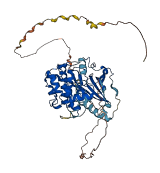
Descriptions
Autoinhibitory domains (AIDs)
Target domain |
67-328 (Protein kinase domain) |
Relief mechanism |
Partner binding |
Assay |
|
Accessory elements
211-234 (Activation loop from InterPro)
Target domain |
67-328 (Protein kinase domain) |
Relief mechanism |
|
Assay |
|
211-234 (Activation loop from InterPro)
Target domain |
67-328 (Protein kinase domain) |
Relief mechanism |
|
Assay |
|
References
- Yeon JH et al. (2016) "Systems-wide Identification of cis-Regulatory Elements in Proteins", Cell systems, 2, 89-100
- Lai KO et al. (2015) "Cyclin-dependent Kinase 5 (Cdk5)-dependent Phosphorylation of p70 Ribosomal S6 Kinase 1 (S6K) Is Required for Dendritic Spine Morphogenesis", The Journal of biological chemistry, 290, 14637-46
- Dennis PB et al. (1998) "Phosphorylation sites in the autoinhibitory domain participate in p70(s6k) activation loop phosphorylation", The Journal of biological chemistry, 273, 14845-52
- Mahalingam M et al. (1996) "Constitutive activation of S6 kinase by deletion of amino-terminal autoinhibitory and rapamycin sensitivity domains", Molecular and cellular biology, 16, 405-13
Autoinhibited structure

Activated structure
1 structures for Q9Z1M4
| Entry ID | Method | Resolution | Chain | Position | Source |
|---|---|---|---|---|---|
| AF-Q9Z1M4-F1 | Predicted | AlphaFoldDB |
19 variants for Q9Z1M4
| Variant ID(s) | Position | Change | Description | Diseaes Association | Provenance |
|---|---|---|---|---|---|
| rs3389495339 | 58 | G>D | No | EVA | |
| rs3389514840 | 60 | E>K | No | EVA | |
| rs3389509699 | 93 | G>E | No | EVA | |
| rs3389424866 | 113 | T>I | No | EVA | |
| rs3408885841 | 119 | E>V | No | EVA | |
| rs3389515858 | 174 | Y>* | No | EVA | |
| rs3389519574 | 218 | E>V | No | EVA | |
| rs3389525033 | 260 | Y>N | No | EVA | |
| rs3389424878 | 293 | T>S | No | EVA | |
| rs3408837500 | 299 | L>P | No | EVA | |
| rs3389515874 | 306 | R>P | No | EVA | |
| rs3389514799 | 335 | D>A | No | EVA | |
| rs3409079367 | 357 | Q>R | No | EVA | |
| rs3389507732 | 379 | S>N | No | EVA | |
| rs3389463977 | 421 | P>L | No | EVA | |
| rs3389481261 | 437 | P>H | No | EVA | |
| rs3389515855 | 465 | L>F | No | EVA | |
| rs3389515912 | 474 | K>M | No | EVA | |
| rs3389481258 | 476 | S>F | No | EVA |
1 associated diseases with Q9Z1M4
[MIM: 619079]: Inflammatory bowel disease 30 (IBD30)
A chronic, relapsing inflammation of the gastrointestinal tract with a complex etiology and a multifactorial inheritance pattern. It is subdivided into Crohn disease and ulcerative colitis phenotypes. Crohn disease may affect any part of the gastrointestinal tract from the mouth to the anus, but most frequently it involves the terminal ileum and colon. Bowel inflammation is transmural and discontinuous. It may contain granulomas or be associated with intestinal or perianal fistulas. In contrast, in ulcerative colitis, the inflammation is continuous and limited to rectal and colonic mucosal layers; fistulas and granulomas are not observed. Both diseases include extraintestinal inflammation of the skin, eyes, or joints. . Note=The disease may be caused by variants affecting the gene represented in this entry. A number of groups have studied the possible association between variant rs2043211 and inflammatory bowel disease (PubMed:17030188, PubMed:19319132, PubMed:23506543, PubMed:26462578). According to some studies involving a limited number of patients, this variant is associated with inflammatory bowel disease (PubMed:17030188, PubMed:19319132, PubMed:23506543). Such association is however not confirmed in studies involving a large number of patients (PubMed:26462578). Discrepancies between studies may be caused by the variable consequences of this polymorphism in the different isoforms (PubMed:29408806). Whereas rs2043211 introduces a stop codon after 'Cys-10' (Cys10Ter) in isoform 1, and therefore the likely formation of a downstream transcriptional start site for this isoform, it causes Ile-102 variation in isoform 5, due to the upstream start site (PubMed:29408806). Moreover, most patients bearing this polymorphism continue to express the slightly smaller but fully functional isoform 7, as a result of transcription downstream of the rs2043211 polymorphism (PubMed:29408806). .
Without disease ID
- A chronic, relapsing inflammation of the gastrointestinal tract with a complex etiology and a multifactorial inheritance pattern. It is subdivided into Crohn disease and ulcerative colitis phenotypes. Crohn disease may affect any part of the gastrointestinal tract from the mouth to the anus, but most frequently it involves the terminal ileum and colon. Bowel inflammation is transmural and discontinuous. It may contain granulomas or be associated with intestinal or perianal fistulas. In contrast, in ulcerative colitis, the inflammation is continuous and limited to rectal and colonic mucosal layers; fistulas and granulomas are not observed. Both diseases include extraintestinal inflammation of the skin, eyes, or joints. . Note=The disease may be caused by variants affecting the gene represented in this entry. A number of groups have studied the possible association between variant rs2043211 and inflammatory bowel disease (PubMed:17030188, PubMed:19319132, PubMed:23506543, PubMed:26462578). According to some studies involving a limited number of patients, this variant is associated with inflammatory bowel disease (PubMed:17030188, PubMed:19319132, PubMed:23506543). Such association is however not confirmed in studies involving a large number of patients (PubMed:26462578). Discrepancies between studies may be caused by the variable consequences of this polymorphism in the different isoforms (PubMed:29408806). Whereas rs2043211 introduces a stop codon after 'Cys-10' (Cys10Ter) in isoform 1, and therefore the likely formation of a downstream transcriptional start site for this isoform, it causes Ile-102 variation in isoform 5, due to the upstream start site (PubMed:29408806). Moreover, most patients bearing this polymorphism continue to express the slightly smaller but fully functional isoform 7, as a result of transcription downstream of the rs2043211 polymorphism (PubMed:29408806). .
6 regional properties for Q9Z1M4
| Type | Name | Position | InterPro Accession |
|---|---|---|---|
| domain | Arf GTPase activating protein | 1 - 124 | IPR001164 |
| repeat | Ankyrin repeat | 132 - 228 | IPR002110 |
| domain | GIT, Spa2 homology (SHD) domain | 266 - 296 | IPR013724-1 |
| domain | GIT, Spa2 homology (SHD) domain | 330 - 360 | IPR013724-2 |
| domain | ARF GTPase-activating protein GIT1, C-terminal | 641 - 753 | IPR022018 |
| domain | Arf GTPase-activating protein GIT1/2, coiled-coil domain | 414 - 478 | IPR032352 |
Functions
| Description | ||
|---|---|---|
| EC Number | 2.7.11.1 | Protein-serine/threonine kinases |
| Subcellular Localization |
|
|
| PANTHER Family | ||
| PANTHER Subfamily | ||
| PANTHER Protein Class | ||
| PANTHER Pathway Category | No pathway information available | |
2 GO annotations of cellular component
| Name | Definition |
|---|---|
| cytoplasm | The contents of a cell excluding the plasma membrane and nucleus, but including other subcellular structures. |
| nucleoplasm | That part of the nuclear content other than the chromosomes or the nucleolus. |
6 GO annotations of molecular function
| Name | Definition |
|---|---|
| ATP binding | Binding to ATP, adenosine 5'-triphosphate, a universally important coenzyme and enzyme regulator. |
| peptide binding | Binding to a peptide, an organic compound comprising two or more amino acids linked by peptide bonds. |
| protein kinase activity | Catalysis of the phosphorylation of an amino acid residue in a protein, usually according to the reaction |
| protein serine kinase activity | Catalysis of the reactions |
| protein serine/threonine kinase activity | Catalysis of the reactions |
| ribosomal protein S6 kinase activity | Catalysis of the reaction |
4 GO annotations of biological process
| Name | Definition |
|---|---|
| negative regulation of insulin receptor signaling pathway | Any process that stops, prevents, or reduces the frequency, rate or extent of insulin receptor signaling. |
| phosphorylation | The process of introducing a phosphate group into a molecule, usually with the formation of a phosphoric ester, a phosphoric anhydride or a phosphoric amide. |
| positive regulation of translational initiation | Any process that activates or increases the frequency, rate or extent of translational initiation. |
| TOR signaling | The series of molecular signals mediated by TOR (Target of rapamycin) proteins, members of the phosphoinositide (PI) 3-kinase related kinase (PIKK) family that act as serine/threonine kinases in response to nutrient availability or growth factors. |
16 homologous proteins in AiPD
| UniProt AC | Gene Name | Protein Name | Species | Evidence Code |
|---|---|---|---|---|
| Q6TJY3 | RPS6KB1 | Ribosomal protein S6 kinase beta-1 | Bos taurus (Bovine) | SS |
| P23443 | RPS6KB1 | Ribosomal protein S6 kinase beta-1 | Homo sapiens (Human) | EV SS |
| Q9HBY8 | SGK2 | Serine/threonine-protein kinase Sgk2 | Homo sapiens (Human) | SS |
| O00141 | SGK1 | Serine/threonine-protein kinase Sgk1 | Homo sapiens (Human) | PR |
| Q96BR1 | SGK3 | Serine/threonine-protein kinase Sgk3 | Homo sapiens (Human) | SS |
| Q9UBS0 | RPS6KB2 | Ribosomal protein S6 kinase beta-2 | Homo sapiens (Human) | PR |
| Q8QZV4 | Stk32c | Serine/threonine-protein kinase 32C | Mus musculus (Mouse) | PR |
| Q9ERE3 | Sgk3 | Serine/threonine-protein kinase Sgk3 | Mus musculus (Mouse) | PR |
| Q9WUT3 | Rps6ka2 | Ribosomal protein S6 kinase alpha-2 | Mus musculus (Mouse) | SS |
| P18653 | Rps6ka1 | Ribosomal protein S6 kinase alpha-1 | Mus musculus (Mouse) | SS |
| P18654 | Rps6ka3 | Ribosomal protein S6 kinase alpha-3 | Mus musculus (Mouse) | SS |
| Q9Z2B9 | Rps6ka4 | Ribosomal protein S6 kinase alpha-4 | Mus musculus (Mouse) | SS |
| Q8C050 | Rps6ka5 | Ribosomal protein S6 kinase alpha-5 | Mus musculus (Mouse) | PR |
| Q8BSK8 | Rps6kb1 | Ribosomal protein S6 kinase beta-1 | Mus musculus (Mouse) | SS |
| P67999 | Rps6kb1 | Ribosomal protein S6 kinase beta-1 | Rattus norvegicus (Rat) | EV SS |
| Q5BKK4 | sgk1 | Serine/threonine-protein kinase Sgk1 | Xenopus tropicalis (Western clawed frog) (Silurana tropicalis) | PR |
| 10 | 20 | 30 | 40 | 50 | 60 |
| MAAVFDLDLE | TEEGSEGEGE | PEFSPADVCP | LGELRAAGLE | TVGHYEEVEL | TESSVNLGPE |
| 70 | 80 | 90 | 100 | 110 | 120 |
| RIGPHCFELL | SVLGKGGYGK | VFQVRKVQGT | NLGKIYAMKV | LRKAKIVCSA | KDTAHTRAER |
| 130 | 140 | 150 | 160 | 170 | 180 |
| NILESVKHPF | IVELAYAFQT | GGKLYLILEC | LSGGELFTHL | EREGIFLEDT | ACFYLAEITL |
| 190 | 200 | 210 | 220 | 230 | 240 |
| ALGHLHSHGI | IYRDLKPENI | MLSSQGHIKL | TDFGLCKESI | HEGAITHTFC | GTIEYMAPEI |
| 250 | 260 | 270 | 280 | 290 | 300 |
| LVRTGHNRAV | DWWSLGALMY | DMLTGSPPFT | AENRKKTMDK | IIKGKLVLPP | YLTPDARDLA |
| 310 | 320 | 330 | 340 | 350 | 360 |
| KKFLKRNPTQ | RIGGGLGDAA | DVQRHPFFRH | INWDDLLARR | VDPPFRPSLQ | SEEDVSQFDA |
| 370 | 380 | 390 | 400 | 410 | 420 |
| RFTRQTPVDS | PDDTALSESA | NQAFLGFTYV | APSVLDSIKE | GFSFQPKLRS | PRRLNSSPRT |
| 430 | 440 | 450 | 460 | 470 | 480 |
| PISPLKFSPF | EGFRPSPGPP | EPMEPSLPPL | LPSPPSPPPT | STAPLPIRPP | SGTKKSKKGR |
| GRSGR |