Q5BKK4
Gene name |
sgk1 (sgk) |
Protein name |
Serine/threonine-protein kinase Sgk1 |
Names |
Serum/glucocorticoid-regulated kinase 1 |
Species |
Xenopus tropicalis (Western clawed frog) (Silurana tropicalis) |
KEGG Pathway |
xtr:594981 |
EC number |
|
Protein Class |
|
Descriptions
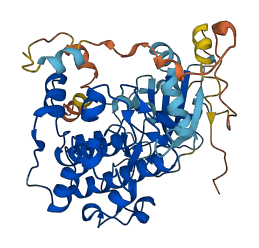
The autoinhibited protein was predicted that may have potential autoinhibitory elements via cis-regPred.
Autoinhibitory domains (AIDs)
Target domain |
|
Relief mechanism |
|
Assay |
cis-regPred |
Accessory elements
226-249 (Activation loop from InterPro)
Target domain |
85-342 (Protein kinase domain) |
Relief mechanism |
|
Assay |
|
Autoinhibited structure
Activated structure
1 structures for Q5BKK4
| Entry ID | Method | Resolution | Chain | Position | Source |
|---|---|---|---|---|---|
| AF-Q5BKK4-F1 | Predicted | AlphaFoldDB |
No variants for Q5BKK4
| Variant ID(s) | Position | Change | Description | Diseaes Association | Provenance |
|---|---|---|---|---|---|
| No variants for Q5BKK4 | |||||
No associated diseases with Q5BKK4
16 regional properties for Q5BKK4
| Type | Name | Position | InterPro Accession |
|---|---|---|---|
| domain | Sema domain | 25 - 508 | IPR001627 |
| repeat | Plexin repeat | 510 - 559 | IPR002165-1 |
| repeat | Plexin repeat | 655 - 696 | IPR002165-2 |
| repeat | Plexin repeat | 804 - 855 | IPR002165-3 |
| domain | IPT domain | 857 - 952 | IPR002909-1 |
| domain | IPT domain | 953 - 1038 | IPR002909-2 |
| domain | IPT domain | 1040 - 1140 | IPR002909-3 |
| domain | IPT domain | 1142 - 1237 | IPR002909-4 |
| domain | Plexin, cytoplasmic RasGAP domain | 1311 - 1863 | IPR013548 |
| domain | PSI domain | 510 - 560 | IPR016201-1 |
| domain | PSI domain | 655 - 702 | IPR016201-2 |
| domain | PSI domain | 803 - 856 | IPR016201-3 |
| domain | Plexin, TIG domain 1 | 565 - 654 | IPR041019 |
| domain | Plexin, TIG domain 2 | 708 - 802 | IPR041362 |
| domain | Plexin-A2, sema domain | 38 - 552 | IPR042826 |
| domain | Plexin, cytoplasmic RhoGTPase-binding domain | 1485 - 1597 | IPR046800 |
3 GO annotations of cellular component
| Name | Definition |
|---|---|
| cytoplasm | The contents of a cell excluding the plasma membrane and nucleus, but including other subcellular structures. |
| endoplasmic reticulum | The irregular network of unit membranes, visible only by electron microscopy, that occurs in the cytoplasm of many eukaryotic cells. The membranes form a complex meshwork of tubular channels, which are often expanded into slitlike cavities called cisternae. The ER takes two forms, rough (or granular), with ribosomes adhering to the outer surface, and smooth (with no ribosomes attached). |
| nucleus | A membrane-bounded organelle of eukaryotic cells in which chromosomes are housed and replicated. In most cells, the nucleus contains all of the cell's chromosomes except the organellar chromosomes, and is the site of RNA synthesis and processing. In some species, or in specialized cell types, RNA metabolism or DNA replication may be absent. |
4 GO annotations of molecular function
| Name | Definition |
|---|---|
| ATP binding | Binding to ATP, adenosine 5'-triphosphate, a universally important coenzyme and enzyme regulator. |
| potassium channel regulator activity | Binds to and modulates the activity of a potassium channel. |
| protein serine kinase activity | Catalysis of the reactions: ATP + protein serine = ADP + protein serine phosphate. |
| protein serine/threonine kinase activity | Catalysis of the reactions: ATP + protein serine = ADP + protein serine phosphate, and ATP + protein threonine = ADP + protein threonine phosphate. |
4 GO annotations of biological process
| Name | Definition |
|---|---|
| apoptotic process | A programmed cell death process which begins when a cell receives an internal (e.g. DNA damage) or external signal (e.g. an extracellular death ligand), and proceeds through a series of biochemical events (signaling pathway phase) which trigger an execution phase. The execution phase is the last step of an apoptotic process, and is typically characterized by rounding-up of the cell, retraction of pseudopodes, reduction of cellular volume (pyknosis), chromatin condensation, nuclear fragmentation (karyorrhexis), plasma membrane blebbing and fragmentation of the cell into apoptotic bodies. When the execution phase is completed, the cell has died. |
| intracellular signal transduction | The process in which a signal is passed on to downstream components within the cell, which become activated themselves to further propagate the signal and finally trigger a change in the function or state of the cell. |
| neuron projection morphogenesis | The process in which the anatomical structures of a neuron projection are generated and organized. A neuron projection is any process extending from a neural cell, such as axons or dendrites. |
| peptidyl-serine phosphorylation | The phosphorylation of peptidyl-serine to form peptidyl-O-phospho-L-serine. |
12 homologous proteins in AiPD
| UniProt AC | Gene Name | Protein Name | Species | Evidence Code |
|---|---|---|---|---|
| Q6TJY3 | RPS6KB1 | Ribosomal protein S6 kinase beta-1 | Bos taurus (Bovine) | SS |
| P23443 | RPS6KB1 | Ribosomal protein S6 kinase beta-1 | Homo sapiens (Human) | EV SS |
| Q9UBS0 | RPS6KB2 | Ribosomal protein S6 kinase beta-2 | Homo sapiens (Human) | PR |
| Q9HBY8 | SGK2 | Serine/threonine-protein kinase Sgk2 | Homo sapiens (Human) | SS |
| Q96BR1 | SGK3 | Serine/threonine-protein kinase Sgk3 | Homo sapiens (Human) | SS |
| O00141 | SGK1 | Serine/threonine-protein kinase Sgk1 | Homo sapiens (Human) | PR |
| Q8QZV4 | Stk32c | Serine/threonine-protein kinase 32C | Mus musculus (Mouse) | PR |
| Q9Z1M4 | Rps6kb2 | Ribosomal protein S6 kinase beta-2 | Mus musculus (Mouse) | SS |
| Q8BSK8 | Rps6kb1 | Ribosomal protein S6 kinase beta-1 | Mus musculus (Mouse) | SS |
| Q9ERE3 | Sgk3 | Serine/threonine-protein kinase Sgk3 | Mus musculus (Mouse) | PR |
| P67999 | Rps6kb1 | Ribosomal protein S6 kinase beta-1 | Rattus norvegicus (Rat) | EV SS |
| A8KBH6 | prkcb | Protein kinase C beta type | Xenopus tropicalis (Western clawed frog) (Silurana tropicalis) | SS |
| 10 | 20 | 30 | 40 | 50 | 60 |
| MRTKNEKSPL | KAFMKQRRMG | LNDFIQKIAT | NSSYACKHSE | VQSILNISPP | QEPELLNENS |
| 70 | 80 | 90 | 100 | 110 | 120 |
| SPPPSPSQQI | NLGPSSNPHA | KPSDFQFLKI | IGKGSFGKVL | LARHNADEKF | YAVKVLQKKA |
| 130 | 140 | 150 | 160 | 170 | 180 |
| ILKKKEEKHI | MSERNVLLKN | VKHPFLVGLH | FSFQTTSRLY | FILDYINGGE | LFYHLQRERC |
| 190 | 200 | 210 | 220 | 230 | 240 |
| FLEPRARFYA | AEIASALGYL | HSLNIVYRDL | KPENILLDSQ | GHIILTDFGL | CKENIEPNGT |
| 250 | 260 | 270 | 280 | 290 | 300 |
| TSTFCGTPEY | LAPEVLHKQP | YDRTVDWWCL | GAVLYEMLYG | LPPFYSRNTA | EMYDNILNKP |
| 310 | 320 | 330 | 340 | 350 | 360 |
| LQLKPNITNS | ARNLLEGLLQ | KDRTKRIGAK | NDFMEIKNHM | FFSPINWDDL | INKKITPPFN |
| 370 | 380 | 390 | 400 | 410 | |
| PNVSGPSDLQ | HFDPEFTEEP | VPNSIGQSPD | SILITASIKE | AAEAFMGFSY | APPMESYL |