Q9Z1B8
Gene name |
Phf1 (Plc1, Tctex-3, Tctex3) |
Protein name |
PHD finger protein 1 |
Names |
Protein PHF1, Polycomb-like protein 1, mPCl1, T-complex testis-expressed 3 |
Species |
Mus musculus (Mouse) |
KEGG Pathway |
mmu:21652 |
EC number |
|
Protein Class |
|
Descriptions
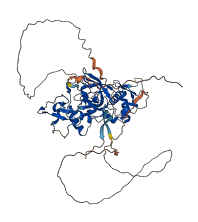
The autoinhibited protein was predicted that may have potential autoinhibitory elements via cis-regPred.
Autoinhibitory domains (AIDs)
Target domain |
|
Relief mechanism |
|
Assay |
cis-regPred |
Accessory elements
No accessory elements
Autoinhibited structure

Activated structure
2 structures for Q9Z1B8
| Entry ID | Method | Resolution | Chain | Position | Source |
|---|---|---|---|---|---|
| 5XFQ | X-ray | 240 A | A/B | 25-360 | PDB |
| AF-Q9Z1B8-F1 | Predicted | AlphaFoldDB |
24 variants for Q9Z1B8
| Variant ID(s) | Position | Change | Description | Diseaes Association | Provenance |
|---|---|---|---|---|---|
| rs3389426167 | 9 | R>S | No | EVA | |
| rs3389395747 | 53 | K>R | No | EVA | |
| rs3407445035 | 57 | A>D | No | EVA | |
| rs3407609779 | 61 | C>G | No | EVA | |
| rs3389456756 | 76 | K>N | No | EVA | |
| rs3389438323 | 80 | P>L | No | EVA | |
| rs3389359159 | 97 | T>N | No | EVA | |
| rs3389437718 | 104 | L>P | No | EVA | |
| rs3389445100 | 108 | E>K | No | EVA | |
| rs3407457700 | 156 | Y>H | No | EVA | |
| rs3389395695 | 158 | R>L | No | EVA | |
| rs3407191363 | 160 | M>I | No | EVA | |
| rs3411602239 | 239 | G>S | No | EVA | |
| rs3389448673 | 299 | G>E | No | EVA | |
| rs3389451669 | 301 | R>H | No | EVA | |
| rs3389445140 | 384 | V>L | No | EVA | |
| rs3405739031 | 421 | E>V | No | EVA | |
| rs3407876148 | 459 | D>N | No | EVA | |
| rs3389456792 | 484 | H>Q | No | EVA | |
| rs3389448651 | 498 | P>L | No | EVA | |
| rs3389462743 | 532 | D>N | No | EVA | |
| rs3389445810 | 540 | R>K | No | EVA | |
| rs3406541347 | 557 | G>S | No | EVA | |
| rs3407609789 | 558 | I>R | No | EVA |
No associated diseases with Q9Z1B8
10 regional properties for Q9Z1B8
| Type | Name | Position | InterPro Accession |
|---|---|---|---|
| domain | Zinc finger, PHD-type | 89 - 140 | IPR001965-1 |
| domain | Zinc finger, PHD-type | 188 - 238 | IPR001965-2 |
| domain | Tudor domain | 29 - 86 | IPR002999 |
| conserved_site | Zinc finger, PHD-type, conserved site | 90 - 139 | IPR019786 |
| domain | Zinc finger, PHD-finger | 87 - 142 | IPR019787 |
| domain | Polycomb-like MTF2 factor 2, C-terminal domain | 528 - 556 | IPR025894 |
| domain | PHD finger protein 1, PHD finger 1 | 89 - 139 | IPR031202 |
| domain | Lysine-specific demethylase 4-like, Tudor domain | 34 - 69 | IPR040477 |
| domain | PHD finger protein 1, PHD finger 2 | 188 - 239 | IPR047010 |
| domain | PHD finger protein 1, Tudor domain | 30 - 82 | IPR047399 |
Functions
6 GO annotations of cellular component
| Name | Definition |
|---|---|
| centrosome | A structure comprised of a core structure (in most organisms, a pair of centrioles) and peripheral material from which a microtubule-based structure, such as a spindle apparatus, is organized. Centrosomes occur close to the nucleus during interphase in many eukaryotic cells, though in animal cells it changes continually during the cell-division cycle. |
| cytoplasm | The contents of a cell excluding the plasma membrane and nucleus, but including other subcellular structures. |
| ESC/E(Z) complex | A multimeric protein complex that can methylate lysine-27 and lysine-9 residues of histone H3. In Drosophila the core subunits of the complex include ESC, E(Z), CAF1 (NURF-55) and SU(Z)12. In mammals the core subunits of the complex include EED, EZH2, SUZ12 and RBBP4. |
| nucleoplasm | That part of the nuclear content other than the chromosomes or the nucleolus. |
| nucleus | A membrane-bounded organelle of eukaryotic cells in which chromosomes are housed and replicated. In most cells, the nucleus contains all of the cell's chromosomes except the organellar chromosomes, and is the site of RNA synthesis and processing. In some species, or in specialized cell types, RNA metabolism or DNA replication may be absent. |
| site of double-strand break | A region of a chromosome at which a DNA double-strand break has occurred. DNA damage signaling and repair proteins accumulate at the lesion to respond to the damage and repair the DNA to form a continuous DNA helix. |
7 GO annotations of molecular function
| Name | Definition |
|---|---|
| chromatin binding | Binding to chromatin, the network of fibers of DNA, protein, and sometimes RNA, that make up the chromosomes of the eukaryotic nucleus during interphase. |
| DNA binding | Any molecular function by which a gene product interacts selectively and non-covalently with DNA (deoxyribonucleic acid). |
| histone methyltransferase binding | Binding to a histone methyltransferase enzyme. |
| identical protein binding | Binding to an identical protein or proteins. |
| metal ion binding | Binding to a metal ion. |
| methylated histone binding | Binding to a histone in which a residue has been modified by methylation. |
| transcription corepressor binding | Binding to a transcription corepressor, a protein involved in negative regulation of transcription via protein-protein interactions with transcription factors and other proteins that negatively regulate transcription. Transcription corepressors do not bind DNA directly, but rather mediate protein-protein interactions between repressing transcription factors and the basal transcription machinery. |
5 GO annotations of biological process
| Name | Definition |
|---|---|
| cellular response to DNA damage stimulus | Any process that results in a change in state or activity of a cell (in terms of movement, secretion, enzyme production, gene expression, etc.) as a result of a stimulus indicating damage to its DNA from environmental insults or errors during metabolism. |
| chromatin organization | The assembly or remodeling of chromatin composed of DNA complexed with histones, other associated proteins, and sometimes RNA. |
| negative regulation of histone H3-K27 methylation | Any process that decreases the rate, frequency, or extent of histone H3-K27 methylation. Histone H3-K27 methylation is the modification of histone H3 by addition of a methyl group to lysine at position 27 of the histone. |
| positive regulation of histone H3-K27 methylation | Any process that increases the rate, frequency, or extent of histone H3-K27 methylation. Histone H3-K27 methylation is the modification of histone H3 by addition of a methyl group to lysine at position 27 of the histone. |
| regulation of DNA-templated transcription | Any process that modulates the frequency, rate or extent of cellular DNA-templated transcription. |
3 homologous proteins in AiPD
| 10 | 20 | 30 | 40 | 50 | 60 |
| MAQLPRLSRL | GAPSLWDPAS | PAPTSGPRPR | LWEGQDVLAR | WTDGLLYLGT | IKKVDSAREV |
| 70 | 80 | 90 | 100 | 110 | 120 |
| CLVQFEDDSQ | FLVLWKDISP | AALPGEELLC | CVCRSETVVP | GNRLVSCEKC | RHAYHQDCHV |
| 130 | 140 | 150 | 160 | 170 | 180 |
| PRAPAPGEGE | GASWVCRQCV | FAIATKRGGA | LKKGPYARAM | LGMKLSLPYG | LKGLDWDAGH |
| 190 | 200 | 210 | 220 | 230 | 240 |
| LSNRQQSYCY | CGGPGEWNLK | MLQCRSCLQW | FHEACTQCLS | KPLLYGDRFY | EFECCVCRGG |
| 250 | 260 | 270 | 280 | 290 | 300 |
| PEKVRRLQLR | WVDVAHLVLY | HLSVCCKKKY | FDFDREILPF | TSENWDSLLL | GELSDTPKGE |
| 310 | 320 | 330 | 340 | 350 | 360 |
| RSSQLLSALN | SHKDRFISGR | EIKKRKCLFG | LHARTPPPVE | LLTGDGAPTS | FPSGQGPGGG |
| 370 | 380 | 390 | 400 | 410 | 420 |
| VSRPLGKRWR | SEPEPLRRRQ | KGKVEELGPP | TAAHSRHGSR | EQRALQASVS | PPPPSPNQSY |
| 430 | 440 | 450 | 460 | 470 | 480 |
| EGSSGYNFRP | TDARCLPSSP | IRMFASFHPS | ASTAGTSGDS | EPPDRSPLGL | HIGFPTDTPK |
| 490 | 500 | 510 | 520 | 530 | 540 |
| SSPHSVTASS | SSVPALTPGF | SRHSPPSPLC | RSLSPGTGGG | VRGGVSYLSR | GDPVRVLARR |
| 550 | |||||
| VRPDGSVQYL | VEWGGGGIF |