Q02395
Gene name |
Mtf2 (Pcl2) |
Protein name |
Metal-response element-binding transcription factor 2 |
Names |
Metal regulatory transcription factor 2, Metal-response element DNA-binding protein M96, Polycomb-like protein 2, mPCl2, Zinc-regulated factor 1, ZiRF1 |
Species |
Mus musculus (Mouse) |
KEGG Pathway |
mmu:17765 |
EC number |
|
Protein Class |
|
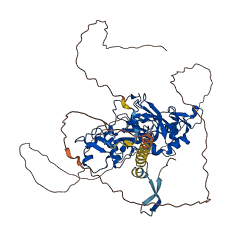
Descriptions
The autoinhibited protein was predicted that may have potential autoinhibitory elements via cis-regPred.
Autoinhibitory domains (AIDs)
Target domain |
|
Relief mechanism |
|
Assay |
cis-regPred |
Accessory elements
No accessory elements
Autoinhibited structure

Activated structure
3 structures for Q02395
| Entry ID | Method | Resolution | Chain | Position | Source |
|---|---|---|---|---|---|
| 2EQJ | NMR | - | A | 40-98 | PDB |
| 2YT5 | NMR | - | A | 104-162 | PDB |
| AF-Q02395-F1 | Predicted | AlphaFoldDB |
22 variants for Q02395
| Variant ID(s) | Position | Change | Description | Diseaes Association | Provenance |
|---|---|---|---|---|---|
| rs3388769731 | 3 | D>E | No | EVA | |
| rs233300735 | 7 | A>V | No | EVA | |
| rs3388758544 | 25 | S>P | No | EVA | |
| rs3388761741 | 26 | A>T | No | EVA | |
| rs3388775355 | 29 | N>T | No | EVA | |
| rs3388782924 | 201 | Q>* | No | EVA | |
| rs3388764710 | 242 | D>Y | No | EVA | |
| rs3396029030 | 315 | E>* | No | EVA | |
| rs3395901533 | 315 | E>D | No | EVA | |
| rs3395959727 | 315 | E>V | No | EVA | |
| rs3395901609 | 317 | Y>F | No | EVA | |
| rs3395987125 | 318 | E>G | No | EVA | |
| rs3388775348 | 367 | G>* | No | EVA | |
| rs3388775348 | 367 | G>R | No | EVA | |
| rs239618934 | 383 | T>I | No | EVA | |
| rs3388772937 | 387 | R>K | No | EVA | |
| rs32061848 | 430 | N>T | No | EVA | |
| rs1132208599 | 498 | R>I | No | EVA | |
| rs1133003364 | 504 | P>S | No | EVA | |
| rs1135361500 | 516 | V>G | No | EVA | |
| rs1134878371 | 517 | K>* | No | EVA | |
| rs1133414538 | 525 | Y>F | No | EVA |
No associated diseases with Q02395
9 regional properties for Q02395
| Type | Name | Position | InterPro Accession |
|---|---|---|---|
| domain | Zinc finger, PHD-type | 104 - 155 | IPR001965-1 |
| domain | Zinc finger, PHD-type | 203 - 253 | IPR001965-2 |
| domain | Tudor domain | 44 - 101 | IPR002999 |
| conserved_site | Zinc finger, PHD-type, conserved site | 105 - 154 | IPR019786 |
| domain | Zinc finger, PHD-finger | 102 - 157 | IPR019787 |
| domain | Polycomb-like MTF2 factor 2, C-terminal domain | 545 - 591 | IPR025894 |
| domain | Lysine-specific demethylase 4-like, Tudor domain | 49 - 84 | IPR040477 |
| domain | MTF2, PHD domain 1 | 104 - 156 | IPR042014 |
| domain | MTF2, PHD domain 2 | 203 - 254 | IPR042015 |
4 GO annotations of cellular component
| Name | Definition |
|---|---|
| cytoplasm | The contents of a cell excluding the plasma membrane and nucleus, but including other subcellular structures. |
| focal adhesion | A cell-substrate junction that anchors the cell to the extracellular matrix and that forms a point of termination of actin filaments. In insects focal adhesion has also been referred to as hemi-adherens junction (HAJ). |
| nucleoplasm | That part of the nuclear content other than the chromosomes or the nucleolus. |
| nucleus | A membrane-bounded organelle of eukaryotic cells in which chromosomes are housed and replicated. In most cells, the nucleus contains all of the cell's chromosomes except the organellar chromosomes, and is the site of RNA synthesis and processing. In some species, or in specialized cell types, RNA metabolism or DNA replication may be absent. |
7 GO annotations of molecular function
| Name | Definition |
|---|---|
| chromatin binding | Binding to chromatin, the network of fibers of DNA, protein, and sometimes RNA, that make up the chromosomes of the eukaryotic nucleus during interphase. |
| DNA binding | Any molecular function by which a gene product interacts selectively and non-covalently with DNA (deoxyribonucleic acid). |
| DNA-binding transcription repressor activity, RNA polymerase II-specific | A DNA-binding transcription factor activity that represses or decreases the transcription of specific gene sets transcribed by RNA polymerase II. |
| metal ion binding | Binding to a metal ion. |
| methylated histone binding | Binding to a histone in which a residue has been modified by methylation. |
| RNA polymerase II transcription regulatory region sequence-specific DNA binding | Binding to a specific sequence of DNA that is part of a regulatory region that controls the transcription of a gene or cistron by RNA polymerase II. |
| transcription corepressor binding | Binding to a transcription corepressor, a protein involved in negative regulation of transcription via protein-protein interactions with transcription factors and other proteins that negatively regulate transcription. Transcription corepressors do not bind DNA directly, but rather mediate protein-protein interactions between repressing transcription factors and the basal transcription machinery. |
10 GO annotations of biological process
| Name | Definition |
|---|---|
| cellular response to leukemia inhibitory factor | Any process that results in a change in state or activity of a cell (in terms of movement, secretion, enzyme production, gene expression, etc.) as a result of a leukemia inhibitory factor stimulus. |
| chromatin organization | The assembly or remodeling of chromatin composed of DNA complexed with histones, other associated proteins, and sometimes RNA. |
| negative regulation of histone H3-K27 methylation | Any process that decreases the rate, frequency, or extent of histone H3-K27 methylation. Histone H3-K27 methylation is the modification of histone H3 by addition of a methyl group to lysine at position 27 of the histone. |
| negative regulation of transcription by RNA polymerase II | Any process that stops, prevents, or reduces the frequency, rate or extent of transcription mediated by RNA polymerase II. |
| positive regulation of histone H3-K27 methylation | Any process that increases the rate, frequency, or extent of histone H3-K27 methylation. Histone H3-K27 methylation is the modification of histone H3 by addition of a methyl group to lysine at position 27 of the histone. |
| positive regulation of transcription by RNA polymerase II | Any process that activates or increases the frequency, rate or extent of transcription from an RNA polymerase II promoter. |
| regulation of DNA-templated transcription | Any process that modulates the frequency, rate or extent of cellular DNA-templated transcription. |
| segment specification | The process in which segments assume individual identities; exemplified in insects by the actions of the products of the homeotic genes. |
| stem cell differentiation | The process in which a relatively unspecialized cell acquires specialized features of a stem cell. A stem cell is a cell that retains the ability to divide and proliferate throughout life to provide progenitor cells that can differentiate into specialized cells. |
| stem cell population maintenance | The process by which an organism or tissue maintains a population of stem cells of a single type. This can be achieved by a number of mechanisms: stem cell asymmetric division maintains stem cell numbers; stem cell symmetric division increases them; maintenance of a stem cell niche maintains the conditions for commitment to the stem cell fate for some types of stem cell; stem cells may arise de novo from other cell types. |
| 10 | 20 | 30 | 40 | 50 | 60 |
| MRDSTGAGNS | LVHKRSPLRR | NQKTSASLNK | LSLQDGHKAK | KPACKFEEGQ | DVLARWSDGL |
| 70 | 80 | 90 | 100 | 110 | 120 |
| FYLGTIKKIN | ILKQSCFIIF | EDSSKSWVLW | KDIQTGATGS | GEMVCTICQE | EYSEAPNEMV |
| 130 | 140 | 150 | 160 | 170 | 180 |
| ICDKCGQGYH | QLCHTPHIDS | SVIDSDEKWL | CRQCVFATTT | KRGGALKKGP | NAKALQVMKQ |
| 190 | 200 | 210 | 220 | 230 | 240 |
| TLPYSVADLE | WDAGHKTNVQ | QCYCYCGGPG | DWYLKMLQCC | KCKQWFHEAC | VQCLQKPMLF |
| 250 | 260 | 270 | 280 | 290 | 300 |
| GDRFYTFICS | VCSSGPEYLK | RLPLQWVDIA | HLCLYNLSVI | HKKKYFDSEL | ELMTYINENW |
| 310 | 320 | 330 | 340 | 350 | 360 |
| DRLHPGELAD | TPKSERYEHV | LEALNDYKTM | FMSGKEIKKK | KHLFGLRIRV | PPVPPNVAFK |
| 370 | 380 | 390 | 400 | 410 | 420 |
| AEKEPEGTSH | EFKIKGRKAS | KPTSDSREVS | NGIEKKGKKK | SVGRPPGPYT | RKMIQKTAEL |
| 430 | 440 | 450 | 460 | 470 | 480 |
| PLDKESVSEN | PTLDLPCSIG | RTEGIAHSSN | TSDVDLTGAS | SANETTSASI | SRHCGLSDSR |
| 490 | 500 | 510 | 520 | 530 | 540 |
| KRTRTGRSWP | AAIPHLRRRR | GRLPRRALQT | QNSEVVKDDE | GKEDYQFEEL | NTEILNNLAD |
| 550 | 560 | 570 | 580 | 590 | |
| QELQLNHLKN | SITSYFGAAG | RIACGEKYRV | LARRVTLDGK | VQYLVEWEGA | TAS |