Q9XW79
Gene name |
pph-4.1 |
Protein name |
Serine/threonine-protein phosphatase 4 catalytic subunit 1 |
Names |
PP4C-1 |
Species |
Caenorhabditis elegans |
KEGG Pathway |
cel:CELE_Y75B8A.30 |
EC number |
3.1.3.16: Phosphoric monoester hydrolases |
Protein Class |
|
Descriptions
The autoinhibited protein was predicted that may have potential autoinhibitory elements via cis-regPred.
Autoinhibitory domains (AIDs)
Target domain |
|
Relief mechanism |
|
Assay |
cis-regPred |
Accessory elements
No accessory elements
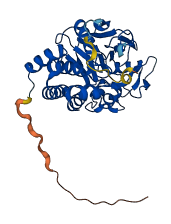
Autoinhibited structure

Activated structure
1 structures for Q9XW79
| Entry ID | Method | Resolution | Chain | Position | Source |
|---|---|---|---|---|---|
| AF-Q9XW79-F1 | Predicted | AlphaFoldDB |
No variants for Q9XW79
| Variant ID(s) | Position | Change | Description | Diseaes Association | Provenance |
|---|---|---|---|---|---|
| No variants for Q9XW79 | |||||
No associated diseases with Q9XW79
Functions
| Description | ||
|---|---|---|
| EC Number | 3.1.3.16 | Phosphoric monoester hydrolases |
| Subcellular Localization |
|
|
| PANTHER Family | ||
| PANTHER Subfamily | ||
| PANTHER Protein Class | ||
| PANTHER Pathway Category | No pathway information available | |
3 GO annotations of cellular component
| Name | Definition |
|---|---|
| centrosome | A structure comprised of a core structure (in most organisms, a pair of centrioles) and peripheral material from which a microtubule-based structure, such as a spindle apparatus, is organized. Centrosomes occur close to the nucleus during interphase in many eukaryotic cells, though in animal cells it changes continually during the cell-division cycle. |
| cytoplasm | The contents of a cell excluding the plasma membrane and nucleus, but including other subcellular structures. |
| nucleus | A membrane-bounded organelle of eukaryotic cells in which chromosomes are housed and replicated. In most cells, the nucleus contains all of the cell's chromosomes except the organellar chromosomes, and is the site of RNA synthesis and processing. In some species, or in specialized cell types, RNA metabolism or DNA replication may be absent. |
3 GO annotations of molecular function
| Name | Definition |
|---|---|
| metal ion binding | Binding to a metal ion. |
| myosin phosphatase activity | Catalysis of the reaction: phosphomyosin + H2O = myosin + phosphate. |
| protein serine/threonine phosphatase activity | Catalysis of the reaction: protein serine phosphate + H2O = protein serine + phosphate, and protein threonine phosphate + H2O = protein threonine + phosphate. |
7 GO annotations of biological process
| Name | Definition |
|---|---|
| cell division | The process resulting in division and partitioning of components of a cell to form more cells; may or may not be accompanied by the physical separation of a cell into distinct, individually membrane-bounded daughter cells. |
| chiasma assembly | The cell cycle process in which a connection between chromatids assembles, indicating where an exchange of homologous segments has taken place by the crossing-over of non-sister chromatids. |
| dephosphorylation | The process of removing one or more phosphoric (ester or anhydride) residues from a molecule. |
| double-strand break repair via homologous recombination | The error-free repair of a double-strand break in DNA in which the broken DNA molecule is repaired using homologous sequences. A strand in the broken DNA searches for a homologous region in an intact chromosome to serve as the template for DNA synthesis. The restoration of two intact DNA molecules results in the exchange, reciprocal or nonreciprocal, of genetic material between the intact DNA molecule and the broken DNA molecule. |
| embryo development ending in birth or egg hatching | The process whose specific outcome is the progression of an embryo over time, from zygote formation until the end of the embryonic life stage. The end of the embryonic life stage is organism-specific and may be somewhat arbitrary; for mammals it is usually considered to be birth, for insects the hatching of the first instar larva from the eggshell. |
| meiotic cell cycle | Progression through the phases of the meiotic cell cycle, in which canonically a cell replicates to produce four offspring with half the chromosomal content of the progenitor cell via two nuclear divisions. |
| regulation of meiotic DNA double-strand break formation involved in reciprocal meiotic recombination | Any process that modulates the frequency, rate or extent of meiotic DNA double-strand break formation involved in reciprocal meiotic recombination. |
1 homologous proteins in AiPD
| UniProt AC | Gene Name | Protein Name | Species | Evidence Code |
|---|---|---|---|---|
| Q9XTT8 | pph-4.2 | Serine/threonine-protein phosphatase 4 catalytic subunit 2 | Caenorhabditis elegans | PR |
| 10 | 20 | 30 | 40 | 50 | 60 |
| MALACTDSAN | STFSRVDSPT | SGPSDQLTTH | DLDRHIEKLM | RCELIAEQDV | KTLCAKAREI |
| 70 | 80 | 90 | 100 | 110 | 120 |
| LAEEGNVQVI | DSPVTICGDI | HGQFYDLMEL | FKVGGPVPNT | NYLFLGDFVD | RGFYSVETFL |
| 130 | 140 | 150 | 160 | 170 | 180 |
| LLLALKARYP | DRMMLIRGNH | ESRQITQVYG | FYDECLRKYG | NASVWKHCTE | VFDYLSLAAV |
| 190 | 200 | 210 | 220 | 230 | 240 |
| IDGKVFCVHG | GLSPSISTMD | QIRVIDRKQE | VPHDGPMCDL | LWSDPEEGNV | GWGLSPRGAG |
| 250 | 260 | 270 | 280 | 290 | 300 |
| YLFGADASKT | FCETNGVDLI | CRAHQLVMEG | YKWHFNEKVL | TVWSAPNYCY | RCGNVAAILE |
| 310 | 320 | 330 | |||
| LDENLNKEFT | IFEAAPQENR | GAPAKKPHAD | YFL |