Q9XUN9
Gene name |
tni-3 (T20B3.2) |
Protein name |
Troponin I 3 |
Names |
CeTNI-3, TnI 3 |
Species |
Caenorhabditis elegans |
KEGG Pathway |
cel:CELE_T20B3.2 |
EC number |
|
Protein Class |
|
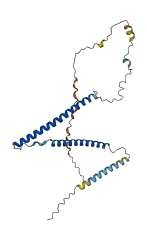
Descriptions
The autoinhibited protein was predicted that may have potential autoinhibitory elements via cis-regPred.
Autoinhibitory domains (AIDs)
Target domain |
|
Relief mechanism |
|
Assay |
cis-regPred |
Accessory elements
No accessory elements
Autoinhibited structure

Activated structure
1 structures for Q9XUN9
| Entry ID | Method | Resolution | Chain | Position | Source |
|---|---|---|---|---|---|
| AF-Q9XUN9-F1 | Predicted | AlphaFoldDB |
No variants for Q9XUN9
| Variant ID(s) | Position | Change | Description | Diseaes Association | Provenance |
|---|---|---|---|---|---|
| No variants for Q9XUN9 | |||||
No associated diseases with Q9XUN9
No regional properties for Q9XUN9
| Type | Name | Position | InterPro Accession |
|---|---|---|---|
| No domain, repeats, and functional sites for Q9XUN9 | |||
3 GO annotations of cellular component
| Name | Definition |
|---|---|
| myofibril | The contractile element of skeletal and cardiac muscle; a long, highly organized bundle of actin, myosin, and other proteins that contracts by a sliding filament mechanism. |
| sarcomere | The repeating unit of a myofibril in a muscle cell, composed of an array of overlapping thick and thin filaments between two adjacent Z discs. |
| troponin complex | A complex of accessory proteins (typically troponin T, troponin I and troponin C) found associated with actin in muscle thin filaments; involved in calcium regulation of muscle contraction. |
3 GO annotations of molecular function
| Name | Definition |
|---|---|
| actin binding | Binding to monomeric or multimeric forms of actin, including actin filaments. |
| metal ion binding | Binding to a metal ion. |
| troponin C binding | Binding to troponin C, the calcium-binding subunit of the troponin complex. |
3 GO annotations of biological process
| Name | Definition |
|---|---|
| muscle contraction | A process in which force is generated within muscle tissue, resulting in a change in muscle geometry. Force generation involves a chemo-mechanical energy conversion step that is carried out by the actin/myosin complex activity, which generates force through ATP hydrolysis. |
| oviposition | The deposition of eggs (either fertilized or not) upon a surface or into a medium such as water. |
| post-embryonic body morphogenesis | The process in which the anatomical structures of the post-embryonic soma are generated and organized. |
| 10 | 20 | 30 | 40 | 50 | 60 |
| MLIEDENIRY | GGAQADVEDD | AARKAQEREL | KKAEVRKRME | EAAKKGSKKK | GFLTPERKKK |
| 70 | 80 | 90 | 100 | 110 | 120 |
| LRKLLMMKAA | EDLKQQQMLK | EQERQKTLQQ | RTIPLPDVDS | INDQGQLLKI | YEDMFARVCA |
| 130 | 140 | 150 | 160 | 170 | 180 |
| LEEEKFDINF | GVSQTEAEIN | QLTIQVNDLR | GKFVKPTLKK | VSKYDNKFKS | SGEVKEKSNF |
| 190 | 200 | 210 | 220 | 230 | 240 |
| RNNLKVVKKE | TDLDEIMAKK | KGTADGKPEW | SKKEKKEEEA | APVELAAPVE | PEAEPEPEAA |
| 250 | |||||
| EPAAEEPEAE | EEEEEEEEEE |