Q9VTF9
Gene name |
Ufd1-like (UFD1L, CG6233) |
Protein name |
Ubiquitin fusion degradation protein 1 homolog |
Names |
UB fusion protein 1 |
Species |
Drosophila melanogaster (Fruit fly) |
KEGG Pathway |
dme:Dmel_CG6233 |
EC number |
|
Protein Class |
|
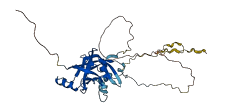
Descriptions
The autoinhibited protein was predicted that may have potential autoinhibitory elements via cis-regPred.
Autoinhibitory domains (AIDs)
Target domain |
|
Relief mechanism |
|
Assay |
cis-regPred |
Accessory elements
No accessory elements
Autoinhibited structure

Activated structure
1 structures for Q9VTF9
| Entry ID | Method | Resolution | Chain | Position | Source |
|---|---|---|---|---|---|
| AF-Q9VTF9-F1 | Predicted | AlphaFoldDB |
No variants for Q9VTF9
| Variant ID(s) | Position | Change | Description | Diseaes Association | Provenance |
|---|---|---|---|---|---|
| No variants for Q9VTF9 | |||||
No associated diseases with Q9VTF9
No regional properties for Q9VTF9
| Type | Name | Position | InterPro Accession |
|---|---|---|---|
| No domain, repeats, and functional sites for Q9VTF9 | |||
2 GO annotations of cellular component
| Name | Definition |
|---|---|
| proteasome complex | A large multisubunit complex which catalyzes protein degradation, found in eukaryotes, archaea and some bacteria. In eukaryotes, this complex consists of the barrel shaped proteasome core complex and one or two associated proteins or complexes that act in regulating entry into or exit from the core. |
| VCP-NPL4-UFD1 AAA ATPase complex | A multiprotein ATPase complex required for the efficient dislocation of ER-lumenal degradation substrates, and their subsequent proteolysis by the proteasome. In budding yeast, this complex includes Cdc48p, Npl4p and Ufd1p proteins. In mammals, this complex includes a hexamer of VCP/p97 (a cytosolic ATPase) and trimers of each of its cofactors UFD1L and NPL4 (NPLOC4) (e.g. a 6:3:3 stoichiometry). |
2 GO annotations of molecular function
| Name | Definition |
|---|---|
| polyubiquitin modification-dependent protein binding | Binding to a protein upon poly-ubiquitination of the target protein. |
| ubiquitin protein ligase binding | Binding to a ubiquitin protein ligase enzyme, any of the E3 proteins. |
8 GO annotations of biological process
| Name | Definition |
|---|---|
| cellular response to virus | Any process that results in a change in state or activity of a cell (in terms of movement, secretion, enzyme production, gene expression, etc.) as a result of a stimulus from a virus. |
| ER-associated misfolded protein catabolic process | The chemical reactions and pathways resulting in the breakdown of misfolded proteins transported from the endoplasmic reticulum and targeted to cytoplasmic proteasomes for degradation. |
| negative regulation of smoothened signaling pathway | Any process that stops, prevents, or reduces the frequency, rate or extent of smoothened signaling. |
| positive regulation of proteasomal ubiquitin-dependent protein catabolic process | Any process that activates or increases the frequency, rate or extent of the breakdown of a protein or peptide by hydrolysis of its peptide bonds, initiated by the covalent attachment of ubiquitin, and mediated by the proteasome. |
| proteasome-mediated ubiquitin-dependent protein catabolic process | The chemical reactions and pathways resulting in the breakdown of a protein or peptide by hydrolysis of its peptide bonds, initiated by the covalent attachment of ubiquitin, and mediated by the proteasome. |
| proteolysis | The hydrolysis of proteins into smaller polypeptides and/or amino acids by cleavage of their peptide bonds. |
| ubiquitin-dependent ERAD pathway | The series of steps necessary to target endoplasmic reticulum (ER)-resident proteins for degradation by the cytoplasmic proteasome. Begins with recognition of the ER-resident protein, includes retrotranslocation (dislocation) of the protein from the ER to the cytosol, protein ubiquitination necessary for correct substrate transfer, transport of the protein to the proteasome, and ends with degradation of the protein by the cytoplasmic proteasome. |
| ubiquitin-dependent protein catabolic process | The chemical reactions and pathways resulting in the breakdown of a protein or peptide by hydrolysis of its peptide bonds, initiated by the covalent attachment of a ubiquitin group, or multiple ubiquitin groups, to the protein. |
2 homologous proteins in AiPD
| 10 | 20 | 30 | 40 | 50 | 60 |
| MFHFSGFNMM | FPEGRNFHAN | YKCFSVSMLP | GNERTDVEKG | GKIIMPPSAL | DTLTRLNVEY |
| 70 | 80 | 90 | 100 | 110 | 120 |
| PMLFKLTNVK | KSRSSHAGVL | EFVADEGKCY | LPHWMMENLL | LGEGDILNIE | SVSLPVATFS |
| 130 | 140 | 150 | 160 | 170 | 180 |
| KFQPHSTDFL | DITNPKAVLE | NALRNFACLT | RGDVIAIKYN | KKVYELCVLE | TKPGNAVSII |
| 190 | 200 | 210 | 220 | 230 | 240 |
| ECDMNVEFEA | PVGYKDHSET | QASGSGQQGA | AGTVGGEIAG | ATNAILEEVV | ETFKGSGVRL |
| 250 | 260 | 270 | 280 | 290 | 300 |
| DGKKKKESQL | ETPVVKKVLA | RGVPDYDFQF | GLIRFDRNIR | PISDRSQEDD | AVAGNADASD |
| 310 | |||||
| AESFHGTGFS | MKKTRK |