P53044
Gene name |
UFD1 (PIP3, YGR048W) |
Protein name |
Ubiquitin fusion degradation protein 1 |
Names |
UB fusion protein 1, Polymerase-interacting protein 3 |
Species |
Saccharomyces cerevisiae (strain ATCC 204508 / S288c) (Baker's yeast) |
KEGG Pathway |
sce:YGR048W |
EC number |
|
Protein Class |
|
Descriptions
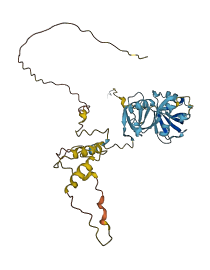
The autoinhibited protein was predicted that may have potential autoinhibitory elements via cis-regPred.
Autoinhibitory domains (AIDs)
Target domain |
|
Relief mechanism |
|
Assay |
cis-regPred |
Accessory elements
No accessory elements
Autoinhibited structure

Activated structure
9 structures for P53044
3 variants for P53044
| Variant ID(s) | Position | Change | Description | Diseaes Association | Provenance |
|---|---|---|---|---|---|
| s07-590453 | 208 | K>N | No | SGRP | |
| s07-590619 | 264 | N>Y | No | SGRP | |
| s07-590659 | 277 | D>G | No | SGRP |
No associated diseases with P53044
No regional properties for P53044
| Type | Name | Position | InterPro Accession |
|---|---|---|---|
| No domain, repeats, and functional sites for P53044 | |||
7 GO annotations of cellular component
| Name | Definition |
|---|---|
| cytosol | The part of the cytoplasm that does not contain organelles but which does contain other particulate matter, such as protein complexes. |
| Doa10p ubiquitin ligase complex | A multiprotein complex that recognizes and ubiquitinates membrane proteins with misfolded cytosolic domains during ER-associated protein degradation (ERAD). In S. cerevisiae, this complex contains the ubiquitin ligase Ssm4p/Doa10p. |
| Hrd1p ubiquitin ligase ERAD-L complex | A multiprotein complex that recognizes and ubiquitinates proteins with misfolded luminal domains during ER-associated protein degradation (ERAD). In S. cerevisiae, this complex contains the ubiquitin ligase Hrd1p. |
| nucleus | A membrane-bounded organelle of eukaryotic cells in which chromosomes are housed and replicated. In most cells, the nucleus contains all of the cell's chromosomes except the organellar chromosomes, and is the site of RNA synthesis and processing. In some species, or in specialized cell types, RNA metabolism or DNA replication may be absent. |
| replisome | A multi-component enzymatic machine at the replication fork which mediates DNA replication. Includes DNA primase, one or more DNA polymerases, DNA helicases, and other proteins. |
| RQC complex | A multiprotein complex that forms a stable complex with large ribosomal subunits (60S in eukaryotes and 50S in prokaryotes) containing stalled polypeptides and triggers their degradation (ribosomal quality control). In budding yeast, this complex includes Cdc48p, Rkr1p, Tae2p, Rqc1p, Npl4p and Ufd1p proteins. |
| VCP-NPL4-UFD1 AAA ATPase complex | A multiprotein ATPase complex required for the efficient dislocation of ER-lumenal degradation substrates, and their subsequent proteolysis by the proteasome. In budding yeast, this complex includes Cdc48p, Npl4p and Ufd1p proteins. In mammals, this complex includes a hexamer of VCP/p97 (a cytosolic ATPase) and trimers of each of its cofactors UFD1L and NPL4 (NPLOC4) (e.g. a 6:3:3 stoichiometry). |
2 GO annotations of molecular function
| Name | Definition |
|---|---|
| polyubiquitin modification-dependent protein binding | Binding to a protein upon poly-ubiquitination of the target protein. |
| ubiquitin binding | Binding to ubiquitin, a protein that when covalently bound to other cellular proteins marks them for proteolytic degradation. |
12 GO annotations of biological process
| Name | Definition |
|---|---|
| cytoplasm protein quality control by the ubiquitin-proteasome system | The chemical reactions and pathways resulting in the breakdown of misfolded proteins in the cytoplasm, which are targeted to cytoplasmic proteasomes for degradation. |
| DNA replication termination | The process in which DNA replication at a replication fork ceases; occurs when the replication fork reaches a specific termination site or when two replication forks meet. |
| ER-associated misfolded protein catabolic process | The chemical reactions and pathways resulting in the breakdown of misfolded proteins transported from the endoplasmic reticulum and targeted to cytoplasmic proteasomes for degradation. |
| mitochondria-associated ubiquitin-dependent protein catabolic process | The chemical reactions and pathways resulting in the breakdown of proteins transported from mitochondria and targeted to cytoplasmic proteasomes for degradation as a response to oxidative stress conditions. |
| negative regulation of telomerase activity | Any process that stops or reduces the activity of the enzyme telomerase, which catalyzes of the reaction: deoxynucleoside triphosphate + DNA(n) = diphosphate + DNA(n+1). |
| nonfunctional rRNA decay | An rRNA catabolic process that results in the targeted detection and degradation of aberrant rRNAs contained within translationally defective ribosomes, thereby acting as a quality-control system. |
| positive regulation of protein localization to nucleus | Any process that activates or increases the frequency, rate or extent of protein localization to nucleus. |
| proteasome-mediated ubiquitin-dependent protein catabolic process | The chemical reactions and pathways resulting in the breakdown of a protein or peptide by hydrolysis of its peptide bonds, initiated by the covalent attachment of ubiquitin, and mediated by the proteasome. |
| protein localization to vacuole | A process in which a protein is transported to, or maintained at, a location in a vacuole. |
| retrograde protein transport, ER to cytosol | The directed movement of unfolded or misfolded proteins from the endoplasmic reticulum to the cytosol through the translocon. |
| ribosome-associated ubiquitin-dependent protein catabolic process | The chemical reactions and pathways resulting in the breakdown of a protein or peptide encoded by an aberrant message and associated with a stalled ribosome. Degradation is initiated by the covalent attachment of a ubiquitin group, or multiple ubiquitin groups, to the ribosome-associated protein. |
| ubiquitin-dependent ERAD pathway | The series of steps necessary to target endoplasmic reticulum (ER)-resident proteins for degradation by the cytoplasmic proteasome. Begins with recognition of the ER-resident protein, includes retrotranslocation (dislocation) of the protein from the ER to the cytosol, protein ubiquitination necessary for correct substrate transfer, transport of the protein to the proteasome, and ends with degradation of the protein by the cytoplasmic proteasome. |
| 10 | 20 | 30 | 40 | 50 | 60 |
| MFSGFSSFGG | GNGFVNMPQT | FEEFFRCYPI | AMMNDRIRKD | DANFGGKIFL | PPSALSKLSM |
| 70 | 80 | 90 | 100 | 110 | 120 |
| LNIRYPMLFK | LTANETGRVT | HGGVLEFIAE | EGRVYLPQWM | METLGIQPGS | LLQISSTDVP |
| 130 | 140 | 150 | 160 | 170 | 180 |
| LGQFVKLEPQ | SVDFLDISDP | KAVLENVLRN | FSTLTVDDVI | EISYNGKTFK | IKILEVKPES |
| 190 | 200 | 210 | 220 | 230 | 240 |
| SSKSICVIET | DLVTDFAPPV | GYVEPDYKAL | KAQQDKEKKN | SFGKGQVLDP | SVLGQGSMST |
| 250 | 260 | 270 | 280 | 290 | 300 |
| RIDYAGIANS | SRNKLSKFVG | QGQNISGKAP | KAEPKQDIKD | MKITFDGEPA | KLDLPEGQLF |
| 310 | 320 | 330 | 340 | 350 | 360 |
| FGFPMVLPKE | DEESAAGSKS | SEQNFQGQGI | SLRKSNKRKT | KSDHDSSKSK | APKSPEVIEI |
| D |