Q9VQM4
Gene name |
gkt (Tdp1, CG8825, CG8826) |
Protein name |
Probable tyrosyl-DNA phosphodiesterase |
Names |
Tyr-DNA phosphodiesterase, Protein glaikit |
Species |
Drosophila melanogaster (Fruit fly) |
KEGG Pathway |
dme:Dmel_CG8825 |
EC number |
|
Protein Class |
|
Descriptions
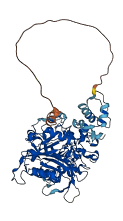
The autoinhibited protein was predicted that may have potential autoinhibitory elements via cis-regPred.
Autoinhibitory domains (AIDs)
Target domain |
|
Relief mechanism |
|
Assay |
cis-regPred |
Accessory elements
No accessory elements
Autoinhibited structure

Activated structure
1 structures for Q9VQM4
| Entry ID | Method | Resolution | Chain | Position | Source |
|---|---|---|---|---|---|
| AF-Q9VQM4-F1 | Predicted | AlphaFoldDB |
No variants for Q9VQM4
| Variant ID(s) | Position | Change | Description | Diseaes Association | Provenance |
|---|---|---|---|---|---|
| No variants for Q9VQM4 | |||||
No associated diseases with Q9VQM4
1 regional properties for Q9VQM4
| Type | Name | Position | InterPro Accession |
|---|---|---|---|
| domain | Aprataxin and PNK-like factor, PBZ domain | 2 - 24 | IPR019406 |
2 GO annotations of cellular component
| Name | Definition |
|---|---|
| cytoplasm | The contents of a cell excluding the plasma membrane and nucleus, but including other subcellular structures. |
| nucleus | A membrane-bounded organelle of eukaryotic cells in which chromosomes are housed and replicated. In most cells, the nucleus contains all of the cell's chromosomes except the organellar chromosomes, and is the site of RNA synthesis and processing. In some species, or in specialized cell types, RNA metabolism or DNA replication may be absent. |
4 GO annotations of molecular function
| Name | Definition |
|---|---|
| 3'-tyrosyl-DNA phosphodiesterase activity | Catalysis of the hydrolysis of 3'-phosphotyrosyl groups formed as covalent intermediates (in DNA backbone breakage) between DNA topoisomerase I and DNA. |
| double-stranded DNA binding | Binding to double-stranded DNA. |
| exonuclease activity | Catalysis of the hydrolysis of ester linkages within nucleic acids by removing nucleotide residues from the 3' or 5' end. |
| single-stranded DNA binding | Binding to single-stranded DNA. |
5 GO annotations of biological process
| Name | Definition |
|---|---|
| central nervous system development | The process whose specific outcome is the progression of the central nervous system over time, from its formation to the mature structure. The central nervous system is the core nervous system that serves an integrating and coordinating function. In vertebrates it consists of the brain and spinal cord. In those invertebrates with a central nervous system it typically consists of a brain, cerebral ganglia and a nerve cord. |
| DNA repair | The process of restoring DNA after damage. Genomes are subject to damage by chemical and physical agents in the environment (e.g. UV and ionizing radiations, chemical mutagens, fungal and bacterial toxins, etc.) and by free radicals or alkylating agents endogenously generated in metabolism. DNA is also damaged because of errors during its replication. A variety of different DNA repair pathways have been reported that include direct reversal, base excision repair, nucleotide excision repair, photoreactivation, bypass, double-strand break repair pathway, and mismatch repair pathway. |
| double-strand break repair | The repair of double-strand breaks in DNA via homologous and nonhomologous mechanisms to reform a continuous DNA helix. |
| establishment or maintenance of epithelial cell apical/basal polarity | Any cellular process that results in the specification, formation or maintenance of the apicobasal polarity of an epithelial cell. |
| single strand break repair | The repair of single strand breaks in DNA. Repair of such breaks is mediated by the same enzyme systems as are used in base excision repair. |
4 homologous proteins in AiPD
| UniProt AC | Gene Name | Protein Name | Species | Evidence Code |
|---|---|---|---|---|
| P38319 | TDP1 | Tyrosyl-DNA phosphodiesterase 1 | Saccharomyces cerevisiae (strain ATCC 204508 / S288c) (Baker's yeast) | PR |
| Q9NUW8 | TDP1 | Tyrosyl-DNA phosphodiesterase 1 | Homo sapiens (Human) | PR |
| Q8BJ37 | Tdp1 | Tyrosyl-DNA phosphodiesterase 1 | Mus musculus (Mouse) | PR |
| Q8H1D9 | TDP1 | Tyrosyl-DNA phosphodiesterase 1 | Arabidopsis thaliana (Mouse-ear cress) | PR |
| 10 | 20 | 30 | 40 | 50 | 60 |
| MKECPYGEKC | YRKNPIHFGE | FSHAHLDAIY | AKGNESGDYE | IPANYSSEMI | HTQLKLLEKL |
| 70 | 80 | 90 | 100 | 110 | 120 |
| FPKQATNKEQ | EAHSSSSKPA | VTAPVASGSS | SSGSLDTNPS | GSSASGPAAS | QDTSNLAKKQ |
| 130 | 140 | 150 | 160 | 170 | 180 |
| KLNAKNIRDY | IPVVIEKGGM | AKKLERAAPY | NMFLTAITDS | KPTHSEPLSI | TLQEILDESL |
| 190 | 200 | 210 | 220 | 230 | 240 |
| GEIESTVQIN | FMVDIGWLLG | HYYFAGILDK | PLLLLYGDES | PELLSIGKFK | QQVTAIRVKM |
| 250 | 260 | 270 | 280 | 290 | 300 |
| PTPFATSHTK | MMFLGYSDGS | MRVVISTANL | YEDDWHNRTQ | GLWISPKLPA | LPVDADTGAG |
| 310 | 320 | 330 | 340 | 350 | 360 |
| ESLTGFKQDL | MLYLVEYKIS | QLQPWIARIR | NSDFSAINVF | FLGSVPGGHR | EGSVRGHPWG |
| 370 | 380 | 390 | 400 | 410 | 420 |
| HARLASLLAK | HAAPIDDRIP | VVCQSSSIGS | LGANVQAWIQ | QDFVNSLKKD | STPVGKLRQM |
| 430 | 440 | 450 | 460 | 470 | 480 |
| PPFKMIYPSY | GNVAGSHDGM | LGGGCLPYGK | NTNDKQPWLK | DYLQQWKSSD | RFRSRAMPHI |
| 490 | 500 | 510 | 520 | 530 | 540 |
| KSYTRFNLED | QSVYWFVLTS | ANLSKAAWGC | FNKNSNIQPC | LRIANYEAGV | LFLPRFVTGE |
| 550 | 560 | 570 | |||
| DTFPLGNNRD | GVPAFPLPYD | VPLTPYAPDD | KPFLMDYLQG |