Q9VNH6
Gene name |
Sec8 |
Protein name |
Exocyst complex component 4 |
Names |
Exocyst complex component Sec8 |
Species |
Drosophila melanogaster (Fruit fly) |
KEGG Pathway |
dme:Dmel_CG2095 |
EC number |
|
Protein Class |
|
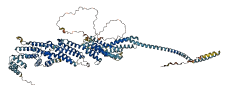
Descriptions
The autoinhibited protein was predicted that may have potential autoinhibitory elements via cis-regPred.
Autoinhibitory domains (AIDs)
Target domain |
|
Relief mechanism |
|
Assay |
cis-regPred |
Accessory elements
No accessory elements
Autoinhibited structure

Activated structure
1 structures for Q9VNH6
| Entry ID | Method | Resolution | Chain | Position | Source |
|---|---|---|---|---|---|
| AF-Q9VNH6-F1 | Predicted | AlphaFoldDB |
No variants for Q9VNH6
| Variant ID(s) | Position | Change | Description | Diseaes Association | Provenance |
|---|---|---|---|---|---|
| No variants for Q9VNH6 | |||||
No associated diseases with Q9VNH6
1 regional properties for Q9VNH6
| Type | Name | Position | InterPro Accession |
|---|---|---|---|
| domain | Gamma-carboxyglutamic acid-rich (GLA) domain | 33 - 98 | IPR000294 |
10 GO annotations of cellular component
| Name | Definition |
|---|---|
| apical plasma membrane | The region of the plasma membrane located at the apical end of the cell. |
| basal plasma membrane | The region of the plasma membrane located at the basal end of the cell. Often used in reference to animal polarized epithelial membranes, where the basal membrane is the part attached to the extracellular matrix, or in plant cells, where the basal membrane is defined with respect to the zygotic axis. |
| cytoplasm | The contents of a cell excluding the plasma membrane and nucleus, but including other subcellular structures. |
| exocyst | A protein complex peripherally associated with the plasma membrane that determines where vesicles dock and fuse. At least eight complex components are conserved between yeast and mammals. |
| growth cone membrane | The portion of the plasma membrane surrounding a growth cone. |
| membrane | A lipid bilayer along with all the proteins and protein complexes embedded in it an attached to it. |
| plasma membrane | The membrane surrounding a cell that separates the cell from its external environment. It consists of a phospholipid bilayer and associated proteins. |
| presynapse | The part of a synapse that is part of the presynaptic cell. |
| rhabdomere | The specialized microvilli-containing organelle on the apical surfaces of a photoreceptor cell containing the visual pigment rhodopsin and most of the proteins involved in phototransduction. |
| synapse | The junction between an axon of one neuron and a dendrite of another neuron, a muscle fiber or a glial cell. As the axon approaches the synapse it enlarges into a specialized structure, the presynaptic terminal bouton, which contains mitochondria and synaptic vesicles. At the tip of the terminal bouton is the presynaptic membrane; facing it, and separated from it by a minute cleft (the synaptic cleft) is a specialized area of membrane on the receiving cell, known as the postsynaptic membrane. In response to the arrival of nerve impulses, the presynaptic terminal bouton secretes molecules of neurotransmitters into the synaptic cleft. These diffuse across the cleft and transmit the signal to the postsynaptic membrane. |
No GO annotations of molecular function
| Name | Definition |
|---|---|
| No GO annotations for molecular function |
19 GO annotations of biological process
| Name | Definition |
|---|---|
| actomyosin contractile ring contraction | The process of an actomyosin ring getting smaller in diameter, in the context of cytokinesis that takes place as part of a cell cycle. |
| border follicle cell migration | The directed movement of a border cell through the nurse cells to reach the oocyte. An example of this is found in Drosophila melanogaster. |
| chemical synaptic transmission | The vesicular release of classical neurotransmitter molecules from a presynapse, across a chemical synapse, the subsequent activation of neurotransmitter receptors at the postsynapse of a target cell (neuron, muscle, or secretory cell) and the effects of this activation on the postsynaptic membrane potential and ionic composition of the postsynaptic cytosol. This process encompasses both spontaneous and evoked release of neurotransmitter and all parts of synaptic vesicle exocytosis. Evoked transmission starts with the arrival of an action potential at the presynapse. |
| exocytosis | A process of secretion by a cell that results in the release of intracellular molecules (e.g. hormones, matrix proteins) contained within a membrane-bounded vesicle. Exocytosis can occur either by full fusion, when the vesicle collapses into the plasma membrane, or by a kiss-and-run mechanism that involves the formation of a transient contact, a pore, between a granule (for exemple of chromaffin cells) and the plasma membrane. The latter process most of the time leads to only partial secretion of the granule content. Exocytosis begins with steps that prepare vesicles for fusion with the membrane (tethering and docking) and ends when molecules are secreted from the cell. |
| Golgi to plasma membrane transport | The directed movement of substances from the Golgi to the plasma membrane in transport vesicles that move from the trans-Golgi network to the plasma membrane, where they fuse and release their contents by exocytosis. |
| meiosis I cytokinesis | A cell cycle process that results in the division of the cytoplasm of a cell after meiosis I, resulting in the separation of the original cell into two daughter cells. |
| meiosis II cytokinesis | A cell cycle process that results in the division of the cytoplasm of a cell after meiosis II, resulting in the separation of the original cell into two daughter cells. |
| meiotic spindle organization | A process that is carried out at the cellular level which results in the assembly, arrangement of constituent parts, or disassembly of the microtubule spindle during a meiotic cell cycle. |
| neurotransmitter secretion | The regulated release of neurotransmitter from the presynapse into the synaptic cleft via calcium-regulated exocytosis during synaptic transmission. |
| plasma membrane organization | A process that is carried out at the cellular level which results in the assembly, arrangement of constituent parts, or disassembly of the plasma membrane. |
| positive regulation of synaptic assembly at neuromuscular junction | Any process that activates or increases the frequency, rate or extent of synaptic assembly at neuromuscular junction. |
| protein transport | The directed movement of proteins into, out of or within a cell, or between cells, by means of some agent such as a transporter or pore. |
| regulation of synapse structure or activity | Any process that modulates the physical form or the activity of a synapse, the junction between a neuron and a target (neuron, muscle, or secretory cell). |
| spermatid development | The process whose specific outcome is the progression of a spermatid over time, from its formation to the mature structure. |
| synaptic vesicle docking | The initial (indirect) attachment of a synaptic vesicle membrane to the presynaptic active zone membrane, mediated by proteins protruding from the membrane and proteins of the presynaptic active zone cytoplasmic component. Synaptic vesicle tethering is the first step in this process. |
| synaptic vesicle targeting | The process in which synaptic vesicles are directed to specific destination membranes, mediated by molecules at the vesicle membrane and target membrane surfaces. |
| vesicle tethering involved in exocytosis | The initial, indirect interaction between a secretory vesicle membrane and a site of exocytosis in the plasma membrane. This interaction is mediated by tethering factors (or complexes), which interact with both membranes. Interaction can occur via direct binding to membrane phospholipids or membrane proteins, or via binding to vesicle coat proteins. This process is distinct from and prior to docking and fusion. |
| vesicle-mediated transport | A cellular transport process in which transported substances are moved in membrane-bounded vesicles; transported substances are enclosed in the vesicle lumen or located in the vesicle membrane. The process begins with a step that directs a substance to the forming vesicle, and includes vesicle budding and coating. Vesicles are then targeted to, and fuse with, an acceptor membrane. |
| viral entry into host cell | The process that occurs after viral attachment by which a virus, or viral nucleic acid, breaches the plasma membrane or cell envelope and enters the host cell. The process ends when the viral nucleic acid is released into the host cell cytoplasm. |
1 homologous proteins in AiPD
| UniProt AC | Gene Name | Protein Name | Species | Evidence Code |
|---|---|---|---|---|
| Q96A65 | EXOC4 | Exocyst complex component 4 | Homo sapiens (Human) | PR |
| 10 | 20 | 30 | 40 | 50 | 60 |
| MDAPPPTKPP | RGVKYGKDES | AGCGFLVNVI | KSLGFSETTE | ERQKEKQKIE | AEFKRSDLRL |
| 70 | 80 | 90 | 100 | 110 | 120 |
| NELVSRHDQQ | LTQVLPLFSQ | VSSEVTASRE | RIHAVKENLG | VCKRLLQCRR | DELRKMWMDA |
| 130 | 140 | 150 | 160 | 170 | 180 |
| VQHKYVLEML | EQIQELRKVP | QRVVGYTAKR | QYLHASKALT | DALTTLNGPL | QAVEGLSDLR |
| 190 | 200 | 210 | 220 | 230 | 240 |
| TDLQTRRQQL | YQRLHEELVT | QVYTNSANEA | LSSFQRTNSS | RLNSSFTRGI | GARRSTDRIE |
| 250 | 260 | 270 | 280 | 290 | 300 |
| ANARVRKALA | EMAQSFDLDK | AEVIEDADLI | YPELSMSYFV | AIIVESFGML | HKVPDSLETL |
| 310 | 320 | 330 | 340 | 350 | 360 |
| RVQIQTELLN | VVRHTTHQLS | VSGATADTNP | LLSLLEVIFK | QFKAIAKTHS | LLLKNYLSVG |
| 370 | 380 | 390 | 400 | 410 | 420 |
| QKYSVVGPQP | YDLTDFWAQA | QSVLQLLLTD | YLDIQNAAAD | ESAQTGFSEP | TSNINSYFLR |
| 430 | 440 | 450 | 460 | 470 | 480 |
| RKVPSTKRSM | FKFDKSSHVG | TSNNSDAFKE | HRRNASDASV | DDNLAGQLGG | SGKGSTSGLF |
| 490 | 500 | 510 | 520 | 530 | 540 |
| PHEKKQREKI | LICTPDQSII | TKVYLPLMGY | IKEIENFMKC | KPGQPCSLHD | FLDNYIKDTF |
| 550 | 560 | 570 | 580 | 590 | 600 |
| LTKGHNRNLQ | LTIESLSKNQ | DAWRTIISPE | EIKALNLSRP | LLQSTVMVER | RLMETKNLIQ |
| 610 | 620 | 630 | 640 | 650 | 660 |
| DLPCYSEDLL | KMVCALLKAY | REICQAAYRG | IVQPDSEDKR | IYSVAWLKDE | DISRFLKTLP |
| 670 | 680 | 690 | 700 | 710 | 720 |
| NWTDLKTYSQ | KSRHNRKLHR | GSFEPSEEES | PLQVQQRNIR | EAEMLTSNLG | EGGITQQEIL |
| 730 | 740 | 750 | 760 | 770 | 780 |
| VEISVLKELA | ILQESMEWFS | CRVSEFANDL | RRPLVNGLNA | VPAECGADIA | VKDGTIKVMT |
| 790 | 800 | 810 | 820 | 830 | 840 |
| NLALEFDELA | NTCLLVLHLE | VRVQCFHYLR | SKSSVRTNSY | VGSKDDILEP | DRQVQVLTKR |
| 850 | 860 | 870 | 880 | 890 | 900 |
| LSEMDEAFSA | TLHPRKTRYI | FEGLAHLASR | ILIQASNYLE | HIDQITVQRM | CRNAIALQQT |
| 910 | 920 | 930 | 940 | 950 | 960 |
| LSNITASREV | ALDQARHFYE | LLCMEPDEIL | NALLERGTQF | SEMQLLNALQ | LSCKSFGITD |
| 970 | 980 | ||||
| ANLLASYQQK | LSDILGAKPS | KGVVV |