Q9VN03
Gene name |
Suv3 |
Protein name |
ATP-dependent RNA helicase SUV3 homolog, mitochondrial |
Names |
|
Species |
Drosophila melanogaster (Fruit fly) |
KEGG Pathway |
dme:Dmel_CG9791 |
EC number |
3.6.4.13: Acting on ATP; involved in cellular and subcellular movement |
Protein Class |
|
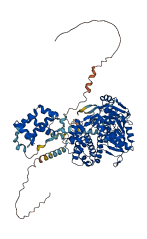
Descriptions
The autoinhibited protein was predicted that may have potential autoinhibitory elements via cis-regPred.
Autoinhibitory domains (AIDs)
Target domain |
|
Relief mechanism |
|
Assay |
cis-regPred |
Accessory elements
No accessory elements
Autoinhibited structure

Activated structure
1 structures for Q9VN03
| Entry ID | Method | Resolution | Chain | Position | Source |
|---|---|---|---|---|---|
| AF-Q9VN03-F1 | Predicted | AlphaFoldDB |
No variants for Q9VN03
| Variant ID(s) | Position | Change | Description | Diseaes Association | Provenance |
|---|---|---|---|---|---|
| No variants for Q9VN03 | |||||
No associated diseases with Q9VN03
5 regional properties for Q9VN03
| Type | Name | Position | InterPro Accession |
|---|---|---|---|
| domain | Helicase, C-terminal | 330 - 508 | IPR001650 |
| domain | Mitochondrial degradasome RNA helicase subunit, C-terminal domain | 613 - 657 | IPR022192 |
| domain | Suv3, C-terminal domain 1 | 545 - 586 | IPR041082 |
| domain | Suv3, N-terminal | 52 - 166 | IPR041453 |
| domain | Suv3, DEXQ-box helicase domain | 187 - 332 | IPR044774 |
Functions
| Description | ||
|---|---|---|
| EC Number | 3.6.4.13 | Acting on ATP; involved in cellular and subcellular movement |
| Subcellular Localization |
|
|
| PANTHER Family | ||
| PANTHER Subfamily | ||
| PANTHER Protein Class | ||
| PANTHER Pathway Category | No pathway information available | |
3 GO annotations of cellular component
| Name | Definition |
|---|---|
| mitochondrial degradosome | A mitochondrial protein complex with 3' to 5' exoribonuclease activity that participates in intron-independent turnover and processing of mitochondrial transcripts. In humans, the mitochondrial degradosome is a pentameric complex, and in yeast it exists as a heterodimer. |
| mitochondrial matrix | The gel-like material, with considerable fine structure, that lies in the matrix space, or lumen, of a mitochondrion. It contains the enzymes of the tricarboxylic acid cycle and, in some organisms, the enzymes concerned with fatty acid oxidation. |
| mitochondrion | A semiautonomous, self replicating organelle that occurs in varying numbers, shapes, and sizes in the cytoplasm of virtually all eukaryotic cells. It is notably the site of tissue respiration. |
5 GO annotations of molecular function
| Name | Definition |
|---|---|
| ATP binding | Binding to ATP, adenosine 5'-triphosphate, a universally important coenzyme and enzyme regulator. |
| ATP hydrolysis activity | Catalysis of the reaction: ATP + H2O = ADP + H+ phosphate. ATP hydrolysis is used in some reactions as an energy source, for example to catalyze a reaction or drive transport against a concentration gradient. |
| DNA binding | Any molecular function by which a gene product interacts selectively and non-covalently with DNA (deoxyribonucleic acid). |
| DNA helicase activity | Unwinding of a DNA helix, driven by ATP hydrolysis. |
| RNA helicase activity | Unwinding of an RNA helix, driven by ATP hydrolysis. |
9 GO annotations of biological process
| Name | Definition |
|---|---|
| DNA duplex unwinding | The process in which interchain hydrogen bonds between two strands of DNA are broken or 'melted', generating a region of unpaired single strands. |
| mitochondrial mRNA catabolic process | The chemical reactions and pathways resulting in the breakdown of mRNA transcribed from the mitochondrial genome and occurring in the mitochondrion. |
| mitochondrial mRNA polyadenylation | The enzymatic addition of a sequence of 40-60 adenylyl residues at the 3' end of a eukaryotic mitochondrial mRNA primary transcript. Mitochondria contain both stabilizing and destabilizing poly(A) tails. |
| mitochondrial RNA 3'-end processing | Any process involved in forming the mature 3' end of an RNA molecule transcribed from a mitochondrial genome; occurs in the mitochondrion. |
| mitochondrial RNA processing | The conversion of a primary RNA molecule transcribed from a mitochondrial genome into one or more mature RNA molecules; occurs in the mitochondrion. |
| mitochondrial tRNA processing | The process in which a pre-tRNA molecule is converted to a mature tRNA, ready for addition of an aminoacyl group, in the mitochondrion. |
| positive regulation of mitochondrial translation | Any process that activates or increases the frequency, rate or extent of the chemical reactions and pathways resulting in the formation of proteins by the translation of mRNA in a mitochondrion. |
| regulation of mitochondrial mRNA stability | Any process that modulates the propensity of mitochondrial mRNA molecules to degradation. Includes processes that both stabilize and destabilize mitochondrial mRNAs. |
| RNA catabolic process | The chemical reactions and pathways resulting in the breakdown of RNA, ribonucleic acid, one of the two main type of nucleic acid, consisting of a long, unbranched macromolecule formed from ribonucleotides joined in 3',5'-phosphodiester linkage. |
3 homologous proteins in AiPD
| UniProt AC | Gene Name | Protein Name | Species | Evidence Code |
|---|---|---|---|---|
| Q8IYB8 | SUPV3L1 | ATP-dependent RNA helicase SUPV3L1, mitochondrial | Homo sapiens (Human) | PR |
| Q80YD1 | Supv3l1 | ATP-dependent RNA helicase SUPV3L1, mitochondrial | Mus musculus (Mouse) | PR |
| Q5EBA1 | Supv3l1 | ATP-dependent RNA helicase SUPV3L1, mitochondrial | Rattus norvegicus (Rat) | PR |
| 10 | 20 | 30 | 40 | 50 | 60 |
| MQNCRRCISL | TGLLRMTLYL | RPSFSIDLSL | RRLHRAAFLF | SRKKPETNLS | TLFKPVQVHA |
| 70 | 80 | 90 | 100 | 110 | 120 |
| YVDSEDVGSE | LSGKLEKAEL | LKILNKFTQR | REIKSLCNEN | GLDDYLQQQA | FGSFRRFCIE |
| 130 | 140 | 150 | 160 | 170 | 180 |
| AENLPVDLHI | TFSDITQGAG | HIDDIFPYFL | RHAKTVFPHL | DCMDDLKKIS | DLRQPANWYS |
| 190 | 200 | 210 | 220 | 230 | 240 |
| NARAITRKIV | FHAGPTNSGK | TYHAMERYLS | AKTGVYCGPL | KLLATEVYNK | ANERGTPCDL |
| 250 | 260 | 270 | 280 | 290 | 300 |
| VTGEERKFGI | SESLPANHVA | CTVEMTSVNT | PYEVAVIDEI | QQIRDPQRGW | AWTRAFLGLI |
| 310 | 320 | 330 | 340 | 350 | 360 |
| ADEVHVCGEP | GALDLLQKIC | ETTGETVEVR | LYDRLTELTV | ENTALGSLDN | IVPGDCIVCF |
| 370 | 380 | 390 | 400 | 410 | 420 |
| SKHDIYTVSR | EIEARGKEVA | VIYGGLPPGT | KLAQAAKFND | PANSCKVMVA | TDAIGMGLNL |
| 430 | 440 | 450 | 460 | 470 | 480 |
| SIRRIIFYSL | IKPSMNERGE | REIDTISVSS | ALQIAGRAGR | FRTQWEHGYV | TAFKSEDLQT |
| 490 | 500 | 510 | 520 | 530 | 540 |
| LQRILARTPE | PIKQAGLHPT | ADQIELYAYH | LPSSSLSNLM | DIFVNLCTVD | DSLYFMCNIE |
| 550 | 560 | 570 | 580 | 590 | 600 |
| DFKFLAEMIQ | HVALPLRARY | VFCCAPINRK | MPFVCSMFLK | VARQYSRNEP | ITFDFIKKNC |
| 610 | 620 | 630 | 640 | 650 | 660 |
| GWPFKLPKTI | LDLVHLEAVF | DVMDLYLWLS | YRFMDLFPEA | AYVRDAQKEL | DEIIQQGVFQ |
| 670 | 680 | 690 | 700 | 710 | 720 |
| ITRLLKNTEA | SQDGETSNYA | IRRITHVKEP | RLPSLSRGRL | TERLLAQGLL | TPGMLSELRK |
| 730 | 740 | 750 | 760 | ||
| EWDAQQLGKS | NSQSNENSEP | VVNSDDEDNY | SGIGRKTRKK | RRK |