Q5EBA1
Gene name |
Supv3l1 |
Protein name |
ATP-dependent RNA helicase SUPV3L1, mitochondrial |
Names |
Suppressor of var1 3-like protein 1, SUV3-like protein 1 |
Species |
Rattus norvegicus (Rat) |
KEGG Pathway |
rno:294385 |
EC number |
3.6.4.13: Acting on ATP; involved in cellular and subcellular movement |
Protein Class |
|
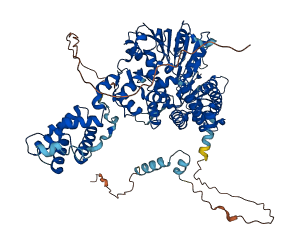
Descriptions
The autoinhibited protein was predicted that may have potential autoinhibitory elements via cis-regPred.
Autoinhibitory domains (AIDs)
Target domain |
|
Relief mechanism |
|
Assay |
cis-regPred |
Accessory elements
No accessory elements
Autoinhibited structure

Activated structure
1 structures for Q5EBA1
| Entry ID | Method | Resolution | Chain | Position | Source |
|---|---|---|---|---|---|
| AF-Q5EBA1-F1 | Predicted | AlphaFoldDB |
No variants for Q5EBA1
| Variant ID(s) | Position | Change | Description | Diseaes Association | Provenance |
|---|---|---|---|---|---|
| No variants for Q5EBA1 | |||||
No associated diseases with Q5EBA1
5 regional properties for Q5EBA1
| Type | Name | Position | InterPro Accession |
|---|---|---|---|
| domain | Helicase, C-terminal | 353 - 521 | IPR001650 |
| domain | Mitochondrial degradasome RNA helicase subunit, C-terminal domain | 625 - 671 | IPR022192 |
| domain | Suv3, C-terminal domain 1 | 558 - 598 | IPR041082 |
| domain | Suv3, N-terminal | 62 - 179 | IPR041453 |
| domain | Suv3, DEXQ-box helicase domain | 200 - 345 | IPR044774 |
Functions
| Description | ||
|---|---|---|
| EC Number | 3.6.4.13 | Acting on ATP; involved in cellular and subcellular movement |
| Subcellular Localization |
|
|
| PANTHER Family | ||
| PANTHER Subfamily | ||
| PANTHER Protein Class | ||
| PANTHER Pathway Category | No pathway information available | |
5 GO annotations of cellular component
| Name | Definition |
|---|---|
| mitochondrial degradosome | A mitochondrial protein complex with 3' to 5' exoribonuclease activity that participates in intron-independent turnover and processing of mitochondrial transcripts. In humans, the mitochondrial degradosome is a pentameric complex, and in yeast it exists as a heterodimer. |
| mitochondrial matrix | The gel-like material, with considerable fine structure, that lies in the matrix space, or lumen, of a mitochondrion. It contains the enzymes of the tricarboxylic acid cycle and, in some organisms, the enzymes concerned with fatty acid oxidation. |
| mitochondrial nucleoid | The region of a mitochondrion to which the DNA is confined. |
| mitochondrion | A semiautonomous, self replicating organelle that occurs in varying numbers, shapes, and sizes in the cytoplasm of virtually all eukaryotic cells. It is notably the site of tissue respiration. |
| nucleus | A membrane-bounded organelle of eukaryotic cells in which chromosomes are housed and replicated. In most cells, the nucleus contains all of the cell's chromosomes except the organellar chromosomes, and is the site of RNA synthesis and processing. In some species, or in specialized cell types, RNA metabolism or DNA replication may be absent. |
8 GO annotations of molecular function
| Name | Definition |
|---|---|
| 3'-5' RNA helicase activity | Unwinding of an RNA helix in the 3' to 5' direction, driven by ATP hydrolysis. |
| ATP binding | Binding to ATP, adenosine 5'-triphosphate, a universally important coenzyme and enzyme regulator. |
| ATP hydrolysis activity | Catalysis of the reaction: ATP + H2O = ADP + H+ phosphate. ATP hydrolysis is used in some reactions as an energy source, for example to catalyze a reaction or drive transport against a concentration gradient. |
| DNA binding | Any molecular function by which a gene product interacts selectively and non-covalently with DNA (deoxyribonucleic acid). |
| DNA helicase activity | Unwinding of a DNA helix, driven by ATP hydrolysis. |
| double-stranded RNA binding | Binding to double-stranded RNA. |
| protein homodimerization activity | Binding to an identical protein to form a homodimer. |
| RNA helicase activity | Unwinding of an RNA helix, driven by ATP hydrolysis. |
12 GO annotations of biological process
| Name | Definition |
|---|---|
| DNA duplex unwinding | The process in which interchain hydrogen bonds between two strands of DNA are broken or 'melted', generating a region of unpaired single strands. |
| DNA recombination | Any process in which a new genotype is formed by reassortment of genes resulting in gene combinations different from those that were present in the parents. In eukaryotes genetic recombination can occur by chromosome assortment, intrachromosomal recombination, or nonreciprocal interchromosomal recombination. Interchromosomal recombination occurs by crossing over. In bacteria it may occur by genetic transformation, conjugation, transduction, or F-duction. |
| mitochondrial mRNA catabolic process | The chemical reactions and pathways resulting in the breakdown of mRNA transcribed from the mitochondrial genome and occurring in the mitochondrion. |
| mitochondrial mRNA surveillance | The set of processes involved in identifying and degrading messenger RNA (mRNA) within the mitochondrion. |
| mitochondrial ncRNA surveillance | The set of processes involved in identifying and degrading defective or aberrant non-coding RNA transcripts (ncRNAs) within the mitochondrion. |
| mitochondrial RNA 3'-end processing | Any process involved in forming the mature 3' end of an RNA molecule transcribed from a mitochondrial genome; occurs in the mitochondrion. |
| mitochondrial RNA surveillance | The set of processes involved in identifying and degrading defective or aberrant RNAs that takes place in the mitochondrion. |
| mitochondrion morphogenesis | The process in which the anatomical structures of a mitochondrion are generated and organized. |
| negative regulation of apoptotic process | Any process that stops, prevents, or reduces the frequency, rate or extent of cell death by apoptotic process. |
| positive regulation of cell growth | Any process that activates or increases the frequency, rate, extent or direction of cell growth. |
| positive regulation of mitochondrial RNA catabolic process | Any process that activates or increases the frequency, rate or extent of the chemical reactions and pathways involving catabolism in the mitochondrion of RNA transcribed from the mitochondrial genome. |
| RNA catabolic process | The chemical reactions and pathways resulting in the breakdown of RNA, ribonucleic acid, one of the two main type of nucleic acid, consisting of a long, unbranched macromolecule formed from ribonucleotides joined in 3',5'-phosphodiester linkage. |
3 homologous proteins in AiPD
| UniProt AC | Gene Name | Protein Name | Species | Evidence Code |
|---|---|---|---|---|
| Q9VN03 | Suv3 | ATP-dependent RNA helicase SUV3 homolog, mitochondrial | Drosophila melanogaster (Fruit fly) | PR |
| Q8IYB8 | SUPV3L1 | ATP-dependent RNA helicase SUPV3L1, mitochondrial | Homo sapiens (Human) | PR |
| Q80YD1 | Supv3l1 | ATP-dependent RNA helicase SUPV3L1, mitochondrial | Mus musculus (Mouse) | PR |
| 10 | 20 | 30 | 40 | 50 | 60 |
| MSLPRCALLW | ARLPAGRGAG | PRAAPCSALR | ALVGSFPGAS | GRVPCLAASS | SASGGSKAPN |
| 70 | 80 | 90 | 100 | 110 | 120 |
| TSLFVPLTVK | PQGPSADGDV | GAELTRPLDK | NEVKKILDKF | YKRQEIQKLS | ADYGLDARLF |
| 130 | 140 | 150 | 160 | 170 | 180 |
| HQAFISFRNY | IMQSHSLDVD | IHIVLNDICF | SAAHVDDLFP | FFLRHAKQIF | PVLECKDDLR |
| 190 | 200 | 210 | 220 | 230 | 240 |
| QISDLRRPPN | WYPEARAIQR | KIIFHSGPTN | SGKTYHAIQR | YLSATSGVYC | GPLKLLAHEI |
| 250 | 260 | 270 | 280 | 290 | 300 |
| FEKSNAAGVP | CDLVTGEERL | TVEPEGKQAT | HVSCTVEMCN | VATPYEVAVI | DEIQMIRDPA |
| 310 | 320 | 330 | 340 | 350 | 360 |
| RGWAWTRALL | GLCAEEVHLC | GESAAIDLVT | ELLYTTGEEV | EVQKYERLTP | ISVLDRALES |
| 370 | 380 | 390 | 400 | 410 | 420 |
| LDNLRPGDCI | VCFSKNDIYS | VSRQIEIRGL | ESAVIYGSLP | PGTKLAQARK | FNDPNDPCKI |
| 430 | 440 | 450 | 460 | 470 | 480 |
| LVATDAIGMG | LNLSIRRIIF | YSLIKPSINE | KGEKELEPIT | TSQALQIAGR | AGRFSSHFKE |
| 490 | 500 | 510 | 520 | 530 | 540 |
| GEVTTMHRDD | LALLKEILNR | PVDPIQAAGL | HPTAEQIEMF | AYHLPETTLS | NLIDIFVDFA |
| 550 | 560 | 570 | 580 | 590 | 600 |
| QVDGQYFVCN | MDDFKFSAEL | IQHIPLSLRV | RYVFCTAPIN | KKQPFVCSSL | LQFARQYSRN |
| 610 | 620 | 630 | 640 | 650 | 660 |
| EPLTFAWLRR | YIKWPLLPPK | NIKDLMDLEA | VHDVFDLYLW | LSYRFIDMFP | DSSFVRSLQK |
| 670 | 680 | 690 | 700 | 710 | 720 |
| ELDVIIQEGV | HNITKLIKIS | ESHKLLNLEP | SGSQSRLPGA | SKSPARRTRG | TKTGNKAAEP |
| 730 | 740 | 750 | 760 | 770 | |
| PSPSDKELPL | ASRLVQQGLL | TADMLKQLQK | EWLTQRPEQG | KEKVGTRRKK | KDPNSD |