Q9UP83
Gene name |
COG5 (GOLTC1, GTC90) |
Protein name |
Conserved oligomeric Golgi complex subunit 5 |
Names |
COG complex subunit 5, 13S Golgi transport complex 90 kDa subunit, GTC-90, Component of oligomeric Golgi complex 5, Golgi transport complex 1 |
Species |
Homo sapiens (Human) |
KEGG Pathway |
hsa:10466 |
EC number |
|
Protein Class |
|
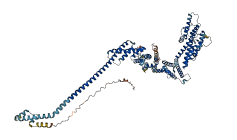
Descriptions
The autoinhibited protein was predicted that may have potential autoinhibitory elements via cis-regPred.
Autoinhibitory domains (AIDs)
Target domain |
|
Relief mechanism |
|
Assay |
cis-regPred |
Accessory elements
No accessory elements
Autoinhibited structure

Activated structure
1 structures for Q9UP83
| Entry ID | Method | Resolution | Chain | Position | Source |
|---|---|---|---|---|---|
| AF-Q9UP83-F1 | Predicted | AlphaFoldDB |
4 variants for Q9UP83
| Variant ID(s) | Position | Change | Description | Diseaes Association | Provenance |
|---|---|---|---|---|---|
|
rs2269970 RCV000081393 RCV000377238 CA148493 VAR_039142 |
330 | F>L | COG5-congenital disorder of glycosylation [ClinVar] | Yes |
ClinGen ClinVar UniProt 1000Genomes ESP ExAC TOPMed dbSNP gnomAD |
|
CA4431036 rs34087251 VAR_039182 RCV000318026 RCV000420991 |
365 | I>V | COG5-congenital disorder of glycosylation [ClinVar] | Yes |
ClinGen ClinVar UniProt 1000Genomes ESP ExAC TOPMed dbSNP gnomAD |
|
RCV001079771 VAR_055664 RCV000514707 CA4430966 rs35393416 |
452 | H>R | COG5-congenital disorder of glycosylation [ClinVar] | Yes |
ClinGen ClinVar UniProt 1000Genomes ESP ExAC TOPMed dbSNP gnomAD |
| VAR_039143 | 558 | S>P | No | UniProt |
1 associated diseases with Q9UP83
[MIM: 613612]: Congenital disorder of glycosylation 2I (CDG2I)
A multisystem disorder caused by a defect in glycoprotein biosynthesis and characterized by under-glycosylated serum glycoproteins. Congenital disorders of glycosylation result in a wide variety of clinical features, such as defects in the nervous system development, psychomotor retardation, dysmorphic features, hypotonia, coagulation disorders, and immunodeficiency. The broad spectrum of features reflects the critical role of N-glycoproteins during embryonic development, differentiation, and maintenance of cell functions. Congenital disorder of glycosylation type 2I is characterized by mild neurological impairments. {ECO:0000269|PubMed:19690088}. Note=The disease is caused by variants affecting the gene represented in this entry.
Without disease ID
- A multisystem disorder caused by a defect in glycoprotein biosynthesis and characterized by under-glycosylated serum glycoproteins. Congenital disorders of glycosylation result in a wide variety of clinical features, such as defects in the nervous system development, psychomotor retardation, dysmorphic features, hypotonia, coagulation disorders, and immunodeficiency. The broad spectrum of features reflects the critical role of N-glycoproteins during embryonic development, differentiation, and maintenance of cell functions. Congenital disorder of glycosylation type 2I is characterized by mild neurological impairments. {ECO:0000269|PubMed:19690088}. Note=The disease is caused by variants affecting the gene represented in this entry.
No regional properties for Q9UP83
| Type | Name | Position | InterPro Accession |
|---|---|---|---|
| No domain, repeats, and functional sites for Q9UP83 | |||
7 GO annotations of cellular component
| Name | Definition |
|---|---|
| cytosol | The part of the cytoplasm that does not contain organelles but which does contain other particulate matter, such as protein complexes. |
| Golgi apparatus | A membrane-bound cytoplasmic organelle of the endomembrane system that further processes the core oligosaccharides (e.g. N-glycans) added to proteins in the endoplasmic reticulum and packages them into membrane-bound vesicles. The Golgi apparatus operates at the intersection of the secretory, lysosomal, and endocytic pathways. |
| Golgi membrane | The lipid bilayer surrounding any of the compartments of the Golgi apparatus. |
| Golgi transport complex | A multisubunit tethering complex of the CATCHR family (complexes associated with tethering containing helical rods) that has a role in tethering vesicles to the Golgi prior to fusion. Composed of 8 subunits COG1-8. |
| membrane | A lipid bilayer along with all the proteins and protein complexes embedded in it an attached to it. |
| nucleoplasm | That part of the nuclear content other than the chromosomes or the nucleolus. |
| trans-Golgi network membrane | The lipid bilayer surrounding any of the compartments that make up the trans-Golgi network. |
No GO annotations of molecular function
| Name | Definition |
|---|---|
| No GO annotations for molecular function |
6 GO annotations of biological process
| Name | Definition |
|---|---|
| glycosylation | The covalent attachment and further modification of carbohydrate residues to a substrate molecule. |
| Golgi organization | A process that is carried out at the cellular level which results in the assembly, arrangement of constituent parts, or disassembly of the Golgi apparatus. |
| inter-Golgi cisterna vesicle-mediated transport | The directed movement of substances from one Golgi cisterna to another, mediated by small transport vesicles. |
| intra-Golgi vesicle-mediated transport | The directed movement of substances within the Golgi, mediated by small transport vesicles. These either fuse with the cis-Golgi or with each other to form the membrane stacks known as the cis-Golgi reticulum (network). |
| protein transport | The directed movement of proteins into, out of or within a cell, or between cells, by means of some agent such as a transporter or pore. |
| retrograde transport, vesicle recycling within Golgi | The retrograde movement of substances within the Golgi, mediated by COP I vesicles. Cis-Golgi vesicles are constantly moving forward through the Golgi stack by cisternal progression, eventually becoming trans-Golgi vesicles. They then selectively transport membrane and luminal proteins from the trans- to the medial-Golgi while leaving others behind in the trans-Golgi cisternae; similarly, they selectively move proteins from the medial- to the cis-Golgi. |
1 homologous proteins in AiPD
| UniProt AC | Gene Name | Protein Name | Species | Evidence Code |
|---|---|---|---|---|
| Q8C0L8 | Cog5 | Conserved oligomeric Golgi complex subunit 5 | Mus musculus (Mouse) | PR |
| 10 | 20 | 30 | 40 | 50 | 60 |
| MGWVGGRRRD | SASPPGRSRS | AADDINPAPA | NMEGGGGSVA | VAGLGARGSG | AAAATVRELL |
| 70 | 80 | 90 | 100 | 110 | 120 |
| QDGCYSDFLN | EDFDVKTYTS | QSIHQAVIAE | QLAKLAQGIS | QLDRELHLQV | VARHEDLLAQ |
| 130 | 140 | 150 | 160 | 170 | 180 |
| ATGIESLEGV | LQMMQTRIGA | LQGAVDRIKA | KIVEPYNKIV | ARTAQLARLQ | VACDLLRRII |
| 190 | 200 | 210 | 220 | 230 | 240 |
| RILNLSKRLQ | GQLQGGSREI | TKAAQSLNEL | DYLSQGIDLS | GIEVIENDLL | FIARARLEVE |
| 250 | 260 | 270 | 280 | 290 | 300 |
| NQAKRLLEQG | LETQNPTQVG | TALQVFYNLG | TLKDTITSVV | DGYCATLEEN | INSALDIKVL |
| 310 | 320 | 330 | 340 | 350 | 360 |
| TQPSQSAVRG | GPGRSTMPTP | GNTAALRASF | WTNMEKLMDH | IYAVCGQVQH | LQKVLAKKRD |
| 370 | 380 | 390 | 400 | 410 | 420 |
| PVSHICFIEE | IVKDGQPEIF | YTFWNSVTQA | LSSQFHMATN | SSMFLKQAFE | GEYPKLLRLY |
| 430 | 440 | 450 | 460 | 470 | 480 |
| NDLWKRLQQY | SQHIQGNFNA | SGTTDLYVDL | QHMEDDAQDI | FIPKKPDYDP | EKALKDSLQP |
| 490 | 500 | 510 | 520 | 530 | 540 |
| YEAAYLSKSL | SRLFDPINLV | FPPGGRNPPS | SDELDGIIKT | IASELNVAAV | DTNLTLAVSK |
| 550 | 560 | 570 | 580 | 590 | 600 |
| NVAKTIQLYS | VKSEQLLSTQ | GDASQVIGPL | TEGQRRNVAV | VNSLYKLHQS | VTKAIHALME |
| 610 | 620 | 630 | 640 | 650 | 660 |
| NAVQPLLTSV | GDAIEAIIIT | MHQEDFSGSL | SSSGKPDVPC | SLYMKELQGF | IARVMSDYFK |
| 670 | 680 | 690 | 700 | 710 | 720 |
| HFECLDFVFD | NTEAIAQRAV | ELFIRHASLI | RPLGEGGKMR | LAADFAQMEL | AVGPFCRRVS |
| 730 | 740 | 750 | 760 | 770 | 780 |
| DLGKSYRMLR | SFRPLLFQAS | EHVASSPALG | DVIPFSIIIQ | FLFTRAPAEL | KSPFQRAEWS |
| 790 | 800 | 810 | 820 | 830 | |
| HTRFSQWLDD | HPSEKDRLLL | IRGALEAYVQ | SVRSREGKEF | APVYPIMVQL | LQKAMSALQ |