Q9R1K9
Gene name |
Cetn2 (Calt) |
Protein name |
Centrin-2 |
Names |
Caltractin isoform 1 |
Species |
Mus musculus (Mouse) |
KEGG Pathway |
mmu:26370 |
EC number |
|
Protein Class |
|
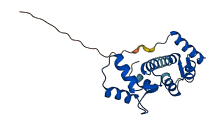
Descriptions
The autoinhibited protein was predicted that may have potential autoinhibitory elements via cis-regPred.
Autoinhibitory domains (AIDs)
Target domain |
|
Relief mechanism |
|
Assay |
cis-regPred |
Accessory elements
No accessory elements
Autoinhibited structure

Activated structure
1 structures for Q9R1K9
| Entry ID | Method | Resolution | Chain | Position | Source |
|---|---|---|---|---|---|
| AF-Q9R1K9-F1 | Predicted | AlphaFoldDB |
5 variants for Q9R1K9
| Variant ID(s) | Position | Change | Description | Diseaes Association | Provenance |
|---|---|---|---|---|---|
| rs50049976 | 28 | D>N | No | EVA | |
| rs3389559026 | 79 | E>D | No | EVA | |
| rs3389561360 | 84 | M>I | No | EVA | |
| rs3389563134 | 89 | F>L | No | EVA | |
| rs3389556996 | 172 | Y>* | No | EVA |
No associated diseases with Q9R1K9
5 regional properties for Q9R1K9
| Type | Name | Position | InterPro Accession |
|---|---|---|---|
| conserved_site | ATP-dependent RNA helicase DEAD-box, conserved site | 145 - 153 | IPR000629 |
| domain | EF-hand domain | 28 - 99 | IPR002048-1 |
| domain | EF-hand domain | 101 - 172 | IPR002048-2 |
| binding_site | EF-Hand 1, calcium-binding site | 41 - 53 | IPR018247-1 |
| binding_site | EF-Hand 1, calcium-binding site | 150 - 162 | IPR018247-2 |
Functions
11 GO annotations of cellular component
| Name | Definition |
|---|---|
| 9+2 motile cilium | A motile cilium where the axoneme has a ring of nine outer microtubule doublets plus two central microtubules (and is therefore called a 9+2 axoneme). |
| apical part of cell | The region of a polarized cell that forms a tip or is distal to a base. For example, in a polarized epithelial cell, the apical region has an exposed surface and lies opposite to the basal lamina that separates the epithelium from other tissue. |
| centriole | A cellular organelle, found close to the nucleus in many eukaryotic cells, consisting of a small cylinder with microtubular walls, 300-500 nm long and 150-250 nm in diameter. It contains nine short, parallel, peripheral microtubular fibrils, each fibril consisting of one complete microtubule fused to two incomplete microtubules. Cells usually have two centrioles, lying at right angles to each other. At division, each pair of centrioles generates another pair and the twin pairs form the pole of the mitotic spindle. |
| centrosome | A structure comprised of a core structure (in most organisms, a pair of centrioles) and peripheral material from which a microtubule-based structure, such as a spindle apparatus, is organized. Centrosomes occur close to the nucleus during interphase in many eukaryotic cells, though in animal cells it changes continually during the cell-division cycle. |
| ciliary basal body | A membrane-tethered, short cylindrical array of microtubules and associated proteins found at the base of a eukaryotic cilium (also called flagellum) that is similar in structure to a centriole and derives from it. The cilium basal body is the site of assembly and remodelling of the cilium and serves as a nucleation site for axoneme growth. As well as anchoring the cilium, it is thought to provide a selective gateway regulating the entry of ciliary proteins and vesicles by intraflagellar transport. |
| cilium | A specialized eukaryotic organelle that consists of a filiform extrusion of the cell surface and of some cytoplasmic parts. Each cilium is largely bounded by an extrusion of the cytoplasmic (plasma) membrane, and contains a regular longitudinal array of microtubules, anchored to a basal body. |
| cytoplasm | The contents of a cell excluding the plasma membrane and nucleus, but including other subcellular structures. |
| nuclear pore nuclear basket | A filamentous, cage-like assembly on the nuclear face of the nuclear pore complex (NPC). In S. cerevisiae, Mlp1p and Mlp2p are two major components of the NPC nuclear basket. In vertebrates, Tpr is a major component. |
| photoreceptor connecting cilium | The portion of the photoreceptor cell cilium linking the photoreceptor inner and outer segments. It's considered to be equivalent to the ciliary transition zone. |
| transcription export complex 2 | A protein complex that couples SAGA-dependent gene expression to mRNA export at the inner side of the nuclear pore complex (NPC). The TREX-2 complex is tethered to the inner side of the NPC via the nucleoporins Nup1 and Nup60; in S. cerevisiae it contains Sac3p, Thp1p, Sem1, Sus1p and Cdc31p. |
| XPC complex | A nucleotide-excision repair complex that is involved in damage sensing during global genome nucleotide excision repair (GG-NER). It is part of the pre-incision (or initial recognition) complex bound to sites of DNA damage. In human, it is composed of XPC, RAD23B and CETN2. |
4 GO annotations of molecular function
| Name | Definition |
|---|---|
| calcium ion binding | Binding to a calcium ion (Ca2+). |
| G-protein beta/gamma-subunit complex binding | Binding to a complex of G-protein beta/gamma subunits. |
| heterotrimeric G-protein binding | Binding to a heterotrimeric G-protein. |
| microtubule binding | Binding to a microtubule, a filament composed of tubulin monomers. |
8 GO annotations of biological process
| Name | Definition |
|---|---|
| cell division | The process resulting in division and partitioning of components of a cell to form more cells; may or may not be accompanied by the physical separation of a cell into distinct, individually membrane-bounded daughter cells. |
| centriole replication | The cell cycle process in which a daughter centriole is formed perpendicular to an existing centriole. An immature centriole contains a ninefold radially symmetric array of single microtubules; mature centrioles consist of a radial array of nine microtubule triplets, doublets, or singlets depending upon the species and cell type. Duplicated centrioles also become the ciliary basal body in cells that form cilia during G0. |
| mitotic cell cycle | Progression through the phases of the mitotic cell cycle, the most common eukaryotic cell cycle, which canonically comprises four successive phases called G1, S, G2, and M and includes replication of the genome and the subsequent segregation of chromosomes into daughter cells. In some variant cell cycles nuclear replication or nuclear division may not be followed by cell division, or G1 and G2 phases may be absent. |
| mRNA transport | The directed movement of mRNA, messenger ribonucleic acid, into, out of or within a cell, or between cells, by means of some agent such as a transporter or pore. |
| nucleotide-excision repair | A DNA repair process in which a small region of the strand surrounding the damage is removed from the DNA helix as an oligonucleotide. The small gap left in the DNA helix is filled in by the sequential action of DNA polymerase and DNA ligase. Nucleotide excision repair recognizes a wide range of substrates, including damage caused by UV irradiation (pyrimidine dimers and 6-4 photoproducts) and chemicals (intrastrand cross-links and bulky adducts). |
| protein transport | The directed movement of proteins into, out of or within a cell, or between cells, by means of some agent such as a transporter or pore. |
| regulation of cytokinesis | Any process that modulates the frequency, rate or extent of the division of the cytoplasm of a cell and its separation into two daughter cells. |
| spermatogenesis | The developmental process by which male germ line stem cells self renew or give rise to successive cell types resulting in the development of a spermatozoa. |
1 homologous proteins in AiPD
| UniProt AC | Gene Name | Protein Name | Species | Evidence Code |
|---|---|---|---|---|
| P41208 | CETN2 | Centrin-2 | Homo sapiens (Human) | PR |
| 10 | 20 | 30 | 40 | 50 | 60 |
| MASNFKKTTM | ASSAQRKRMS | PKPELTEDQK | QEIREAFDLF | DADGTGTIDI | KELKVAMRAL |
| 70 | 80 | 90 | 100 | 110 | 120 |
| GFEPKKEEIK | KMISEIDKEG | TGKMNFSDFL | TVMTQKMSEK | DTKEEILKAF | KLFDDDETGK |
| 130 | 140 | 150 | 160 | 170 | |
| ISFKNLKRVA | KELGENLTDE | ELQEMIDEAD | RDGDGEVNEQ | EFLRIMKKTS | LY |