Q9NQA5
Gene name |
TRPV5 (ECAC1) |
Protein name |
Transient receptor potential cation channel subfamily V member 5 |
Names |
TrpV5, Calcium transport protein 2, CaT2, Epithelial calcium channel 1, ECaC, ECaC1, Osm-9-like TRP channel 3, OTRPC3 |
Species |
Homo sapiens (Human) |
KEGG Pathway |
hsa:56302 |
EC number |
|
Protein Class |
|
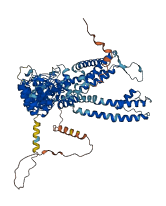
Descriptions
The autoinhibited protein was predicted that may have potential autoinhibitory elements via cis-regPred.
Autoinhibitory domains (AIDs)
Target domain |
|
Relief mechanism |
|
Assay |
cis-regPred |
Accessory elements
No accessory elements
Autoinhibited structure

Activated structure
2 structures for Q9NQA5
| Entry ID | Method | Resolution | Chain | Position | Source |
|---|---|---|---|---|---|
| 5OEO | NMR | - | C | 655-725 | PDB |
| AF-Q9NQA5-F1 | Predicted | AlphaFoldDB |
4 variants for Q9NQA5
| Variant ID(s) | Position | Change | Description | Diseaes Association | Provenance |
|---|---|---|---|---|---|
|
VAR_022247 rs4252372 CA4533755 |
8 | A>V | No |
ClinGen UniProt 1000Genomes ESP ExAC TOPMed dbSNP gnomAD |
|
|
rs4236480 RCV000947082 VAR_022248 CA168222464 |
154 | R>H | No |
ClinGen ClinVar UniProt 1000Genomes ESP ExAC TOPMed dbSNP gnomAD |
|
|
VAR_022249 CA168208355 rs4252499 RCV000948181 |
563 | A>T | No |
ClinGen ClinVar UniProt 1000Genomes ESP ExAC TOPMed dbSNP gnomAD |
|
|
VAR_022250 CA168205142 rs4252509 |
712 | L>F | No |
ClinGen UniProt ESP ExAC TOPMed dbSNP gnomAD |
No associated diseases with Q9NQA5
4 regional properties for Q9NQA5
| Type | Name | Position | InterPro Accession |
|---|---|---|---|
| repeat | Ankyrin repeat | 44 - 148 | IPR002110-1 |
| repeat | Ankyrin repeat | 162 - 194 | IPR002110-2 |
| repeat | Ankyrin repeat | 239 - 268 | IPR002110-3 |
| domain | Ion transport domain | 335 - 589 | IPR005821 |
Functions
3 GO annotations of cellular component
| Name | Definition |
|---|---|
| apical plasma membrane | The region of the plasma membrane located at the apical end of the cell. |
| integral component of plasma membrane | The component of the plasma membrane consisting of the gene products and protein complexes having at least some part of their peptide sequence embedded in the hydrophobic region of the membrane. |
| plasma membrane | The membrane surrounding a cell that separates the cell from its external environment. It consists of a phospholipid bilayer and associated proteins. |
4 GO annotations of molecular function
| Name | Definition |
|---|---|
| calcium channel activity | Enables the facilitated diffusion of a calcium ion (by an energy-independent process) involving passage through a transmembrane aqueous pore or channel without evidence for a carrier-mediated mechanism. |
| calmodulin binding | Binding to calmodulin, a calcium-binding protein with many roles, both in the calcium-bound and calcium-free states. |
| ion channel activity | Enables the facilitated diffusion of an ion (by an energy-independent process) by passage through a transmembrane aqueous pore or channel without evidence for a carrier-mediated mechanism. May be either selective (it enables passage of a specific ion only) or non-selective (it enables passage of two or more ions of same charge but different size). |
| metal ion binding | Binding to a metal ion. |
6 GO annotations of biological process
| Name | Definition |
|---|---|
| calcium ion homeostasis | Any process involved in the maintenance of an internal steady state of calcium ions within an organism or cell. |
| calcium ion import across plasma membrane | The directed movement of calcium ions from outside of a cell, across the plasma membrane and into the cytosol. |
| calcium ion transmembrane transport | A process in which a calcium ion is transported from one side of a membrane to the other by means of some agent such as a transporter or pore. |
| calcium ion transport | The directed movement of calcium (Ca) ions into, out of or within a cell, or between cells, by means of some agent such as a transporter or pore. |
| protein homotetramerization | The formation of a protein homotetramer, a macromolecular structure consisting of four noncovalently associated identical subunits. |
| regulation of urine volume | Any process that modulates the amount of urine excreted from the body over a unit of time. |
1 homologous proteins in AiPD
| UniProt AC | Gene Name | Protein Name | Species | Evidence Code |
|---|---|---|---|---|
| P69744 | Trpv5 | Transient receptor potential cation channel subfamily V member 5 | Mus musculus (Mouse) | PR |
| 10 | 20 | 30 | 40 | 50 | 60 |
| MGGFLPKAEG | PGSQLQKLLP | SFLVREQDWD | QHLDKLHMLQ | QKRILESPLL | RASKENDLSV |
| 70 | 80 | 90 | 100 | 110 | 120 |
| LRQLLLDCTC | DVRQRGALGE | TALHIAALYD | NLEAALVLME | AAPELVFEPT | TCEAFAGQTA |
| 130 | 140 | 150 | 160 | 170 | 180 |
| LHIAVVNQNV | NLVRALLTRR | ASVSARATGT | AFRRSPRNLI | YFGEHPLSFA | ACVNSEEIVR |
| 190 | 200 | 210 | 220 | 230 | 240 |
| LLIEHGADIR | AQDSLGNTVL | HILILQPNKT | FACQMYNLLL | SYDGHGDHLQ | PLDLVPNHQG |
| 250 | 260 | 270 | 280 | 290 | 300 |
| LTPFKLAGVE | GNTVMFQHLM | QKRRHIQWTY | GPLTSILYDL | TEIDSWGEEL | SFLELVVSSD |
| 310 | 320 | 330 | 340 | 350 | 360 |
| KREARQILEQ | TPVKELVSFK | WNKYGRPYFC | ILAALYLLYM | ICFTTCCVYR | PLKFRGGNRT |
| 370 | 380 | 390 | 400 | 410 | 420 |
| HSRDITILQQ | KLLQEAYETR | EDIIRLVGEL | VSIVGAVIIL | LLEIPDIFRV | GASRYFGKTI |
| 430 | 440 | 450 | 460 | 470 | 480 |
| LGGPFHVIII | TYASLVLVTM | VMRLTNTNGE | VVPMSFALVL | GWCSVMYFTR | GFQMLGPFTI |
| 490 | 500 | 510 | 520 | 530 | 540 |
| MIQKMIFGDL | MRFCWLMAVV | ILGFASAFYI | IFQTEDPTSL | GQFYDYPMAL | FTTFELFLTV |
| 550 | 560 | 570 | 580 | 590 | 600 |
| IDAPANYDVD | LPFMFSIVNF | AFAIIATLLM | LNLFIAMMGD | THWRVAQERD | ELWRAQVVAT |
| 610 | 620 | 630 | 640 | 650 | 660 |
| TVMLERKLPR | CLWPRSGICG | CEFGLGDRWF | LRVENHNDQN | PLRVLRYVEV | FKNSDKEDDQ |
| 670 | 680 | 690 | 700 | 710 | 720 |
| EHPSEKQPSG | AESGTLARAS | LALPTSSLSR | TASQSSSHRG | WEILRQNTLG | HLNLGLNLSE |
| GDGEEVYHF |