Q9LZW2
Gene name |
OFP1 (At5g01840, T20L15.110) |
Protein name |
Transcription repressor OFP1 |
Names |
Ovate family protein 1, AtOFP1 |
Species |
Arabidopsis thaliana (Mouse-ear cress) |
KEGG Pathway |
ath:AT5G01840 |
EC number |
|
Protein Class |
|
Descriptions
The autoinhibited protein was predicted that may have potential autoinhibitory elements via cis-regPred.
Autoinhibitory domains (AIDs)
Target domain |
|
Relief mechanism |
|
Assay |
cis-regPred |
Accessory elements
No accessory elements
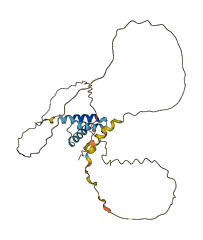
Autoinhibited structure

Activated structure
1 structures for Q9LZW2
| Entry ID | Method | Resolution | Chain | Position | Source |
|---|---|---|---|---|---|
| AF-Q9LZW2-F1 | Predicted | AlphaFoldDB |
34 variants for Q9LZW2
| Variant ID(s) | Position | Change | Description | Diseaes Association | Provenance |
|---|---|---|---|---|---|
| ENSVATH10488690 | 4 | N>K | No | 1000Genomes | |
| ENSVATH13874046 | 23 | D>N | No | 1000Genomes | |
| tmp_5_324667_C_T | 39 | T>I | No | 1000Genomes | |
| ENSVATH10488691 | 41 | S>A | No | 1000Genomes | |
| ENSVATH00600548 | 49 | P>S | No | 1000Genomes | |
| ENSVATH10488692 | 64 | R>P | No | 1000Genomes | |
| ENSVATH06905474 | 75 | H>Y | No | 1000Genomes | |
| tmp_5_324796_G_A | 82 | G>E | No | 1000Genomes | |
| tmp_5_324820_C_T | 90 | T>I | No | 1000Genomes | |
| ENSVATH00600549 | 98 | T>I | No | 1000Genomes | |
| ENSVATH00600549 | 98 | T>N | No | 1000Genomes | |
| ENSVATH06905476 | 110 | F>L | No | 1000Genomes | |
| tmp_5_324897_T_A | 116 | S>T | No | 1000Genomes | |
| tmp_5_324942_C_A | 131 | H>N | No | 1000Genomes | |
| tmp_5_324970_A_G | 140 | K>R | No | 1000Genomes | |
| tmp_5_324983_T_G | 144 | F>L | No | 1000Genomes | |
| tmp_5_324990_C_G | 147 | P>A | No | 1000Genomes | |
| ENSVATH10488694 | 151 | E>K | No | 1000Genomes | |
| tmp_5_325039_C_T | 163 | A>V | No | 1000Genomes | |
| tmp_5_325041_C_G | 164 | R>G | No | 1000Genomes | |
| tmp_5_325042_G_C | 164 | R>P | No | 1000Genomes | |
| tmp_5_325051_C_T | 167 | A>V | No | 1000Genomes | |
| ENSVATH13874048 | 168 | V>G | No | 1000Genomes | |
| ENSVATH06905478 | 169 | N>S | No | 1000Genomes | |
| ENSVATH13874050 | 191 | R>G | No | 1000Genomes | |
| ENSVATH10488726 | 196 | A>G | No | 1000Genomes | |
| tmp_5_325144_G_T | 198 | R>L | No | 1000Genomes | |
| tmp_5_325231_G_A | 227 | R>K | No | 1000Genomes | |
| ENSVATH06905483 | 240 | L>I | No | 1000Genomes | |
| tmp_5_325278_A_G | 243 | N>D | No | 1000Genomes | |
| tmp_5_325351_C_T | 267 | P>L | No | 1000Genomes | |
| tmp_5_325350_C_A | 267 | P>T | No | 1000Genomes | |
| tmp_5_325354_A_T | 268 | H>L | No | 1000Genomes | |
| ENSVATH10488729 | 270 | K>I | No | 1000Genomes |
No associated diseases with Q9LZW2
2 GO annotations of cellular component
| Name | Definition |
|---|---|
| cytoskeleton | A cellular structure that forms the internal framework of eukaryotic and prokaryotic cells. The cytoskeleton includes intermediate filaments, microfilaments, microtubules, the microtrabecular lattice, and other structures characterized by a polymeric filamentous nature and long-range order within the cell. The various elements of the cytoskeleton not only serve in the maintenance of cellular shape but also have roles in other cellular functions, including cellular movement, cell division, endocytosis, and movement of organelles. |
| nucleolus | A small, dense body one or more of which are present in the nucleus of eukaryotic cells. It is rich in RNA and protein, is not bounded by a limiting membrane, and is not seen during mitosis. Its prime function is the transcription of the nucleolar DNA into 45S ribosomal-precursor RNA, the processing of this RNA into 5.8S, 18S, and 28S components of ribosomal RNA, and the association of these components with 5S RNA and proteins synthesized outside the nucleolus. This association results in the formation of ribonucleoprotein precursors; these pass into the cytoplasm and mature into the 40S and 60S subunits of the ribosome. |
1 GO annotations of molecular function
| Name | Definition |
|---|---|
| DNA binding | Any molecular function by which a gene product interacts selectively and non-covalently with DNA (deoxyribonucleic acid). |
4 GO annotations of biological process
| Name | Definition |
|---|---|
| cortical microtubule organization | A process that is carried out at the cellular level which results in the assembly, arrangement of constituent parts, or disassembly of structures formed of microtubules and associated proteins in the cell cortex, i.e. just beneath the plasma membrane of a cell. |
| DNA repair | The process of restoring DNA after damage. Genomes are subject to damage by chemical and physical agents in the environment (e.g. UV and ionizing radiations, chemical mutagens, fungal and bacterial toxins, etc.) and by free radicals or alkylating agents endogenously generated in metabolism. DNA is also damaged because of errors during its replication. A variety of different DNA repair pathways have been reported that include direct reversal, base excision repair, nucleotide excision repair, photoreactivation, bypass, double-strand break repair pathway, and mismatch repair pathway. |
| negative regulation of DNA-templated transcription | Any process that stops, prevents, or reduces the frequency, rate or extent of cellular DNA-templated transcription. |
| regulation of unidimensional cell growth | Any process that modulates the frequency, rate or extent of unidimensional cell growth, the process in which a cell irreversibly increases in size in one |
1 homologous proteins in AiPD
| UniProt AC | Gene Name | Protein Name | Species | Evidence Code |
|---|---|---|---|---|
| Q8VZN1 | OFP5 | Transcription repressor OFP5 | Arabidopsis thaliana (Mouse-ear cress) | PR |
| 10 | 20 | 30 | 40 | 50 | 60 |
| MGNNYRFKLS | ELIPNAWFYK | LRDMSKSKKK | NLQSQPNSTT | SKKKHHAVPT | PTSTTPLSPR |
| 70 | 80 | 90 | 100 | 110 | 120 |
| PPRRPSHSSK | APPSHPPRKS | SGNRLRHRAT | VDSKSSTTSG | DSTTTETGSF | SPDFRSDQVL |
| 130 | 140 | 150 | 160 | 170 | 180 |
| LPDESLTGSW | HSPCSSKLSK | TATFTPPPEL | ELRPIITKTA | ATARKTAVNS | PAGVRLRMRS |
| 190 | 200 | 210 | 220 | 230 | 240 |
| PRISVSSSAR | RSGSSARRSR | AVVKASVDPK | RDFKESMEEM | IAENKIRATK | DLEELLACYL |
| 250 | 260 | ||||
| CLNSDEYHAI | IINVFKQIWL | DLNLPPPHSK |