Q8VZN1
Gene name |
OFP5 (At4g18830, F13C5.5) |
Protein name |
Transcription repressor OFP5 |
Names |
Ovate family protein 5, AtOFP5 |
Species |
Arabidopsis thaliana (Mouse-ear cress) |
KEGG Pathway |
ath:AT4G18830 |
EC number |
|
Protein Class |
|
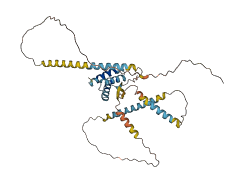
Descriptions
The autoinhibited protein was predicted that may have potential autoinhibitory elements via cis-regPred.
Autoinhibitory domains (AIDs)
Target domain |
|
Relief mechanism |
|
Assay |
cis-regPred |
Accessory elements
No accessory elements
Autoinhibited structure

Activated structure
1 structures for Q8VZN1
| Entry ID | Method | Resolution | Chain | Position | Source |
|---|---|---|---|---|---|
| AF-Q8VZN1-F1 | Predicted | AlphaFoldDB |
35 variants for Q8VZN1
| Variant ID(s) | Position | Change | Description | Diseaes Association | Provenance |
|---|---|---|---|---|---|
| ENSVATH06719227 | 3 | R>T | No | 1000Genomes | |
| ENSVATH06719228 | 9 | P>H | No | 1000Genomes | |
| tmp_4_10337480_C_T | 11 | S>F | No | 1000Genomes | |
| ENSVATH11990053 | 21 | A>T | No | 1000Genomes | |
| tmp_4_10337518_G_A | 24 | V>I | No | 1000Genomes | |
| tmp_4_10337548_T_C | 34 | S>P | No | 1000Genomes | |
| tmp_4_10337586_A_T | 46 | E>D | No | 1000Genomes | |
| ENSVATH00520908 | 51 | N>K | No | 1000Genomes | |
| ENSVATH00520909 | 59 | S>G | No | 1000Genomes | |
| ENSVATH06719229 | 64 | R>Q | No | 1000Genomes | |
| tmp_4_10337660_G_A | 71 | S>N | No | 1000Genomes | |
| tmp_4_10337697_C_G | 83 | N>K | No | 1000Genomes | |
| tmp_4_10337809_G_A | 121 | V>M | No | 1000Genomes | |
| ENSVATH06719230 | 127 | D>G | No | 1000Genomes | |
| tmp_4_10337863_G_A | 139 | V>M | No | 1000Genomes | |
| tmp_4_10337930_C_T | 161 | S>L | No | 1000Genomes | |
| ENSVATH00520910 | 167 | V>F | No | 1000Genomes | |
| ENSVATH06719232 | 178 | T>K | No | 1000Genomes | |
| ENSVATH06719232 | 178 | T>R | No | 1000Genomes | |
| tmp_4_10337984_G_A | 179 | G>E | No | 1000Genomes | |
| tmp_4_10337994_T_A | 182 | S>R | No | 1000Genomes | |
| ENSVATH00520911 | 192 | T>S | No | 1000Genomes | |
| ENSVATH06719234 | 194 | T>A | No | 1000Genomes | |
| tmp_4_10338140_T_A | 231 | I>K | No | 1000Genomes | |
| ENSVATH02876895 | 235 | E>G | No | 1000Genomes | |
| ENSVATH14249738 | 237 | N>T | No | 1000Genomes | |
| tmp_4_10338160_A_C | 238 | K>Q | No | 1000Genomes | |
| ENSVATH06719235 | 249 | K>N | No | 1000Genomes | |
| tmp_4_10338228_G_T | 260 | K>N | No | 1000Genomes | |
| tmp_4_10338251_A_C | 268 | H>P | No | 1000Genomes | |
| tmp_4_10338290_A_C | 281 | N>T | No | 1000Genomes | |
| tmp_4_10338412_T_C | 322 | C>R | No | 1000Genomes | |
| ENSVATH11990087 | 328 | T>R | No | 1000Genomes | |
| ENSVATH02876896 | 344 | N>D | No | 1000Genomes | |
| ENSVATH02876897 | 345 | D>E | No | 1000Genomes |
No associated diseases with Q8VZN1
1 regional properties for Q8VZN1
| Type | Name | Position | InterPro Accession |
|---|---|---|---|
| domain | Ovate protein family, C-terminal | 284 - 345 | IPR006458 |
2 GO annotations of cellular component
| Name | Definition |
|---|---|
| cortical cytoskeleton | The portion of the cytoskeleton that lies just beneath the plasma membrane. |
| nucleolus | A small, dense body one or more of which are present in the nucleus of eukaryotic cells. It is rich in RNA and protein, is not bounded by a limiting membrane, and is not seen during mitosis. Its prime function is the transcription of the nucleolar DNA into 45S ribosomal-precursor RNA, the processing of this RNA into 5.8S, 18S, and 28S components of ribosomal RNA, and the association of these components with 5S RNA and proteins synthesized outside the nucleolus. This association results in the formation of ribonucleoprotein precursors; these pass into the cytoplasm and mature into the 40S and 60S subunits of the ribosome. |
No GO annotations of molecular function
| Name | Definition |
|---|---|
| No GO annotations for molecular function |
3 GO annotations of biological process
| Name | Definition |
|---|---|
| cortical microtubule organization | A process that is carried out at the cellular level which results in the assembly, arrangement of constituent parts, or disassembly of structures formed of microtubules and associated proteins in the cell cortex, i.e. just beneath the plasma membrane of a cell. |
| embryo sac development | The process whose specific outcome is the progression of the embryo sac over time, from its formation to the mature structure. The process begins with the meiosis of the megasporocyte to form four haploid megaspores. Three of the megaspores disintegrate, and the fourth undergoes mitosis giving rise to a binucleate syncytial embryo sac. The two haploid nuclei migrate to the opposite poles of the embryo sac and then undergo two rounds of mitosis generating four haploid nuclei at each pole. One nucleus from each set of four migrates to the center of the cell. Cellularization occurs, resulting in an eight-nucleate seven-celled structure. This structure contains two synergid cells and an egg cell at the micropylar end, and three antipodal cells at the other end. A binucleate endosperm mother cell is formed at the center. The two polar nuclei fuse resulting in a mononucleate diploid endosperm mother cell. The three antipodal cells degenerate. |
| negative regulation of DNA-templated transcription | Any process that stops, prevents, or reduces the frequency, rate or extent of cellular DNA-templated transcription. |
1 homologous proteins in AiPD
| UniProt AC | Gene Name | Protein Name | Species | Evidence Code |
|---|---|---|---|---|
| Q9LZW2 | OFP1 | Transcription repressor OFP1 | Arabidopsis thaliana (Mouse-ear cress) | PR |
| 10 | 20 | 30 | 40 | 50 | 60 |
| MMRWGRKKPV | SSSSSSGLSR | ALPVSWFSKL | SGSSDLKPAK | EKKQDEKASQ | NISVKTSLSS |
| 70 | 80 | 90 | 100 | 110 | 120 |
| TTRRSDIHEN | SKRFQRVSVE | KENSATRSAD | KESNEKFEEI | MSSVRKKVRD | FQKETCGFLE |
| 130 | 140 | 150 | 160 | 170 | 180 |
| VEAMDRDNGT | VILTPRIQVN | RDKQRCERRD | QRLLEQKPKR | SEQDAGVKVK | KPARRTGTGG |
| 190 | 200 | 210 | 220 | 230 | 240 |
| YSREDSVILG | HTITKPAHQW | EKLKEVKLRE | VKLKADQQRK | SLYLKRELNR | IGTKENNKVR |
| 250 | 260 | 270 | 280 | 290 | 300 |
| VFSPRASEKC | RVKAIEDLKK | AKQRAREHEL | LIETADGGME | NESFAVVKCS | SDPQKDFRDS |
| 310 | 320 | 330 | 340 | ||
| MIEMIMENGI | NHPEELKELL | VCYLRLNTDE | YHDMIISVFQ | QVHNDFNFH |