Q9LMH0
Gene name |
KTI12 |
Protein name |
Protein KTI12 homolog |
Names |
AtKTI12, At1g13870, Protein DEFORMED ROOTS AND LEAVES 1, AtDRL1, Protein ELONGATA4 |
Species |
Arabidopsis thaliana (Mouse-ear cress) |
KEGG Pathway |
ath:AT1G13870 |
EC number |
|
Protein Class |
|
Descriptions
The autoinhibited protein was predicted that may have potential autoinhibitory elements via cis-regPred.
Autoinhibitory domains (AIDs)
Target domain |
|
Relief mechanism |
|
Assay |
cis-regPred |
Accessory elements
No accessory elements
Autoinhibited structure

Activated structure
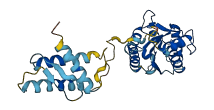
1 structures for Q9LMH0
| Entry ID | Method | Resolution | Chain | Position | Source |
|---|---|---|---|---|---|
| AF-Q9LMH0-F1 | Predicted | AlphaFoldDB |
21 variants for Q9LMH0
| Variant ID(s) | Position | Change | Description | Diseaes Association | Provenance |
|---|---|---|---|---|---|
| tmp_1_4748253_T_A | 31 | K>N | No | 1000Genomes | |
| tmp_1_4748195_C_T | 51 | A>T | No | 1000Genomes | |
| ENSVATH00022346 | 53 | M>V | No | 1000Genomes | |
| ENSVATH04572852 | 67 | V>I | No | 1000Genomes | |
| tmp_1_4748119_A_T | 76 | I>N | No | 1000Genomes | |
| ENSVATH01048319 | 77 | V>I | No | 1000Genomes | |
| ENSVATH13892850 | 99 | A>T | No | 1000Genomes | |
| ENSVATH11171608 | 123 | S>N | No | 1000Genomes | |
| ENSVATH04572850 | 124 | D>G | No | 1000Genomes | |
| ENSVATH04572849 | 126 | G>D | No | 1000Genomes | |
| ENSVATH00022342 | 132 | D>G | No | 1000Genomes | |
| ENSVATH00022341 | 159 | Y>F | No | 1000Genomes | |
| tmp_1_4747823_C_A | 175 | A>S | No | 1000Genomes | |
| tmp_1_4747735_A_C | 204 | F>C | No | 1000Genomes | |
| ENSVATH04572846 | 219 | E>G | No | 1000Genomes | |
| ENSVATH13892849 | 226 | E>K | No | 1000Genomes | |
| ENSVATH01048316 | 232 | A>G | No | 1000Genomes | |
| tmp_1_4747553_C_T | 265 | V>I | No | 1000Genomes | |
| ENSVATH11171607 | 277 | P>S | No | 1000Genomes | |
| tmp_1_4747493_C_T | 285 | A>T | No | 1000Genomes | |
| tmp_1_4747492_G_A | 285 | A>V | No | 1000Genomes |
No associated diseases with Q9LMH0
No regional properties for Q9LMH0
| Type | Name | Position | InterPro Accession |
|---|---|---|---|
| No domain, repeats, and functional sites for Q9LMH0 | |||
3 GO annotations of cellular component
| Name | Definition |
|---|---|
| cytoplasm | The contents of a cell excluding the plasma membrane and nucleus, but including other subcellular structures. |
| elongator holoenzyme complex | A heterohexameric protein complex composed two discrete heterotrimeric subcomplexes that is involved in modification of wobble nucleosides in tRNA. |
| nucleus | A membrane-bounded organelle of eukaryotic cells in which chromosomes are housed and replicated. In most cells, the nucleus contains all of the cell's chromosomes except the organellar chromosomes, and is the site of RNA synthesis and processing. In some species, or in specialized cell types, RNA metabolism or DNA replication may be absent. |
2 GO annotations of molecular function
| Name | Definition |
|---|---|
| ATP binding | Binding to ATP, adenosine 5'-triphosphate, a universally important coenzyme and enzyme regulator. |
| calmodulin binding | Binding to calmodulin, a calcium-binding protein with many roles, both in the calcium-bound and calcium-free states. |
7 GO annotations of biological process
| Name | Definition |
|---|---|
| 5-carbamoylmethyl uridine residue modification | The chemical reactions and pathways involving the addition of a 5-carbamoylmethyl group to a uridine residue in RNA. |
| leaf development | The process whose specific outcome is the progression of the leaf over time, from its formation to the mature structure. |
| meristem structural organization | Organization of a region of tissue in a plant that is composed of one or more undifferentiated cells capable of undergoing mitosis and differentiation, thereby effecting growth and development of a plant by giving rise to more meristem or specialized tissue. |
| regulation of transcription by RNA polymerase II | Any process that modulates the frequency, rate or extent of transcription mediated by RNA polymerase II. |
| root meristem growth | The increase in size or mass of a root meristem, a population of undifferentiated cells in a plant root which maintains a continuous balance between the production of stem cells and the incorporation of their derivatives into the growth of the root. |
| tRNA modification | The covalent alteration of one or more nucleotides within a tRNA molecule to produce a tRNA molecule with a sequence that differs from that coded genetically. |
| tRNA wobble uridine modification | The process in which a uridine in position 34 of a tRNA is post-transcriptionally modified. |
1 homologous proteins in AiPD
| UniProt AC | Gene Name | Protein Name | Species | Evidence Code |
|---|---|---|---|---|
| B9GAG9 | KTI12 | Protein KTI12 homolog | Oryza sativa subsp japonica (Rice) | PR |
| 10 | 20 | 30 | 40 | 50 | 60 |
| MALVVICGQP | CSGKSIAAVT | LAETLKESET | KQSVRIIDEA | SFHLDRNQNY | ANMPAEKNLR |
| 70 | 80 | 90 | 100 | 110 | 120 |
| GKLRSDVDRS | VSTGEIVIVD | SLNSIKGYRY | ELWCIARAAG | IRYCVVYCDV | DEAHCRQWNK |
| 130 | 140 | 150 | 160 | 170 | 180 |
| ERSDRGEDGY | DDGIFEDLVR | RFEKPERRNR | WDSPLFELYP | SREVIDKSSP | VILEAVTYLT |
| 190 | 200 | 210 | 220 | 230 | 240 |
| KTVDSKTQDV | RILQPSIATQ | AARFSEANSL | YELDRATQEI | INAIVEQQSL | GAAISRVTLG |
| 250 | 260 | 270 | 280 | 290 | 300 |
| NELPPIEICR | PIGLPELRRL | RRTFVKLMGQ | SSLSGPPLPT | DADSAKRRFV | DYLNREFGGN |
| NA |