Q9JME5
Gene name |
Ap3b2 |
Protein name |
AP-3 complex subunit beta-2 |
Names |
Adaptor protein complex AP-3 subunit beta-2, Adaptor-related protein complex 3 subunit beta-2, Beta-3B-adaptin, Clathrin assembly protein complex 3 beta-2 large chain |
Species |
Mus musculus (Mouse) |
KEGG Pathway |
mmu:11775 |
EC number |
|
Protein Class |
|
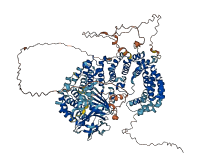
Descriptions
The autoinhibited protein was predicted that may have potential autoinhibitory elements via cis-regPred.
Autoinhibitory domains (AIDs)
Target domain |
|
Relief mechanism |
|
Assay |
cis-regPred |
Accessory elements
No accessory elements
Autoinhibited structure

Activated structure
1 structures for Q9JME5
| Entry ID | Method | Resolution | Chain | Position | Source |
|---|---|---|---|---|---|
| AF-Q9JME5-F1 | Predicted | AlphaFoldDB |
41 variants for Q9JME5
| Variant ID(s) | Position | Change | Description | Diseaes Association | Provenance |
|---|---|---|---|---|---|
| rs3388916711 | 58 | M>L | No | EVA | |
| rs3388905385 | 68 | G>E | No | EVA | |
| rs3388921740 | 165 | A>S | No | EVA | |
| rs3388914395 | 166 | A>V | No | EVA | |
| rs3388881880 | 175 | L>V | No | EVA | |
| rs3388925278 | 213 | R>H | No | EVA | |
| rs3388901798 | 236 | Q>R | No | EVA | |
| rs3388909280 | 252 | L>M | No | EVA | |
| rs3388881883 | 278 | K>* | No | EVA | |
| rs3388919162 | 301 | D>Y | No | EVA | |
| rs3388916679 | 337 | V>M | No | EVA | |
| rs3397761279 | 359 | L>P | No | EVA | |
| rs3388921673 | 385 | T>M | No | EVA | |
| rs3398226951 | 421 | M>T | No | EVA | |
| rs3398154294 | 505 | L>Q | No | EVA | |
| rs3398209487 | 513 | E>* | No | EVA | |
| rs3388916689 | 518 | I>L | No | EVA | |
| rs3388901782 | 530 | F>S | No | EVA | |
| rs3388922768 | 571 | Q>H | No | EVA | |
| rs3388914344 | 596 | S>G | No | EVA | |
| rs3388901806 | 633 | A>T | No | EVA | |
| rs3388922957 | 656 | V>E | No | EVA | |
| rs3388925257 | 709 | S>G | No | EVA | |
| rs51713387 | 722 | E>D | No | EVA | |
| rs3388926140 | 725 | E>K | No | EVA | |
| rs241292996 | 746 | T>I | No | EVA | |
| rs3388916706 | 749 | K>R | No | EVA | |
| rs3388914316 | 760 | S>P | No | EVA | |
| rs252909668 | 796 | G>S | No | EVA | |
| rs3388925328 | 843 | D>Y | No | EVA | |
| rs3388895034 | 848 | P>S | No | EVA | |
| rs3388919168 | 865 | R>W | No | EVA | |
| rs3388921742 | 871 | L>P | No | EVA | |
| rs3388922825 | 897 | N>I | No | EVA | |
| rs3388926139 | 925 | I>V | No | EVA | |
| rs3388880301 | 942 | F>L | No | EVA | |
| rs3388925308 | 948 | A>V | No | EVA | |
| rs3388922986 | 973 | A>G | No | EVA | |
| rs3388909222 | 988 | K>T | No | EVA | |
| rs3388919345 | 1016 | T>N | No | EVA | |
| rs3388926128 | 1052 | R>L | No | EVA |
No associated diseases with Q9JME5
Functions
6 GO annotations of cellular component
| Name | Definition |
|---|---|
| AP-3 adaptor complex | A heterotetrameric AP-type membrane coat adaptor complex that consists of beta3, delta, mu3 and sigma3 subunits and is found associated with endosomal membranes. AP-3 does not appear to associate with clathrin in all organisms. In at least humans, the AP-3 complex can be heterogeneric due to the existence of multiple subunit isoforms encoded by different genes (beta3A and beta3B, mu3A and mu3B, and sigma3A and sigma3B). |
| axon cytoplasm | Any cytoplasm that is part of a axon. |
| clathrin-coated vesicle membrane | The lipid bilayer surrounding a clathrin-coated vesicle. |
| early endosome | A membrane-bounded organelle that receives incoming material from primary endocytic vesicles that have been generated by clathrin-dependent and clathrin-independent endocytosis; vesicles fuse with the early endosome to deliver cargo for sorting into recycling or degradation pathways. |
| presynapse | The part of a synapse that is part of the presynaptic cell. |
| trans-Golgi network | The network of interconnected tubular and cisternal structures located within the Golgi apparatus on the side distal to the endoplasmic reticulum, from which secretory vesicles emerge. The trans-Golgi network is important in the later stages of protein secretion where it is thought to play a key role in the sorting and targeting of secreted proteins to the correct destination. |
No GO annotations of molecular function
| Name | Definition |
|---|---|
| No GO annotations for molecular function |
8 GO annotations of biological process
| Name | Definition |
|---|---|
| anterograde axonal transport | The directed movement of organelles or molecules along microtubules from the cell body toward the cell periphery in nerve cell axons. |
| anterograde synaptic vesicle transport | The directed movement of synaptic vesicle along axonal microtubules from the cell body to the presynapse. |
| clathrin-coated vesicle cargo loading, AP-3-mediated | Formation of a macromolecular complex between proteins of the AP-3 adaptor complex and proteins and/or lipoproteins that are going to be transported by a clathrin-coated vesicle. In some cases, the AP-3 complex is a heterotetrameric AP-type membrane coat adaptor complex that, in some organisms, links clathrin to the membrane surface of a vesicle. |
| intracellular protein transport | The directed movement of proteins in a cell, including the movement of proteins between specific compartments or structures within a cell, such as organelles of a eukaryotic cell. |
| intracellular transport | The directed movement of substances within a cell. |
| synaptic vesicle coating | The formation of clathrin coated pits in the presynaptic membrane endocytic zone, triggered by the presence of high concentrations of synaptic vesicle components. This process leads to, but does not include budding of the membrane to form new vesicles. |
| synaptic vesicle recycling | The trafficking of synaptic vesicles from the pre-synaptic membrane so the vesicle can dock and prime for another round of exocytosis and neurotransmitter release. Recycling occurs after synaptic vesicle exocytosis, and is necessary to replenish presynaptic vesicle pools, sustain transmitter release and preserve the structural integrity of the presynaptic membrane. Recycling can occur following transient fusion with the presynaptic membrane (kiss and run), or via endocytosis of presynaptic membrane. |
| vesicle-mediated transport | A cellular transport process in which transported substances are moved in membrane-bounded vesicles; transported substances are enclosed in the vesicle lumen or located in the vesicle membrane. The process begins with a step that directs a substance to the forming vesicle, and includes vesicle budding and coating. Vesicles are then targeted to, and fuse with, an acceptor membrane. |
| 10 | 20 | 30 | 40 | 50 | 60 |
| MSAAPAYSED | KGGSAGPGEP | EYGHDPASGG | IFSSDYKRHD | DLKEMLDTNK | DSLKLEAMKR |
| 70 | 80 | 90 | 100 | 110 | 120 |
| IVAMIARGKN | ASDLFPAVVK | NVACKNIEVK | KLVYVYLVRY | AEEQQDLALL | SISTFQRGLK |
| 130 | 140 | 150 | 160 | 170 | 180 |
| DPNQLIRASA | LRVLSSIRVP | IIVPIMMLAI | KEAASDMSPY | VRKTAAHAIP | KLYSLDSDQK |
| 190 | 200 | 210 | 220 | 230 | 240 |
| DQLIEVIEKL | LADKTTLVAG | SVVMAFEEVC | PERIDLIHKN | YRKLCNLLID | VEEWGQVVII |
| 250 | 260 | 270 | 280 | 290 | 300 |
| SMLTRYARTQ | FLSPTQNESL | LEENPEKAFY | GSEEDEAKGP | GSEEAATAAL | PARKPYVMDP |
| 310 | 320 | 330 | 340 | 350 | 360 |
| DHRLLLRNTK | PLLQSRSAAV | VMAVAQLYFH | LAPKAEVGVI | AKALVRLLRS | HSEVQYVVLQ |
| 370 | 380 | 390 | 400 | 410 | 420 |
| NVATMSIKRR | GMFEPYLKSF | YIRSTDPTQI | KILKLEVLTN | LANETNIPTV | LREFQTYIRS |
| 430 | 440 | 450 | 460 | 470 | 480 |
| MDKDFVAATI | QAIGRCATNI | GRVRDTCLNG | LVQLLSNRDE | LVVAESVVVI | KKLLQMQPAQ |
| 490 | 500 | 510 | 520 | 530 | 540 |
| HGEIIKHLAK | LTDNIQVPMA | RASILWLIGE | YCEHVPKIAP | DVLRKMAKSF | TAEEDIVKLQ |
| 550 | 560 | 570 | 580 | 590 | 600 |
| VINLAAKLYL | TNSKQTKLLT | QYVLSLAKYD | QNYDIRDRAR | FTRQLIVPSE | QGGALSRHAK |
| 610 | 620 | 630 | 640 | 650 | 660 |
| KLFLAPKPAP | ILESSFKDRD | HFQLGSLSHL | LNAKATGYQE | LPDWPEEAPD | PSVRNVEVPE |
| 670 | 680 | 690 | 700 | 710 | 720 |
| WTKCSNREKR | KEKEKPFYSD | SEGESGPTES | ADSEPESESE | SESKSSSGSG | SGESSSESDN |
| 730 | 740 | 750 | 760 | 770 | 780 |
| EEEDEEKGGG | SESEQSEEED | EKKKKTKKKK | ASEGHREGSS | SEEGSDSSSS | SESEVTSESE |
| 790 | 800 | 810 | 820 | 830 | 840 |
| EEQVEPASWR | KKTPPGSKSA | PVAKEISLLD | LEDFTPPSVQ | PVSPPMVVST | SLAADLEGLT |
| 850 | 860 | 870 | 880 | 890 | 900 |
| LTDSSLVPSL | LSPVSSIGRQ | ELLHRVAGEG | LSVDYAFSRQ | PFSGDPHMVS | LHIYFSNNSE |
| 910 | 920 | 930 | 940 | 950 | 960 |
| TPIKGLHVGT | PKLPAGISIQ | EFPEIESLAP | GESTTTVMGI | NFCDSTQAAN | FQLCTQTRQF |
| 970 | 980 | 990 | 1000 | 1010 | 1020 |
| YVSIQPPVGE | LMAPVFMSEN | EFKKEQGKLT | GMNEITEKLT | LPDTCRSDHM | VVQKVTATAN |
| 1030 | 1040 | 1050 | 1060 | 1070 | 1080 |
| LGRVPCGTSD | EYRFAGRTLT | SGSLVLLTLD | ARAAGAAQLT | VNSEKMVIGT | MLVKDVIQAL |
| TQ |