Q9JJL3
Gene name |
Slco1b2 (Oatp1b2, Slc21a10) |
Protein name |
Solute carrier organic anion transporter family member 1B2 |
Names |
Liver-specific organic anion transporter 1, LST-1, SLC21A6, Solute carrier family 21 member 10 |
Species |
Mus musculus (Mouse) |
KEGG Pathway |
mmu:28253 |
EC number |
|
Protein Class |
|
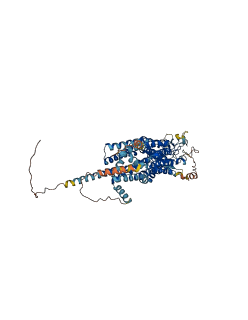
Descriptions
The autoinhibited protein was predicted that may have potential autoinhibitory elements via cis-regPred.
Autoinhibitory domains (AIDs)
Target domain |
|
Relief mechanism |
|
Assay |
cis-regPred |
Accessory elements
No accessory elements
Autoinhibited structure

Activated structure
1 structures for Q9JJL3
| Entry ID | Method | Resolution | Chain | Position | Source |
|---|---|---|---|---|---|
| AF-Q9JJL3-F1 | Predicted | AlphaFoldDB |
54 variants for Q9JJL3
| Variant ID(s) | Position | Change | Description | Diseaes Association | Provenance |
|---|---|---|---|---|---|
| rs3388866875 | 3 | Q>H | No | EVA | |
| rs3388869924 | 7 | P>L | No | EVA | |
| rs240725244 | 7 | P>S | No | EVA | |
| rs16786474 | 22 | C>G | No | EVA | |
| rs3397265974 | 51 | T>N | No | EVA | |
| rs3397490153 | 58 | D>V | No | EVA | |
| rs3397550927 | 67 | I>S | No | EVA | |
| rs3388874286 | 82 | V>A | No | EVA | |
| rs227246582 | 97 | T>I | No | EVA | |
| rs3388866705 | 111 | L>M | No | EVA | |
| rs3388866926 | 114 | F>L | No | EVA | |
| rs3388830862 | 117 | G>* | No | EVA | |
| rs3397561292 | 124 | E>D | No | EVA | |
| rs228483135 | 127 | I>F | No | EVA | |
| rs3397669606 | 130 | L>Q | No | EVA | |
| rs3412879644 | 205 | G>S | No | EVA | |
| rs232309724 | 217 | L>V | No | EVA | |
| rs3388848597 | 227 | K>M | No | EVA | |
| rs3388861698 | 231 | D>V | No | EVA | |
| rs233120177 | 256 | G>S | No | EVA | |
| rs3388861622 | 268 | S>F | No | EVA | |
| rs222492893 | 286 | K>E | No | EVA | |
| rs234065577 | 288 | S>P | No | EVA | |
| rs261316082 | 303 | V>M | No | EVA | |
| rs246452516 | 311 | K>R | No | EVA | |
| rs262365792 | 318 | T>A | No | EVA | |
| rs3397562094 | 336 | F>L | No | EVA | |
| rs242121252 | 365 | T>S | No | EVA | |
| rs3388861710 | 385 | M>I | No | EVA | |
| rs220443274 | 412 | M>I | No | EVA | |
| rs239679384 | 413 | A>T | No | EVA | |
| rs251163157 | 416 | F>L | No | EVA | |
| rs240370203 | 417 | Y>* | No | EVA | |
| rs221692069 | 417 | Y>H | No | EVA | |
| rs264515990 | 419 | S>L | No | EVA | |
| rs3397266026 | 454 | C>R | No | EVA | |
| rs3397359107 | 454 | C>Y | No | EVA | |
| rs3396723092 | 455 | N>K | No | EVA | |
| rs3388848647 | 463 | N>I | No | EVA | |
| rs3388866666 | 474 | V>A | No | EVA | |
| rs232416805 | 494 | M>I | No | EVA | |
| rs244687147 | 496 | I>T | No | EVA | |
| rs3388844439 | 508 | G>D | No | EVA | |
| rs3397265975 | 515 | S>* | No | EVA | |
| rs232466111 | 523 | R>K | No | EVA | |
| rs3388861621 | 526 | C>W | No | EVA | |
| rs3388861657 | 532 | F>L | No | EVA | |
| rs3388869044 | 534 | I>M | No | EVA | |
| rs223377636 | 596 | M>V | No | EVA | |
| rs221976504 | 626 | I>T | No | EVA | |
| rs253243846 | 626 | I>V | No | EVA | |
| rs3388874237 | 627 | A>S | No | EVA | |
| rs237079803 | 669 | P>S | No | EVA | |
| rs254221126 | 685 | S>N | No | EVA |
No associated diseases with Q9JJL3
3 GO annotations of cellular component
| Name | Definition |
|---|---|
| basolateral plasma membrane | The region of the plasma membrane that includes the basal end and sides of the cell. Often used in reference to animal polarized epithelial membranes, where the basal membrane is the part attached to the extracellular matrix, or in plant cells, where the basal membrane is defined with respect to the zygotic axis. |
| integral component of plasma membrane | The component of the plasma membrane consisting of the gene products and protein complexes having at least some part of their peptide sequence embedded in the hydrophobic region of the membrane. |
| plasma membrane | The membrane surrounding a cell that separates the cell from its external environment. It consists of a phospholipid bilayer and associated proteins. |
4 GO annotations of molecular function
| Name | Definition |
|---|---|
| bile acid transmembrane transporter activity | Enables the transfer of bile acid from one side of a membrane to the other. Bile acids are any of a group of steroid carboxylic acids occurring in bile, where they are present as the sodium salts of their amides with glycine or taurine. |
| oligopeptide transmembrane transporter activity | Enables the transfer of oligopeptides from one side of a membrane to the other. Oligopeptides are molecules that contain a small number (2 to 20) of amino-acid residues connected by peptide linkages. |
| organic anion transmembrane transporter activity | Enables the transfer of organic anions from one side of a membrane to the other. Organic anions are atoms or small molecules with a negative charge which contain carbon in covalent linkage. |
| sodium-independent organic anion transmembrane transporter activity | Enables the transfer of organic anions from one side of a membrane to the other, in a sodium independent manner. |
10 GO annotations of biological process
| Name | Definition |
|---|---|
| bile acid and bile salt transport | The directed movement of bile acid and bile salts into, out of or within a cell, or between cells, by means of some agent such as a transporter or pore. |
| liver development | The process whose specific outcome is the progression of the liver over time, from its formation to the mature structure. The liver is an exocrine gland which secretes bile and functions in metabolism of protein and carbohydrate and fat, synthesizes substances involved in the clotting of the blood, synthesizes vitamin A, detoxifies poisonous substances, stores glycogen, and breaks down worn-out erythrocytes. |
| oligopeptide transport | The directed movement of oligopeptides into, out of or within a cell, or between cells, by means of some agent such as a transporter or pore. Oligopeptides are molecules that contain a small number (2 to 20) of amino-acid residues connected by peptide linkages. |
| response to antibiotic | Any process that results in a change in state or activity of a cell or an organism (in terms of movement, secretion, enzyme production, gene expression, etc.) as a result of an antibiotic stimulus. An antibiotic is a chemical substance produced by a microorganism which has the capacity to inhibit the growth of or to kill other microorganisms. |
| response to cytokine | Any process that results in a change in state or activity of a cell or an organism (in terms of movement, secretion, enzyme production, gene expression, etc.) as a result of a cytokine stimulus. |
| response to glucocorticoid | Any process that results in a change in state or activity of a cell or an organism (in terms of movement, secretion, enzyme production, gene expression, etc.) as a result of a glucocorticoid stimulus. Glucocorticoids are hormonal C21 corticosteroids synthesized from cholesterol with the ability to bind with the cortisol receptor and trigger similar effects. Glucocorticoids act primarily on carbohydrate and protein metabolism, and have anti-inflammatory effects. |
| response to lipopolysaccharide | Any process that results in a change in state or activity of an organism (in terms of movement, secretion, enzyme production, gene expression, etc.) as a result of a lipopolysaccharide stimulus; lipopolysaccharide is a major component of the cell wall of gram-negative bacteria. |
| response to peptide hormone | Any process that results in a change in state or activity of a cell or an organism (in terms of movement, secretion, enzyme production, gene expression, etc.) as a result of a peptide hormone stimulus. A peptide hormone is any of a class of peptides that are secreted into the blood stream and have endocrine functions in living animals. |
| response to xenobiotic stimulus | Any process that results in a change in state or activity of a cell or an organism (in terms of movement, secretion, enzyme production, gene expression, etc.) as a result of a stimulus from a xenobiotic, a compound foreign to the organim exposed to it. It may be synthesized by another organism (like ampicilin) or it can be a synthetic chemical. |
| sodium-independent organic anion transport | The directed, sodium-independent, movement of organic anions into, out of or within a cell, or between cells, by means of some agent such as a transporter or pore. |
3 homologous proteins in AiPD
| UniProt AC | Gene Name | Protein Name | Species | Evidence Code |
|---|---|---|---|---|
| O94956 | SLCO2B1 | Solute carrier organic anion transporter family member 2B1 | Homo sapiens (Human) | PR |
| Q9NPD5 | SLCO1B3 | Solute carrier organic anion transporter family member 1B3 | Homo sapiens (Human) | PR |
| Q9QZX8 | Slco1b2 | Solute carrier organic anion transporter family member 1B2 | Rattus norvegicus (Rat) | PR |
| 10 | 20 | 30 | 40 | 50 | 60 |
| MDQTQHPSKA | AQPLRSEKTR | HCDGFRIFLA | ALSFSYICKA | LGGVIMKSSI | TQIERRFDIP |
| 70 | 80 | 90 | 100 | 110 | 120 |
| SSISGLIDGG | FEIGNLLVIV | FVSYFGSKLH | RPKLIGTGCF | IMGIGSILTA | LPHFFMGYYR |
| 130 | 140 | 150 | 160 | 170 | 180 |
| YATENDISSL | HNSTLTCLVN | QTTSLTGTSP | EIMEKGCEKG | SNSYTWIYVL | MGNMLRGIGE |
| 190 | 200 | 210 | 220 | 230 | 240 |
| TPIVPLGVSY | IDDFAKEGNS | SMYLGTLHTI | AMIGPILGFI | MSSVFAKLYV | DVGYVDLRSV |
| 250 | 260 | 270 | 280 | 290 | 300 |
| RITPQDARWV | GAWWLGFIVN | GLLCIICSIP | FFFLPKIPKR | SQKERKNSAS | LHVLKTDEDK |
| 310 | 320 | 330 | 340 | 350 | 360 |
| NPVTNPTTQE | KQAPANLTGF | LWSLRSILTN | EQYVIFLILT | LLQISSFIGS | FTYLFKFIEQ |
| 370 | 380 | 390 | 400 | 410 | 420 |
| QFGQTASQAN | FLLGVITIPT | MASGMFLGGY | LIKRLKLTLL | GITKFVFFTT | TMAYVFYLSY |
| 430 | 440 | 450 | 460 | 470 | 480 |
| FLLICENKAF | AGLTLTYDGM | NPVDSHIDVP | LSYCNSDCIC | DKNQWEPVCG | ENGVTYISPC |
| 490 | 500 | 510 | 520 | 530 | 540 |
| LAGCKSFRGD | KKLMNIEFYD | CSCVSGSGFQ | KGNHSARLGE | CPRDKCKTKY | YFYITFQVII |
| 550 | 560 | 570 | 580 | 590 | 600 |
| SFFTALGSTS | LMLILIRSVQ | PELKSLGMGF | HSLVVRTLGG | ILAPVYYGAL | IDRTCMKWSV |
| 610 | 620 | 630 | 640 | 650 | 660 |
| TSCGARGACR | LYNSRLFGMI | YVGLSIALKT | PILLLYVALI | YVMKRKMKRN | DNKILENGRK |
| 670 | 680 | ||||
| FTDEGNPEPV | NNNGYSCVPS | DEKNSETPL |