Q9JI44
Gene name |
Dmap1 (Mmtr) |
Protein name |
DNA methyltransferase 1-associated protein 1 |
Names |
DNMAP1, DNMT1-associated protein 1, MAT1-mediated transcriptional repressor |
Species |
Mus musculus (Mouse) |
KEGG Pathway |
mmu:66233 |
EC number |
|
Protein Class |
|
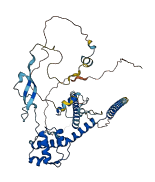
Descriptions
The autoinhibited protein was predicted that may have potential autoinhibitory elements via cis-regPred.
Autoinhibitory domains (AIDs)
Target domain |
|
Relief mechanism |
|
Assay |
cis-regPred |
Accessory elements
No accessory elements
Autoinhibited structure

Activated structure
1 structures for Q9JI44
| Entry ID | Method | Resolution | Chain | Position | Source |
|---|---|---|---|---|---|
| AF-Q9JI44-F1 | Predicted | AlphaFoldDB |
20 variants for Q9JI44
| Variant ID(s) | Position | Change | Description | Diseaes Association | Provenance |
|---|---|---|---|---|---|
| rs3388700617 | 10 | I>N | No | EVA | |
| rs3388711816 | 47 | F>L | No | EVA | |
| rs3388711769 | 92 | V>I | No | EVA | |
| rs3388709683 | 118 | A>P | No | EVA | |
| rs3388711745 | 148 | H>Q | No | EVA | |
| rs3388705681 | 191 | L>M | No | EVA | |
| rs3388709632 | 208 | V>M | No | EVA | |
| rs3388705296 | 224 | R>I | No | EVA | |
| rs3413127668 | 232 | R>W | No | EVA | |
| rs3388699570 | 276 | D>H | No | EVA | |
| rs3388707153 | 312 | F>C | No | EVA | |
| rs3388697604 | 372 | V>M | No | EVA | |
| rs3388711746 | 383 | N>I | No | EVA | |
| rs3388703954 | 390 | M>I | No | EVA | |
| rs3394747098 | 394 | R>Q | No | EVA | |
| rs3394725308 | 396 | E>* | No | EVA | |
| rs3394725323 | 399 | A>P | No | EVA | |
| rs3388693776 | 405 | G>E | No | EVA | |
| rs3394211960 | 444 | P>S | No | EVA | |
| rs3388711762 | 452 | R>G | No | EVA |
No associated diseases with Q9JI44
8 GO annotations of cellular component
| Name | Definition |
|---|---|
| cytoplasm | The contents of a cell excluding the plasma membrane and nucleus, but including other subcellular structures. |
| cytosol | The part of the cytoplasm that does not contain organelles but which does contain other particulate matter, such as protein complexes. |
| NuA4 histone acetyltransferase complex | A complex having histone acetylase activity on chromatin, as well as ATPase, DNA helicase and structural DNA binding activities. The complex is thought to be involved in double-strand DNA break repair. Subunits of the human complex include HTATIP/TIP60, TRRAP, RUVBL1, BUVBL2, beta-actin and BAF53/ACTL6A. In yeast, the complex has 13 subunits, including the catalytic subunit Esa1 (homologous to human Tip60). |
| nucleoplasm | That part of the nuclear content other than the chromosomes or the nucleolus. |
| nucleosome | A complex comprised of DNA wound around a multisubunit core and associated proteins, which forms the primary packing unit of DNA into higher order structures. |
| nucleus | A membrane-bounded organelle of eukaryotic cells in which chromosomes are housed and replicated. In most cells, the nucleus contains all of the cell's chromosomes except the organellar chromosomes, and is the site of RNA synthesis and processing. In some species, or in specialized cell types, RNA metabolism or DNA replication may be absent. |
| replication fork | The Y-shaped region of a replicating DNA molecule, resulting from the separation of the DNA strands and in which the synthesis of new strands takes place. Also includes associated protein complexes. |
| Swr1 complex | A multisubunit protein complex that is involved in chromatin remodeling. It is required for the incorporation of the histone variant H2AZ into chromatin. In S. cerevisiae, the complex contains Swr1p, a Swi2/Snf2-related ATPase, and 12 additional subunits. |
2 GO annotations of molecular function
| Name | Definition |
|---|---|
| RNA polymerase II-specific DNA-binding transcription factor binding | Binding to a sequence-specific DNA binding RNA polymerase II transcription factor, any of the factors that interact selectively and non-covalently with a specific DNA sequence in order to modulate transcription. |
| transcription corepressor activity | A transcription coregulator activity that represses or decreases the transcription of specific gene sets via binding to a DNA-bound DNA-binding transcription factor, either on its own or as part of a complex. Corepressors often act by altering chromatin structure and modifications. For example, one class of transcription corepressors modifies chromatin structure through covalent modification of histones. A second class remodels the conformation of chromatin in an ATP-dependent fashion. A third class modulates interactions of DNA-bound DNA-binding transcription factors with other transcription coregulators. |
14 GO annotations of biological process
| Name | Definition |
|---|---|
| DNA repair | The process of restoring DNA after damage. Genomes are subject to damage by chemical and physical agents in the environment (e.g. UV and ionizing radiations, chemical mutagens, fungal and bacterial toxins, etc.) and by free radicals or alkylating agents endogenously generated in metabolism. DNA is also damaged because of errors during its replication. A variety of different DNA repair pathways have been reported that include direct reversal, base excision repair, nucleotide excision repair, photoreactivation, bypass, double-strand break repair pathway, and mismatch repair pathway. |
| histone acetylation | The modification of a histone by the addition of an acetyl group. |
| histone exchange | The replacement, within chromatin, of resident histones or histone subunits with alternative, sometimes variant, histones or subunits. |
| histone H2A acetylation | The modification of histone H2A by the addition of an acetyl group. |
| histone H4 acetylation | The modification of histone H4 by the addition of an acetyl group. |
| negative regulation of transcription by RNA polymerase II | Any process that stops, prevents, or reduces the frequency, rate or extent of transcription mediated by RNA polymerase II. |
| positive regulation of DNA-templated transcription | Any process that activates or increases the frequency, rate or extent of cellular DNA-templated transcription. |
| positive regulation of double-strand break repair via homologous recombination | Any process that activates or increases the frequency, rate or extent of double-strand break repair via homologous recombination. |
| positive regulation of protein import into nucleus | Any process that activates or increases the frequency, rate or extent of movement of proteins from the cytoplasm into the nucleus. |
| regulation of apoptotic process | Any process that modulates the occurrence or rate of cell death by apoptotic process. |
| regulation of cell cycle | Any process that modulates the rate or extent of progression through the cell cycle. |
| regulation of DNA-templated transcription | Any process that modulates the frequency, rate or extent of cellular DNA-templated transcription. |
| regulation of double-strand break repair | Any process that modulates the frequency, rate or extent of double-strand break repair. |
| response to ethanol | Any process that results in a change in state or activity of a cell or an organism (in terms of movement, secretion, enzyme production, gene expression, etc.) as a result of an ethanol stimulus. |
1 homologous proteins in AiPD
| UniProt AC | Gene Name | Protein Name | Species | Evidence Code |
|---|---|---|---|---|
| Q9NPF5 | DMAP1 | DNA methyltransferase 1-associated protein 1 | Homo sapiens (Human) | PR |
| 10 | 20 | 30 | 40 | 50 | 60 |
| MATGADVRDI | LELGGPEGDA | ASGTISKKDI | INPDKKKSKK | SSETLTFKRP | EGMHREVYAL |
| 70 | 80 | 90 | 100 | 110 | 120 |
| LYSDKKDAPP | LLPSDTGQGY | RTVKAKLGSK | KVRPWKWMPF | TNPARKDGAM | FFHWRRAAEE |
| 130 | 140 | 150 | 160 | 170 | 180 |
| GKDYPFARFN | KTVQVPVYSE | QEYQLYLHDD | AWTKAETDHL | FDLSRRFDLR | FVVIHDRYDH |
| 190 | 200 | 210 | 220 | 230 | 240 |
| QQFKKRSVED | LKERYYHICA | KLANVRAVPG | TDLKIPVFDA | GHERRRKEQL | ERLYNRTPEQ |
| 250 | 260 | 270 | 280 | 290 | 300 |
| VAEEEYLLQE | LRKIEARKKE | REKRSQDLQK | LITAADTTAE | QRRTERKAPK | KKLPQKKEAE |
| 310 | 320 | 330 | 340 | 350 | 360 |
| KPAVPETAGI | KFPDFKSAGV | TLRSQRMKLP | SSVGQKKIKA | LEQMLLELGV | ELSPTPTEEL |
| 370 | 380 | 390 | 400 | 410 | 420 |
| VHMFNELRSD | LVLLYELKQA | CANCEYELQM | LRHRHEALAR | AGVLGAPAAA | AVGPTPASAE |
| 430 | 440 | 450 | 460 | ||
| PTVSESGLGL | DPTKDTIIDV | VGAPLTPNSR | KRRESASSSS | SVKKAKKP |