Q9JHJ0
Gene name |
Tmod3 |
Protein name |
Tropomodulin-3 |
Names |
Ubiquitous tropomodulin, U-Tmod |
Species |
Mus musculus (Mouse) |
KEGG Pathway |
mmu:50875 |
EC number |
|
Protein Class |
|
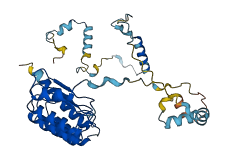
Descriptions
The autoinhibited protein was predicted that may have potential autoinhibitory elements via cis-regPred.
Autoinhibitory domains (AIDs)
Target domain |
|
Relief mechanism |
|
Assay |
cis-regPred |
Accessory elements
No accessory elements
Autoinhibited structure

Activated structure
1 structures for Q9JHJ0
| Entry ID | Method | Resolution | Chain | Position | Source |
|---|---|---|---|---|---|
| AF-Q9JHJ0-F1 | Predicted | AlphaFoldDB |
15 variants for Q9JHJ0
| Variant ID(s) | Position | Change | Description | Diseaes Association | Provenance |
|---|---|---|---|---|---|
| rs3413039319 | 2 | A>V | No | EVA | |
| rs3389056503 | 8 | D>* | No | EVA | |
| rs3389051276 | 9 | L>V | No | EVA | |
| rs3400447873 | 66 | R>G | No | EVA | |
| rs251923530 | 84 | D>E | No | EVA | |
| rs3389061311 | 130 | E>* | No | EVA | |
| rs3389066918 | 134 | L>I | No | EVA | |
| rs3389062619 | 151 | D>V | No | EVA | |
| rs3389066885 | 159 | V>L | No | EVA | |
| rs226455023 | 160 | N>S | No | EVA | |
| rs3389061296 | 201 | V>I | No | EVA | |
| rs3389056516 | 243 | V>E | No | EVA | |
| rs32961538 | 270 | A>T | No | EVA | |
| rs32961536 | 286 | M>V | No | EVA | |
| rs3389004925 | 353 | Q>E | No | EVA |
No associated diseases with Q9JHJ0
No regional properties for Q9JHJ0
| Type | Name | Position | InterPro Accession |
|---|---|---|---|
| No domain, repeats, and functional sites for Q9JHJ0 | |||
6 GO annotations of cellular component
| Name | Definition |
|---|---|
| cytoskeleton | A cellular structure that forms the internal framework of eukaryotic and prokaryotic cells. The cytoskeleton includes intermediate filaments, microfilaments, microtubules, the microtrabecular lattice, and other structures characterized by a polymeric filamentous nature and long-range order within the cell. The various elements of the cytoskeleton not only serve in the maintenance of cellular shape but also have roles in other cellular functions, including cellular movement, cell division, endocytosis, and movement of organelles. |
| filamentous actin | A two-stranded helical polymer of the protein actin. |
| lamellipodium | A thin sheetlike process extended by the leading edge of a migrating cell or extending cell process; contains a dense meshwork of actin filaments. |
| myofibril | The contractile element of skeletal and cardiac muscle; a long, highly organized bundle of actin, myosin, and other proteins that contracts by a sliding filament mechanism. |
| ruffle | Projection at the leading edge of a crawling cell; the protrusions are supported by a microfilament meshwork. |
| striated muscle thin filament | Filaments formed of actin and associated proteins; attached to Z discs at either end of sarcomeres in myofibrils. |
3 GO annotations of molecular function
| Name | Definition |
|---|---|
| actin binding | Binding to monomeric or multimeric forms of actin, including actin filaments. |
| microtubule minus-end binding | Binding to the minus end of a microtubule. |
| tropomyosin binding | Binding to tropomyosin, a protein associated with actin filaments both in cytoplasm and, in association with troponin, in the thin filament of striated muscle. |
8 GO annotations of biological process
| Name | Definition |
|---|---|
| actin cytoskeleton organization | A process that is carried out at the cellular level which results in the assembly, arrangement of constituent parts, or disassembly of cytoskeletal structures comprising actin filaments and their associated proteins. |
| actin filament organization | A process that is carried out at the cellular level which results in the assembly, arrangement of constituent parts, or disassembly of cytoskeletal structures comprising actin filaments. Includes processes that control the spatial distribution of actin filaments, such as organizing filaments into meshworks, bundles, or other structures, as by cross-linking. |
| erythrocyte development | The process whose specific outcome is the progression of an erythrocyte over time, from its formation to the mature structure. |
| mitotic cell cycle phase transition | The cell cycle process by which a cell commits to entering the next mitotic cell cycle phase. |
| muscle contraction | A process in which force is generated within muscle tissue, resulting in a change in muscle geometry. Force generation involves a chemo-mechanical energy conversion step that is carried out by the actin/myosin complex activity, which generates force through ATP hydrolysis. |
| myofibril assembly | Formation of myofibrils, the repeating units of striated muscle. |
| pointed-end actin filament capping | The binding of a protein or protein complex to the pointed (or minus) end of an actin filament, thus preventing the addition, exchange or removal of further actin subunits. |
| positive regulation of mitotic cell cycle phase transition | Any process that activates or increases the frequency, rate or extent of mitotic cell cycle phase transition. |
| 10 | 20 | 30 | 40 | 50 | 60 |
| MALPFRKDLG | DYKDLDEDEL | LGKLSESELK | QLETVLDDLD | PENALLPAGF | RQKNQTSKSA |
| 70 | 80 | 90 | 100 | 110 | 120 |
| TGPFDRERLL | SYLEKQALEH | KDRDDYVPYT | GEKKGKIFIP | KQKPAQTLTE | ETISLDPELE |
| 130 | 140 | 150 | 160 | 170 | 180 |
| EALTSASDTE | LCDLAAILGM | HNLIADTPFC | DVLGSSNGVN | QERFPNVVKG | EKILPVFDEP |
| 190 | 200 | 210 | 220 | 230 | 240 |
| PNPTNVEESL | KRIRENDARL | VEVNLNNIKN | IPIPTLKDFA | KTLEANTHVK | HFSLAATRSN |
| 250 | 260 | 270 | 280 | 290 | 300 |
| DPVAVAFADM | LKVNKTLKSL | NMESNFITGA | GVLALIDALR | DNETLMELKI | DNQRQQLGTS |
| 310 | 320 | 330 | 340 | 350 | |
| VELEMAKMLE | ENTNILKFGY | QFTQQGPRTR | AANAITKNND | LVRKRRIEGD | HQ |