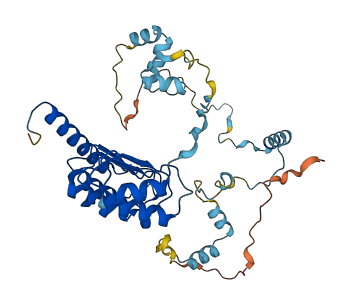
Descriptions
The autoinhibited protein was predicted that may have potential autoinhibitory elements via cis-regPred.
Autoinhibitory domains (AIDs)
Target domain |
|
Relief mechanism |
|
Assay |
cis-regPred |
Accessory elements
No accessory elements
Autoinhibited structure

Activated structure
2 structures for O01479
| Entry ID | Method | Resolution | Chain | Position | Source |
|---|---|---|---|---|---|
| 1PGV | X-ray | 180 A | A | 199-392 | PDB |
| AF-O01479-F1 | Predicted | AlphaFoldDB |
No variants for O01479
| Variant ID(s) | Position | Change | Description | Diseaes Association | Provenance |
|---|---|---|---|---|---|
| No variants for O01479 | |||||
No associated diseases with O01479
1 regional properties for O01479
| Type | Name | Position | InterPro Accession |
|---|---|---|---|
| active_site | Ribonuclease T2, His active site 1 | 57 - 64 | IPR018188 |
5 GO annotations of cellular component
| Name | Definition |
|---|---|
| cytoplasm | The contents of a cell excluding the plasma membrane and nucleus, but including other subcellular structures. |
| cytoskeleton | A cellular structure that forms the internal framework of eukaryotic and prokaryotic cells. The cytoskeleton includes intermediate filaments, microfilaments, microtubules, the microtrabecular lattice, and other structures characterized by a polymeric filamentous nature and long-range order within the cell. The various elements of the cytoskeleton not only serve in the maintenance of cellular shape but also have roles in other cellular functions, including cellular movement, cell division, endocytosis, and movement of organelles. |
| myofibril | The contractile element of skeletal and cardiac muscle; a long, highly organized bundle of actin, myosin, and other proteins that contracts by a sliding filament mechanism. |
| striated muscle thin filament | Filaments formed of actin and associated proteins; attached to Z discs at either end of sarcomeres in myofibrils. |
| terminal web | An actin-rich cytoskeletal network located beneath the microvilli of the apical plasma membrane of polarized epithelial cells. In addition to actin filaments, the terminal web may contain actin-binding proteins, myosin motor proteins, and intermediate filaments. The terminal web can function as a contractile structure that influences the spatial distribution of microvilli as well as the development and morphogenesis of tissues containing polarized epithelial cells. |
2 GO annotations of molecular function
| Name | Definition |
|---|---|
| actin filament binding | Binding to an actin filament, also known as F-actin, a helical filamentous polymer of globular G-actin subunits. |
| tropomyosin binding | Binding to tropomyosin, a protein associated with actin filaments both in cytoplasm and, in association with troponin, in the thin filament of striated muscle. |
9 GO annotations of biological process
| Name | Definition |
|---|---|
| actin filament organization | A process that is carried out at the cellular level which results in the assembly, arrangement of constituent parts, or disassembly of cytoskeletal structures comprising actin filaments. Includes processes that control the spatial distribution of actin filaments, such as organizing filaments into meshworks, bundles, or other structures, as by cross-linking. |
| embryo development ending in birth or egg hatching | The process whose specific outcome is the progression of an embryo over time, from zygote formation until the end of the embryonic life stage. The end of the embryonic life stage is organism-specific and may be somewhat arbitrary; for mammals it is usually considered to be birth, for insects the hatching of the first instar larva from the eggshell. |
| locomotion | Self-propelled movement of a cell or organism from one location to another. |
| muscle thin filament assembly | The aggregation, arrangement and bonding together of proteins to form the actin-based thin filaments of myofibrils in striated muscle. |
| myofibril assembly | Formation of myofibrils, the repeating units of striated muscle. |
| negative regulation of actin filament depolymerization | Any process that stops, prevents, or reduces the frequency, rate or extent of actin depolymerization. |
| nematode larval development | The process whose specific outcome is the progression of the nematode larva over time, from its formation to the mature structure. Nematode larval development begins with the newly hatched first-stage larva (L1) and ends with the end of the last larval stage (for example the fourth larval stage (L4) in C. elegans). Each stage of nematode larval development is characterized by proliferation of specific cell lineages and an increase in body size without alteration of the basic body plan. Nematode larval stages are separated by molts in which each stage-specific exoskeleton, or cuticle, is shed and replaced anew. |
| pointed-end actin filament capping | The binding of a protein or protein complex to the pointed (or minus) end of an actin filament, thus preventing the addition, exchange or removal of further actin subunits. |
| sarcomere organization | The myofibril assembly process that results in the organization of muscle actomyosin into sarcomeres. The sarcomere is the repeating unit of a myofibril in a muscle cell, composed of an array of overlapping thick and thin filaments between two adjacent Z discs. |
| 10 | 20 | 30 | 40 | 50 | 60 |
| MSQAKTDYYS | EEKTFSAPSA | NSQQGTQLPS | KVYNKGLKDL | EDNDIEGLLS | SLSIDELEDL |
| 70 | 80 | 90 | 100 | 110 | 120 |
| NNDFDPDNSM | LPPSQRCRDQ | TDKEPTGPYK | RDNLLKFLED | KAKTEKDWED | VCPYTPGQKR |
| 130 | 140 | 150 | 160 | 170 | 180 |
| GKVYDSDSGR | NSEEPENGKM | EMPIEIDLDD | DEEELECALV | TAPEKDLVDL | AGILGMHNVL |
| 190 | 200 | 210 | 220 | 230 | 240 |
| NQPQYYNALK | GKTQDESTGT | TFNGIMQSYV | PRIVPDEPDN | DTDVESCINR | LREDDTDLKE |
| 250 | 260 | 270 | 280 | 290 | 300 |
| VNINNMKRVS | KERIRSLIEA | ACNSKHIEKF | SLANTAISDS | EARGLIELIE | TSPSLRVLNV |
| 310 | 320 | 330 | 340 | 350 | 360 |
| ESNFLTPELL | ARLLRSTLVT | QSIVEFKADN | QRQSVLGNQV | EMDMMMAIEE | NESLLRVGIS |
| 370 | 380 | 390 | |||
| FASMEARHRV | SEALERNYER | VRLRRLGKDP | NV |