Q9FN29
Gene name |
ATHB-52 (At5g53980, K19P17.15) |
Protein name |
Homeobox-leucine zipper protein ATHB-52 |
Names |
HD-ZIP protein ATHB-52, Homeodomain transcription factor ATHB-52 |
Species |
Arabidopsis thaliana (Mouse-ear cress) |
KEGG Pathway |
ath:AT5G53980 |
EC number |
|
Protein Class |
|
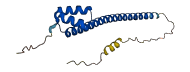
Descriptions
The autoinhibited protein was predicted that may have potential autoinhibitory elements via cis-regPred.
Autoinhibitory domains (AIDs)
Target domain |
|
Relief mechanism |
|
Assay |
cis-regPred |
Accessory elements
No accessory elements
Autoinhibited structure

Activated structure
1 structures for Q9FN29
| Entry ID | Method | Resolution | Chain | Position | Source |
|---|---|---|---|---|---|
| AF-Q9FN29-F1 | Predicted | AlphaFoldDB |
15 variants for Q9FN29
| Variant ID(s) | Position | Change | Description | Diseaes Association | Provenance |
|---|---|---|---|---|---|
| tmp_5_21914103_G_C | 6 | S>T | No | 1000Genomes | |
| ENSVATH07413522 | 8 | G>S | No | 1000Genomes | |
| ENSVATH00732701 | 22 | Q>K | No | 1000Genomes | |
| ENSVATH00732704 | 63 | F>S | No | 1000Genomes | |
| ENSVATH00732706 | 79 | H>L | No | 1000Genomes | |
| ENSVATH03424271 | 80 | E>K | No | 1000Genomes | |
| ENSVATH12750034 | 86 | K>N | No | 1000Genomes | |
| ENSVATH07413524 | 103 | A>T | No | 1000Genomes | |
| tmp_5_21914411_C_A | 109 | L>M | No | 1000Genomes | |
| tmp_5_21914414_T_C | 110 | F>L | No | 1000Genomes | |
| ENSVATH07413525 | 117 | V>F | No | 1000Genomes | |
| ENSVATH12750076 | 124 | S>Y | No | 1000Genomes | |
| ENSVATH12750077 | 134 | V>L | No | 1000Genomes | |
| ENSVATH00732708 | 146 | N>S | No | 1000Genomes | |
| ENSVATH12750078 | 149 | G>E | No | 1000Genomes |
6 associated diseases with Q9FN29
[MIM: 192600]: Cardiomyopathy, familial hypertrophic, 1 (CMH1)
A hereditary heart disorder characterized by ventricular hypertrophy, which is usually asymmetric and often involves the interventricular septum. The symptoms include dyspnea, syncope, collapse, palpitations, and chest pain. They can be readily provoked by exercise. The disorder has inter- and intrafamilial variability ranging from benign to malignant forms with high risk of cardiac failure and sudden cardiac death. . Note=The disease is caused by variants affecting the gene represented in this entry.
[MIM: 608358]: Congenital myopathy 7A, myosin storage, autosomal dominant (CMYP7A)
A skeletal muscle disorder characterized by prominent axial and proximal weakening, spinal stiffness, severe scoliosis, with or without respiratory and cardiac involvement. The age at symptom onset can range from early childhood to late adulthood, and disease severity ranges from asymptomatic to severe muscular weakness and respiratory insufficiency. Histopathological examination shows variable findings including subsarcolemmal hyaline bodies in type 1 fibers. . Note=The disease is caused by variants affecting the gene represented in this entry.
[MIM: 613426]: Cardiomyopathy, dilated, 1S (CMD1S)
A disorder characterized by ventricular dilation and impaired systolic function, resulting in congestive heart failure and arrhythmia. Patients are at risk of premature death. . Note=The disease is caused by variants affecting the gene represented in this entry.
[MIM: 160500]: Myopathy, distal, 1 (MPD1)
A muscular disorder characterized by early-onset selective weakness of the great toe and ankle dorsiflexors, followed by weakness of the finger extensors. Mild proximal weakness occasionally develops years later after the onset of the disease. . Note=The disease is caused by variants affecting the gene represented in this entry.
[MIM: 255160]: Congenital myopathy 7B, myosin storage, autosomal recessive (CMYP7B)
A skeletal muscle disorder characterized by the onset of scapuloperoneal muscle weakness in early childhood or young adulthood. Affected individuals have difficulty walking, steppage gait, and scapular winging due to shoulder girdle involvement. The severity and progression of the disorder is highly variable. Most patients develop respiratory insufficiency and restrictive lung disease. Some develop hypertrophic cardiomyopathy. Histopathological examination shows variable findings including subsarcolemmal hyaline bodies in type 1 fibers. . Note=The disease is caused by variants affecting the gene represented in this entry.
[MIM: 613426]: Left ventricular non-compaction 5 (LVNC5)
A form of left ventricular non-compaction, a cardiomyopathy due to myocardial morphogenesis arrest and characterized by a hypertrophic left ventricle, a severely thickened 2-layered myocardium, numerous prominent trabeculations, deep intertrabecular recesses, and poor systolic function. Clinical manifestations are variable. Some affected individuals experience no symptoms at all, others develop heart failure. In some cases, left ventricular non-compaction is associated with other congenital heart anomalies. LVNC5 is an autosomal dominant condition. . Note=The disease is caused by variants affecting distinct genetic loci, including the gene represented in this entry.
Without disease ID
- A hereditary heart disorder characterized by ventricular hypertrophy, which is usually asymmetric and often involves the interventricular septum. The symptoms include dyspnea, syncope, collapse, palpitations, and chest pain. They can be readily provoked by exercise. The disorder has inter- and intrafamilial variability ranging from benign to malignant forms with high risk of cardiac failure and sudden cardiac death. . Note=The disease is caused by variants affecting the gene represented in this entry.
- A skeletal muscle disorder characterized by prominent axial and proximal weakening, spinal stiffness, severe scoliosis, with or without respiratory and cardiac involvement. The age at symptom onset can range from early childhood to late adulthood, and disease severity ranges from asymptomatic to severe muscular weakness and respiratory insufficiency. Histopathological examination shows variable findings including subsarcolemmal hyaline bodies in type 1 fibers. . Note=The disease is caused by variants affecting the gene represented in this entry.
- A disorder characterized by ventricular dilation and impaired systolic function, resulting in congestive heart failure and arrhythmia. Patients are at risk of premature death. . Note=The disease is caused by variants affecting the gene represented in this entry.
- A muscular disorder characterized by early-onset selective weakness of the great toe and ankle dorsiflexors, followed by weakness of the finger extensors. Mild proximal weakness occasionally develops years later after the onset of the disease. . Note=The disease is caused by variants affecting the gene represented in this entry.
- A skeletal muscle disorder characterized by the onset of scapuloperoneal muscle weakness in early childhood or young adulthood. Affected individuals have difficulty walking, steppage gait, and scapular winging due to shoulder girdle involvement. The severity and progression of the disorder is highly variable. Most patients develop respiratory insufficiency and restrictive lung disease. Some develop hypertrophic cardiomyopathy. Histopathological examination shows variable findings including subsarcolemmal hyaline bodies in type 1 fibers. . Note=The disease is caused by variants affecting the gene represented in this entry.
- A form of left ventricular non-compaction, a cardiomyopathy due to myocardial morphogenesis arrest and characterized by a hypertrophic left ventricle, a severely thickened 2-layered myocardium, numerous prominent trabeculations, deep intertrabecular recesses, and poor systolic function. Clinical manifestations are variable. Some affected individuals experience no symptoms at all, others develop heart failure. In some cases, left ventricular non-compaction is associated with other congenital heart anomalies. LVNC5 is an autosomal dominant condition. . Note=The disease is caused by variants affecting distinct genetic loci, including the gene represented in this entry.
11 regional properties for Q9FN29
| Type | Name | Position | InterPro Accession |
|---|---|---|---|
| domain | Protein kinase domain | 696 - 951 | IPR000719 |
| domain | Immunoglobulin subtype | 335 - 419 | IPR003599-1 |
| domain | Immunoglobulin subtype | 475 - 559 | IPR003599-2 |
| domain | Immunoglobulin subtype | 1047 - 1132 | IPR003599-3 |
| domain | Fibronectin type III | 562 - 657 | IPR003961 |
| domain | Immunoglobulin-like domain | 329 - 417 | IPR007110-1 |
| domain | Immunoglobulin-like domain | 469 - 557 | IPR007110-2 |
| domain | Immunoglobulin-like domain | 1041 - 1130 | IPR007110-3 |
| active_site | Serine/threonine-protein kinase, active site | 813 - 825 | IPR008271 |
| domain | Myosin Light Chain Kinase 1, Kinase domain | 693 - 951 | IPR015725 |
| binding_site | Protein kinase, ATP binding site | 702 - 725 | IPR017441 |
1 GO annotations of cellular component
| Name | Definition |
|---|---|
| nucleus | A membrane-bounded organelle of eukaryotic cells in which chromosomes are housed and replicated. In most cells, the nucleus contains all of the cell's chromosomes except the organellar chromosomes, and is the site of RNA synthesis and processing. In some species, or in specialized cell types, RNA metabolism or DNA replication may be absent. |
4 GO annotations of molecular function
| Name | Definition |
|---|---|
| DNA-binding transcription factor activity | A transcription regulator activity that modulates transcription of gene sets via selective and non-covalent binding to a specific double-stranded genomic DNA sequence (sometimes referred to as a motif) within a cis-regulatory region. Regulatory regions include promoters (proximal and distal) and enhancers. Genes are transcriptional units, and include bacterial operons. |
| DNA-binding transcription factor activity, RNA polymerase II-specific | A DNA-binding transcription factor activity that modulates the transcription of specific gene sets transcribed by RNA polymerase II. |
| sequence-specific DNA binding | Binding to DNA of a specific nucleotide composition, e.g. GC-rich DNA binding, or with a specific sequence motif or type of DNA e.g. promotor binding or rDNA binding. |
| transcription cis-regulatory region binding | Binding to a specific sequence of DNA that is part of a regulatory region that controls transcription of that section of the DNA. The transcribed region might be described as a gene, cistron, or operon. |
3 GO annotations of biological process
| Name | Definition |
|---|---|
| positive regulation of DNA-templated transcription | Any process that activates or increases the frequency, rate or extent of cellular DNA-templated transcription. |
| response to absence of light | Any process that results in a change in state or activity of a cell or an organism (in terms of movement, secretion, enzyme production, gene expression, etc.) as a result of an absence of light stimuli. |
| response to blue light | Any process that results in a change in state or activity of a cell or an organism (in terms of movement, secretion, enzyme production, gene expression, etc.) as a result of a blue light stimulus. Blue light is electromagnetic radiation with a wavelength of between 440 and 500nm. |
20 homologous proteins in AiPD
| UniProt AC | Gene Name | Protein Name | Species | Evidence Code |
|---|---|---|---|---|
| P50577 | DLX5 | Homeobox protein DLX-5 | Gallus gallus (Chicken) | PR |
| Q03014 | HHEX | Hematopoietically-expressed homeobox protein HHEX | Homo sapiens (Human) | PR |
| O60479 | DLX3 | Homeobox protein DLX-3 | Homo sapiens (Human) | PR |
| P56179 | DLX6 | Homeobox protein DLX-6 | Homo sapiens (Human) | PR |
| O95076 | ALX3 | Homeobox protein aristaless-like 3 | Homo sapiens (Human) | PR |
| Q99801 | NKX3-1 | Homeobox protein Nkx-3.1 | Homo sapiens (Human) | PR |
| P70396 | Dlx5 | Homeobox protein DLX-5 | Mus musculus (Mouse) | PR |
| Q64205 | Dlx3 | Homeobox protein DLX-3 | Mus musculus (Mouse) | PR |
| P70397 | Dlx6 | Homeobox protein DLX-6 | Mus musculus (Mouse) | PR |
| P50575 | Dlx5 | Homeobox protein DLX-5 | Rattus norvegicus (Rat) | PR |
| Q6H6S3 | HOX24 | Homeobox-leucine zipper protein HOX24 | Oryza sativa subsp japonica (Rice) | PR |
| Q7XUJ5 | HOX22 | Homeobox-leucine zipper protein HOX22 | Oryza sativa subsp japonica (Rice) | PR |
| Q5VPE5 | HOX28 | Homeobox-leucine zipper protein HOX28 | Oryza sativa subsp japonica (Rice) | PR |
| A3BYC1 | HOX25 | Homeobox-leucine zipper protein HOX25 | Oryza sativa subsp japonica (Rice) | PR |
| P46603 | HAT9 | Homeobox-leucine zipper protein HAT9 | Arabidopsis thaliana (Mouse-ear cress) | PR |
| Q9M276 | ATHB-12 | Homeobox-leucine zipper protein ATHB-12 | Arabidopsis thaliana (Mouse-ear cress) | PR |
| Q98875 | dlx1a | Homeobox protein Dlx1a | Danio rerio (Zebrafish) (Brachydanio rerio) | PR |
| Q98878 | dlx4b | Homeobox protein Dlx4b | Danio rerio (Zebrafish) (Brachydanio rerio) | PR |
| P50574 | dlx2a | Homeobox protein Dlx2a | Danio rerio (Zebrafish) (Brachydanio rerio) | PR |
| Q01702 | dlx3b | Homeobox protein Dlx3b | Danio rerio (Zebrafish) (Brachydanio rerio) | PR |
| 10 | 20 | 30 | 40 | 50 | 60 |
| MENSQSQGKN | KKKRLTQDQV | RQLEKCFTMN | KKLEPDLKLQ | LSNQLGLPQR | QVAVWFQNKR |
| 70 | 80 | 90 | 100 | 110 | 120 |
| ARFKTQSLEV | QHCTLQSKHE | AALSDKAKLE | HQVQFLQDEL | KRARNQLALF | TNQDSPVDNS |
| 130 | 140 | 150 | |||
| NLGSCDEDHD | DQVVVFDELY | ACFVSNGHGS | SSTSWV |