Q9EP51
Gene name |
Vmn1r50 (V1ra5) |
Protein name |
Vomeronasal type-1 receptor 50 |
Names |
Pheromone receptor VN2, Vomeronasal receptor 2, Vomeronasal type-1 receptor A5, Vomeronasal type-1 receptor B1 |
Species |
Mus musculus (Mouse) |
KEGG Pathway |
mmu:113852 |
EC number |
|
Protein Class |
|
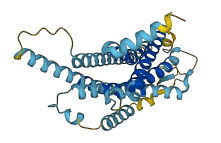
Descriptions
The autoinhibited protein was predicted that may have potential autoinhibitory elements via cis-regPred.
Autoinhibitory domains (AIDs)
Target domain |
|
Relief mechanism |
|
Assay |
cis-regPred |
Accessory elements
No accessory elements
Autoinhibited structure

Activated structure
1 structures for Q9EP51
| Entry ID | Method | Resolution | Chain | Position | Source |
|---|---|---|---|---|---|
| AF-Q9EP51-F1 | Predicted | AlphaFoldDB |
14 variants for Q9EP51
| Variant ID(s) | Position | Change | Description | Diseaes Association | Provenance |
|---|---|---|---|---|---|
| rs3388841197 | 14 | K>E | No | EVA | |
| rs3388837591 | 38 | K>E | No | EVA | |
| rs3388827707 | 51 | Y>* | No | EVA | |
| rs3388833952 | 108 | V>D | No | EVA | |
| rs3388837558 | 128 | S>F | No | EVA | |
| rs3388809247 | 138 | F>L | No | EVA | |
| rs3388849548 | 160 | S>A | No | EVA | |
| rs3388809256 | 176 | P>H | No | EVA | |
| rs3388851064 | 177 | V>M | No | EVA | |
| rs3388844606 | 207 | V>M | No | EVA | |
| rs3388822431 | 209 | V>F | No | EVA | |
| rs3388827735 | 223 | S>N | No | EVA | |
| rs3412641178 | 306 | R>G | No | EVA | |
| rs3388837537 | 309 | N>D | No | EVA |
No associated diseases with Q9EP51
1 regional properties for Q9EP51
| Type | Name | Position | InterPro Accession |
|---|---|---|---|
| domain | GPCR, rhodopsin-like, 7TM | 27 - 289 | IPR017452 |
2 GO annotations of cellular component
| Name | Definition |
|---|---|
| integral component of membrane | The component of a membrane consisting of the gene products and protein complexes having at least some part of their peptide sequence embedded in the hydrophobic region of the membrane. |
| plasma membrane | The membrane surrounding a cell that separates the cell from its external environment. It consists of a phospholipid bilayer and associated proteins. |
1 GO annotations of molecular function
| Name | Definition |
|---|---|
| pheromone receptor activity | Combining with a pheromone to initiate a change in cell activity. A pheromone is a substance used in olfactory communication between organisms of the same species eliciting a change in sexual or social behavior. |
2 GO annotations of biological process
| Name | Definition |
|---|---|
| response to pheromone | Any process that results in a change in state or activity of a cell or an organism (in terms of movement, secretion, enzyme production, gene expression, etc.) as a result of a pheromone stimulus. |
| sensory perception of chemical stimulus | The series of events required for an organism to receive a sensory chemical stimulus, convert it to a molecular signal, and recognize and characterize the signal. This is a neurological process. |
1 homologous proteins in AiPD
| UniProt AC | Gene Name | Protein Name | Species | Evidence Code |
|---|---|---|---|---|
| Q9WUF1 | Vmn1r49 | Vomeronasal type-1 receptor 49 | Mus musculus (Mouse) | PR |
| 10 | 20 | 30 | 40 | 50 | 60 |
| MSKANLLHTD | NNMKITLFSE | VSVGISANSI | LFVVHLCKLL | HENKPKPIDL | YIAFFSITQL |
| 70 | 80 | 90 | 100 | 110 | 120 |
| MLLITMGLIA | VDMFMPWGRW | DSTTCQSLIY | LHRLLRGLTF | CATCLLNVLW | TITLSPRSSC |
| 130 | 140 | 150 | 160 | 170 | 180 |
| LTKFKHKSPH | HISGAFLFFC | VLYMSFSSHL | LVSIIATFNS | TSDNFLYVTQ | SCSILPVSYS |
| 190 | 200 | 210 | 220 | 230 | 240 |
| RTSILSTMMT | MREAFLIGLM | ALSSGYVVVL | LWRHKKQARH | LHSTSLSSKA | SPEQRATSTI |
| 250 | 260 | 270 | 280 | 290 | 300 |
| MLLMGFFVVL | YILDTVIFQA | RLKFKDVSTF | FCVKIIISHS | YATFSPFVFI | CNDKYMIKFV |
| TSMCGRIVNV |