Q9DAR7
Gene name |
Dcps (Dcs1, Hint5) |
Protein name |
m7GpppX diphosphatase |
Names |
DCS-1, Decapping scavenger enzyme, Hint-related 7meGMP-directed hydrolase, Histidine triad nucleotide-binding protein 5, Histidine triad protein member 5, HINT-5, Scavenger mRNA-decapping enzyme DcpS |
Species |
Mus musculus (Mouse) |
KEGG Pathway |
mmu:69305 |
EC number |
3.6.1.59: In phosphorus-containing anhydrides |
Protein Class |
|
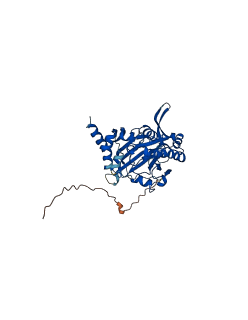
Descriptions
The autoinhibited protein was predicted that may have potential autoinhibitory elements via cis-regPred.
Autoinhibitory domains (AIDs)
Target domain |
|
Relief mechanism |
|
Assay |
cis-regPred |
Accessory elements
No accessory elements
Autoinhibited structure

Activated structure
2 structures for Q9DAR7
| Entry ID | Method | Resolution | Chain | Position | Source |
|---|---|---|---|---|---|
| 1VLR | X-ray | 183 A | A/B | 1-338 | PDB |
| AF-Q9DAR7-F1 | Predicted | AlphaFoldDB |
11 variants for Q9DAR7
| Variant ID(s) | Position | Change | Description | Diseaes Association | Provenance |
|---|---|---|---|---|---|
| rs241953505 | 74 | T>A | No | EVA | |
| rs257237522 | 93 | V>A | No | EVA | |
| rs3389026082 | 94 | A>V | No | EVA | |
| rs3389038449 | 103 | L>I | No | EVA | |
| rs36312673 | 148 | R>C | No | EVA | |
| rs3399970590 | 169 | S>R | No | EVA | |
| rs3388982570 | 172 | I>N | No | EVA | |
| rs3388982570 | 172 | I>S | No | EVA | |
| rs3389001163 | 223 | R>H | No | EVA | |
| rs245574704 | 254 | R>H | No | EVA | |
| rs3389006420 | 274 | H>N | No | EVA |
No associated diseases with Q9DAR7
1 regional properties for Q9DAR7
| Type | Name | Position | InterPro Accession |
|---|---|---|---|
| conserved_site | Histidine triad, conserved site | 263 - 281 | IPR019808 |
Functions
| Description | ||
|---|---|---|
| EC Number | 3.6.1.59 | In phosphorus-containing anhydrides |
| Subcellular Localization |
|
|
| PANTHER Family | ||
| PANTHER Subfamily | ||
| PANTHER Protein Class | ||
| PANTHER Pathway Category | No pathway information available | |
6 GO annotations of cellular component
| Name | Definition |
|---|---|
| cytoplasm | The contents of a cell excluding the plasma membrane and nucleus, but including other subcellular structures. |
| cytosol | The part of the cytoplasm that does not contain organelles but which does contain other particulate matter, such as protein complexes. |
| mitochondrion | A semiautonomous, self replicating organelle that occurs in varying numbers, shapes, and sizes in the cytoplasm of virtually all eukaryotic cells. It is notably the site of tissue respiration. |
| nucleoplasm | That part of the nuclear content other than the chromosomes or the nucleolus. |
| nucleus | A membrane-bounded organelle of eukaryotic cells in which chromosomes are housed and replicated. In most cells, the nucleus contains all of the cell's chromosomes except the organellar chromosomes, and is the site of RNA synthesis and processing. In some species, or in specialized cell types, RNA metabolism or DNA replication may be absent. |
| P-body | A focus in the cytoplasm where mRNAs may become inactivated by decapping or some other mechanism. Protein and RNA localized to these foci are involved in mRNA degradation, nonsense-mediated mRNA decay (NMD), translational repression, and RNA-mediated gene silencing. |
3 GO annotations of molecular function
| Name | Definition |
|---|---|
| identical protein binding | Binding to an identical protein or proteins. |
| m7G(5')pppN diphosphatase activity | Catalysis of the reaction: 7-methylguanosine 5'-triphospho-5'-polynucleotide + H2O = 7-methylguanosine 5'-phosphate + polynucleotide. |
| RNA 7-methylguanosine cap binding | Binding to a 7-methylguanosine group added cotranscriptionally to the 5' end of RNA molecules transcribed by polymerase II. |
5 GO annotations of biological process
| Name | Definition |
|---|---|
| cellular response to menadione | Any process that results in a change in state or activity of a cell (in terms of movement, secretion, enzyme production, gene expression, etc.) as a result of a menadione stimulus. Menadione (also called vitamin K3) is a naphthoquinone having a methyl substituent at the 2-position. |
| deadenylation-dependent decapping of nuclear-transcribed mRNA | Cleavage of the 5'-cap of a nuclear mRNA triggered by shortening of the poly(A) tail to below a minimum functional length. |
| methylguanosine-cap decapping | Cleavage of the 5'-methylguanosine-cap of an mRNA. The methylguanosine-cap is present at the 5'-end of eukaryotic mRNAs. Decapping inactivates translation initiation and promotes 5'-to-3' decay of mRNA. |
| mRNA cis splicing, via spliceosome | The joining together, after removal of an intervening sequence composed of one or more introns, of two segments of the same RNA molecule via spliceosomal catalysis to produce an mRNA composed only of exon sequences that all came from the same primary transcript. |
| negative regulation of programmed cell death | Any process that stops, prevents, or reduces the frequency, rate or extent of programmed cell death, cell death resulting from activation of endogenous cellular processes. |
1 homologous proteins in AiPD
| UniProt AC | Gene Name | Protein Name | Species | Evidence Code |
|---|---|---|---|---|
| Q8MIZ3 | DCPS | m7GpppX diphosphatase | Sus scrofa (Pig) | PR |
| 10 | 20 | 30 | 40 | 50 | 60 |
| MADTAPQLKR | KREQEAEEAE | TPSTEEKEAG | VGNGTSAPVR | LPFSGFRVQK | VLRESARDKI |
| 70 | 80 | 90 | 100 | 110 | 120 |
| IFLHGKVNED | SGDTHGEDAV | VILEKTPFQV | EHVAQLLTGS | PELKLQFSND | IYSTYNLFPP |
| 130 | 140 | 150 | 160 | 170 | 180 |
| RHLSDIKTTV | VYPATEKHLQ | KYMRQDLRLI | RETGDDYRTI | TLPYLESQSL | SIQWVYNILD |
| 190 | 200 | 210 | 220 | 230 | 240 |
| KKAEADRIVF | ENPDPSDGFV | LIPDLKWNQQ | QLDDLYLIAI | CHRRGIRSLR | DLTPEHLPLL |
| 250 | 260 | 270 | 280 | 290 | 300 |
| RNILREGQEA | ILKRYQVTGD | RLRVYLHYLP | SYYHLHVHFT | ALGFEAPGSG | VERAHLLAQV |
| 310 | 320 | 330 | |||
| IENLECDPKH | YQQRTLTFAL | RTDDPLLQLL | QKAQQERN |