Q9D8I2
Gene name |
P2yr13 (Gpr86) |
Protein name |
P2Y purinoceptor 13 |
Names |
P2Y13, G-protein coupled receptor 86 |
Species |
Mus musculus (Mouse) |
KEGG Pathway |
mmu:74191 |
EC number |
|
Protein Class |
|
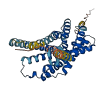
Descriptions
The autoinhibited protein was predicted that may have potential autoinhibitory elements via cis-regPred.
Autoinhibitory domains (AIDs)
Target domain |
|
Relief mechanism |
|
Assay |
cis-regPred |
Accessory elements
No accessory elements
Autoinhibited structure

Activated structure
1 structures for Q9D8I2
| Entry ID | Method | Resolution | Chain | Position | Source |
|---|---|---|---|---|---|
| AF-Q9D8I2-F1 | Predicted | AlphaFoldDB |
25 variants for Q9D8I2
| Variant ID(s) | Position | Change | Description | Diseaes Association | Provenance |
|---|---|---|---|---|---|
| rs3388623820 | 3 | G>V | No | EVA | |
| rs224459002 | 5 | I>V | No | EVA | |
| rs3388633737 | 6 | N>I | No | EVA | |
| rs3413019768 | 9 | G>W | No | EVA | |
| rs3388619760 | 37 | V>A | No | EVA | |
| rs3413025512 | 60 | T>S | No | EVA | |
| rs30110768 | 115 | M>V | No | EVA | |
| rs3388631374 | 124 | R>M | No | EVA | |
| rs245889515 | 136 | F>L | No | EVA | |
| rs3388631434 | 161 | N>S | No | EVA | |
| rs3388631586 | 180 | K>E | No | EVA | |
| rs3388634576 | 182 | P>S | No | EVA | |
| rs3388619698 | 187 | W>C | No | EVA | |
| rs3388628766 | 190 | V>L | No | EVA | |
| rs3388626780 | 197 | F>L | No | EVA | |
| rs3388619720 | 215 | K>R | No | EVA | |
| rs3388627125 | 218 | Y>H | No | EVA | |
| rs3388631965 | 219 | N>S | No | EVA | |
| rs259856593 | 229 | S>R | No | EVA | |
| rs3388633681 | 272 | L>F | No | EVA | |
| rs3388627157 | 277 | F>Y | No | EVA | |
| rs3388630687 | 281 | E>D | No | EVA | |
| rs3388623772 | 297 | I>K | No | EVA | |
| rs3388619728 | 313 | R>* | No | EVA | |
| rs228872342 | 325 | D>E | No | EVA |
No associated diseases with Q9D8I2
1 regional properties for Q9D8I2
| Type | Name | Position | InterPro Accession |
|---|---|---|---|
| domain | GPCR, rhodopsin-like, 7TM | 44 - 298 | IPR017452 |
3 GO annotations of cellular component
| Name | Definition |
|---|---|
| endoplasmic reticulum | The irregular network of unit membranes, visible only by electron microscopy, that occurs in the cytoplasm of many eukaryotic cells. The membranes form a complex meshwork of tubular channels, which are often expanded into slitlike cavities called cisternae. The ER takes two forms, rough (or granular), with ribosomes adhering to the outer surface, and smooth (with no ribosomes attached). |
| integral component of membrane | The component of a membrane consisting of the gene products and protein complexes having at least some part of their peptide sequence embedded in the hydrophobic region of the membrane. |
| plasma membrane | The membrane surrounding a cell that separates the cell from its external environment. It consists of a phospholipid bilayer and associated proteins. |
1 GO annotations of molecular function
| Name | Definition |
|---|---|
| G protein-coupled purinergic nucleotide receptor activity | Combining with a purine nucleotide and transmitting the signal across the membrane by activating an associated G-protein; promotes the exchange of GDP for GTP on the alpha subunit of a heterotrimeric G-protein complex. |
3 GO annotations of biological process
| Name | Definition |
|---|---|
| cellular response to organic cyclic compound | Any process that results in a change in state or activity of a cell (in terms of movement, secretion, enzyme production, gene expression, etc.) as a result of an organic cyclic compound stimulus. |
| G protein-coupled receptor signaling pathway | The series of molecular signals initiated by a ligand binding to its receptor, in which the activated receptor promotes the exchange of GDP for GTP on the alpha-subunit of an associated heterotrimeric G-protein complex. The GTP-bound activated alpha-G-protein then dissociates from the beta- and gamma-subunits to further transmit the signal within the cell. The pathway begins with receptor-ligand interaction, and ends with regulation of a downstream cellular process. The pathway can start from the plasma membrane, Golgi or nuclear membrane. |
| negative regulation of adenylate cyclase activity | Any process that stops, prevents, or reduces the frequency, rate or extent of adenylate cyclase activity. |
6 homologous proteins in AiPD
| UniProt AC | Gene Name | Protein Name | Species | Evidence Code |
|---|---|---|---|---|
| Q9H244 | P2RY12 | P2Y purinoceptor 12 | Homo sapiens (Human) | PR |
| Q9BPV8 | P2RY13 | P2Y purinoceptor 13 | Homo sapiens (Human) | PR |
| Q9UPC5 | GPR34 | Probable G-protein coupled receptor 34 | Homo sapiens (Human) | PR |
| Q9CPV9 | P2ry12 | P2Y purinoceptor 12 | Mus musculus (Mouse) | PR |
| Q6GUG4 | P2ry13 | P2Y purinoceptor 13 | Rattus norvegicus (Rat) | PR |
| Q9EPX4 | P2ry12 | P2Y purinoceptor 12 | Rattus norvegicus (Rat) | PR |
| 10 | 20 | 30 | 40 | 50 | 60 |
| MLGTINTTGM | QGFNKSERCP | RDTRMTQLLF | PVLYTVVFLA | GILLNTVALW | VFVHIPSNST |
| 70 | 80 | 90 | 100 | 110 | 120 |
| FIVYLKNTLV | ADLIMALMLP | FKILSDSHLA | PWQLRGFVCT | LSSVVFYETM | YVGIMMLGLI |
| 130 | 140 | 150 | 160 | 170 | 180 |
| AFDRFLKIIM | PFRKTFVKKT | AFAKTVSISV | WSLMFFISLP | NMILNKEATP | SSVKKCASLK |
| 190 | 200 | 210 | 220 | 230 | 240 |
| SPLGLWWHQV | VSHTCQFIFW | AVFILMLLFY | AVITKKVYNS | YRKFRSKDSR | HKRLEVKVFI |
| 250 | 260 | 270 | 280 | 290 | 300 |
| VMAVFFVCFA | PLHFVRIPYT | YSQTTNKTDC | RLENQLFIAK | EATLFLATTN | ICMDPLIYII |
| 310 | 320 | 330 | |||
| LCKKFTQKVP | CVRWGKARTA | GSSEDHHSSQ | TDNITLA |