Q9D7I8
Gene name |
Fam83d |
Protein name |
Protein FAM83D |
Names |
|
Species |
Mus musculus (Mouse) |
KEGG Pathway |
mmu:71878 |
EC number |
|
Protein Class |
|
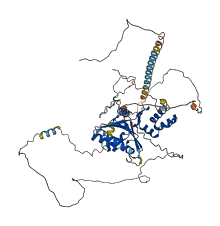
Descriptions
The autoinhibited protein was predicted that may have potential autoinhibitory elements via cis-regPred.
Autoinhibitory domains (AIDs)
Target domain |
|
Relief mechanism |
|
Assay |
cis-regPred |
Accessory elements
No accessory elements
Autoinhibited structure

Activated structure
1 structures for Q9D7I8
| Entry ID | Method | Resolution | Chain | Position | Source |
|---|---|---|---|---|---|
| AF-Q9D7I8-F1 | Predicted | AlphaFoldDB |
29 variants for Q9D7I8
| Variant ID(s) | Position | Change | Description | Diseaes Association | Provenance |
|---|---|---|---|---|---|
| rs3388610985 | 65 | V>M | No | EVA | |
| rs3388608609 | 89 | S>T | No | EVA | |
| rs3388605925 | 169 | D>Y | No | EVA | |
| rs3388610556 | 177 | Q>H | No | EVA | |
| rs27305376 | 194 | T>A | No | EVA | |
| rs3388609834 | 199 | F>L | No | EVA | |
| rs3388610952 | 199 | F>L | No | EVA | |
| rs218744423 | 207 | R>K | No | EVA | |
| rs3388599853 | 217 | T>R | No | EVA | |
| rs3388608819 | 293 | P>H | No | EVA | |
| rs3388603733 | 294 | I>L | No | EVA | |
| rs3388608824 | 297 | K>E | No | EVA | |
| rs3388607758 | 297 | K>T | No | EVA | |
| rs3388608682 | 321 | P>R | No | EVA | |
| rs27305323 | 348 | P>L | No | EVA | |
| rs3388605961 | 364 | T>I | No | EVA | |
| rs3388605922 | 367 | D>E | No | EVA | |
| rs3388608861 | 386 | A>D | No | EVA | |
| rs27305321 | 393 | R>G | No | EVA | |
| rs3410463626 | 417 | T>I | No | EVA | |
| rs3388608883 | 419 | T>S | No | EVA | |
| rs27305320 | 457 | G>E | No | EVA | |
| rs3388604967 | 463 | M>T | No | EVA | |
| rs3388603724 | 476 | S>Y | No | EVA | |
| rs3388594153 | 501 | P>T | No | EVA | |
| rs3388610525 | 502 | A>P | No | EVA | |
| rs3388602467 | 504 | P>L | No | EVA | |
| rs3388597864 | 542 | Q>* | No | EVA | |
| rs3388597859 | 569 | S>Y | No | EVA |
No associated diseases with Q9D7I8
5 regional properties for Q9D7I8
| Type | Name | Position | InterPro Accession |
|---|---|---|---|
| domain | Phenylalanyl-tRNA synthetase | 210 - 483 | IPR002319 |
| domain | Aminoacyl-tRNA synthetase, class II | 229 - 491 | IPR006195 |
| domain | PheRS DNA binding domain 2 | 134 - 165 | IPR040586 |
| domain | PheRS, DNA binding domain 1 | 3 - 61 | IPR040724 |
| domain | PheRS, DNA binding domain 3 | 75 - 132 | IPR040725 |
Functions
7 GO annotations of cellular component
| Name | Definition |
|---|---|
| cytoplasm | The contents of a cell excluding the plasma membrane and nucleus, but including other subcellular structures. |
| cytosol | The part of the cytoplasm that does not contain organelles but which does contain other particulate matter, such as protein complexes. |
| intercellular bridge | A direct connection between the cytoplasm of two cells that is formed following the completion of cleavage furrow ingression during cell division. They are usually present only briefly prior to completion of cytokinesis. However, in some cases, such as the bridges between germ cells during their development, they become stabilised. |
| microtubule cytoskeleton | The part of the cytoskeleton (the internal framework of a cell) composed of microtubules and associated proteins. |
| mitotic spindle | A spindle that forms as part of mitosis. Mitotic and meiotic spindles contain distinctive complements of proteins associated with microtubules. |
| mitotic spindle pole | Either of the ends of a mitotic spindle, a spindle that forms as part of mitosis, where spindle microtubules are organized; usually contains a microtubule organizing center and accessory molecules, spindle microtubules and astral microtubules. |
| spindle | The array of microtubules and associated molecules that forms between opposite poles of a eukaryotic cell during mitosis or meiosis and serves to move the duplicated chromosomes apart. |
3 GO annotations of molecular function
| Name | Definition |
|---|---|
| kinesin binding | Interacting selectively and non-covalently and stoichiometrically with kinesin, a member of a superfamily of microtubule-based motor proteins that perform force-generating tasks such as organelle transport and chromosome segregation. |
| microtubule binding | Binding to a microtubule, a filament composed of tubulin monomers. |
| protein kinase binding | Binding to a protein kinase, any enzyme that catalyzes the transfer of a phosphate group, usually from ATP, to a protein substrate. |
11 GO annotations of biological process
| Name | Definition |
|---|---|
| cell division | The process resulting in division and partitioning of components of a cell to form more cells; may or may not be accompanied by the physical separation of a cell into distinct, individually membrane-bounded daughter cells. |
| cell migration | The controlled self-propelled movement of a cell from one site to a destination guided by molecular cues. Cell migration is a central process in the development and maintenance of multicellular organisms. |
| cell population proliferation | The multiplication or reproduction of cells, resulting in the expansion of a cell population. |
| epithelial to mesenchymal transition | A transition where an epithelial cell loses apical/basolateral polarity, severs intercellular adhesive junctions, degrades basement membrane components and becomes a migratory mesenchymal cell. |
| metaphase plate congression | The alignment of chromosomes at the metaphase plate (spindle equator), a plane halfway between the poles of the spindle. |
| positive regulation of cell cycle G1/S phase transition | Any signalling pathway that activates or increases the activity of a cell cycle cyclin-dependent protein kinase to modulate the switch from G1 phase to S phase of the cell cycle. |
| protein localization to mitotic spindle | A process in which a protein is transported to, or maintained in, a location within a mitotic spindle. |
| regulation of ERK1 and ERK2 cascade | Any process that modulates the frequency, rate or extent of signal transduction mediated by the ERK1 and ERK2 cascade. |
| regulation of protein catabolic process | Any process that modulates the frequency, rate or extent of the chemical reactions and pathways resulting in the breakdown of a protein by the destruction of the native, active configuration, with or without the hydrolysis of peptide bonds. |
| regulation of TOR signaling | Any process that modulates the frequency, rate or extent of TOR signaling. |
| signal transduction | The cellular process in which a signal is conveyed to trigger a change in the activity or state of a cell. Signal transduction begins with reception of a signal (e.g. a ligand binding to a receptor or receptor activation by a stimulus such as light), or for signal transduction in the absence of ligand, signal-withdrawal or the activity of a constitutively active receptor. Signal transduction ends with regulation of a downstream cellular process, e.g. regulation of transcription or regulation of a metabolic process. Signal transduction covers signaling from receptors located on the surface of the cell and signaling via molecules located within the cell. For signaling between cells, signal transduction is restricted to events at and within the receiving cell. |
| 10 | 20 | 30 | 40 | 50 | 60 |
| MAARFELLDD | LPAACLSPCG | PPNPTELFSE | ARRLALEQLL | AGGPDAWAAF | LRRERLGRFL |
| 70 | 80 | 90 | 100 | 110 | 120 |
| NADEVREVLG | AAERPGEDGA | AVAEDSFGSS | HECSSGTYFP | EQSDLEPPAL | ELGWPSFYQG |
| 130 | 140 | 150 | 160 | 170 | 180 |
| AYRGATRVEA | HFQPRGAGAG | GPYGCKDALR | QQLRSAREVI | AVVMDVFSDI | DIFRDLQESC |
| 190 | 200 | 210 | 220 | 230 | 240 |
| RKRGVAVYIL | LDQTLLPHFL | DMCMDLRVHP | EQEKLMTVRT | ITGNIYYARS | GTKVVGKVHE |
| 250 | 260 | 270 | 280 | 290 | 300 |
| KFTLIDGIRV | ATGSYSFTWT | DGKLNSSNLV | ILSGQVVEHF | DLEFRILYAQ | SEPISSKLLS |
| 310 | 320 | 330 | 340 | 350 | 360 |
| NFQINSKFDH | LADRKPQSKE | PTLGNLLRMR | LARLSSTPRK | SNLGPEEPPK | DRAKPKRPDS |
| 370 | 380 | 390 | 400 | 410 | 420 |
| EASTISDEDY | FHSHKDQLED | SKVADAATQT | EPREEMAAVS | LSEVGTQTSS | SMMCVGTQTT |
| 430 | 440 | 450 | 460 | 470 | 480 |
| VVTRAASSQA | TVWSKSTTTQ | TEADESFLPQ | GAQSKEGSPA | SKMSVSRSSS | VRSSSSVSSQ |
| 490 | 500 | 510 | 520 | 530 | 540 |
| GSLASSVSSH | VSLTAADLHT | PAYPKYLGLG | TPHLDLCLRD | SFRNLSKERQ | VHFTGIRSRL |
| 550 | 560 | 570 | 580 | ||
| TQMLTVLSRR | TLFTEHYLSY | SPGSFTRAST | NLVSVRDIAL | YPPYQ |