Q9D4C5
Gene name |
Eaf1 |
Protein name |
ELL-associated factor 1 |
Names |
|
Species |
Mus musculus (Mouse) |
KEGG Pathway |
mmu:74427 |
EC number |
|
Protein Class |
|
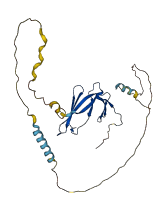
Descriptions
The autoinhibited protein was predicted that may have potential autoinhibitory elements via cis-regPred.
Autoinhibitory domains (AIDs)
Target domain |
|
Relief mechanism |
|
Assay |
cis-regPred |
Accessory elements
No accessory elements
Autoinhibited structure

Activated structure
1 structures for Q9D4C5
| Entry ID | Method | Resolution | Chain | Position | Source |
|---|---|---|---|---|---|
| AF-Q9D4C5-F1 | Predicted | AlphaFoldDB |
7 variants for Q9D4C5
| Variant ID(s) | Position | Change | Description | Diseaes Association | Provenance |
|---|---|---|---|---|---|
| rs3389331819 | 2 | N>H | No | EVA | |
| rs3389331734 | 35 | Y>H | No | EVA | |
| rs252255792 | 128 | A>T | No | EVA | |
| rs3389324976 | 132 | Q>H | No | EVA | |
| rs3405102345 | 229 | P>A | No | EVA | |
| rs3404929514 | 234 | P>A | No | EVA | |
| rs3389318219 | 253 | L>F | No | EVA |
No associated diseases with Q9D4C5
1 regional properties for Q9D4C5
| Type | Name | Position | InterPro Accession |
|---|---|---|---|
| domain | Transcription elongation factor Eaf, N-terminal | 16 - 113 | IPR019194 |
9 GO annotations of cellular component
| Name | Definition |
|---|---|
| Cajal body | A class of nuclear body, first seen after silver staining by Ramon y Cajal in 1903, enriched in small nuclear ribonucleoproteins, and certain general RNA polymerase II transcription factors; ultrastructurally, they appear as a tangle of coiled, electron-dense threads roughly 0.5 micrometers in diameter; involved in aspects of snRNP biogenesis; the protein coilin serves as a marker for Cajal bodies. Some argue that Cajal bodies are the sites for preassembly of transcriptosomes, unitary particles involved in transcription and processing of RNA. |
| intercellular bridge | A direct connection between the cytoplasm of two cells that is formed following the completion of cleavage furrow ingression during cell division. They are usually present only briefly prior to completion of cytokinesis. However, in some cases, such as the bridges between germ cells during their development, they become stabilised. |
| intracellular membrane-bounded organelle | Organized structure of distinctive morphology and function, bounded by a single or double lipid bilayer membrane and occurring within the cell. Includes the nucleus, mitochondria, plastids, vacuoles, and vesicles. Excludes the plasma membrane. |
| nuclear body | Extra-nucleolar nuclear domains usually visualized by confocal microscopy and fluorescent antibodies to specific proteins. |
| nuclear speck | A discrete extra-nucleolar subnuclear domain, 20-50 in number, in which splicing factors are seen to be localized by immunofluorescence microscopy. |
| nucleoplasm | That part of the nuclear content other than the chromosomes or the nucleolus. |
| nucleus | A membrane-bounded organelle of eukaryotic cells in which chromosomes are housed and replicated. In most cells, the nucleus contains all of the cell's chromosomes except the organellar chromosomes, and is the site of RNA synthesis and processing. In some species, or in specialized cell types, RNA metabolism or DNA replication may be absent. |
| super elongation complex | A transcription elongation factor complex that increases the overall rate of RNA polymerase II transcription elongation by suppressing transient polymerase pausing. At minimum, the complex contains a transcription factor of the ELL family, an EAF protein, and an AFF family protein or distant relative and most likely also P-TEFb and AF9 or ENL. The complex is conserved from yeast to humans. In Schizosaccharomyces pombe it contains Ell1, Eaf1, and Ebp1, but it is absent from S. cerevisiae. |
| transcription elongation factor complex | Any protein complex that interacts with RNA polymerase II to increase (positive transcription elongation factor) or reduce (negative transcription elongation factor) the rate of transcription elongation. |
1 GO annotations of molecular function
| Name | Definition |
|---|---|
| transcription elongation factor activity | A molecular function that stimulates the elongation properties of the RNA polymerase during the elongation phase of transcription. A subclass of transcription elongation factors enable the transition from transcription initiation to elongation, while another class rescue stalled RNA polymerases. |
3 GO annotations of biological process
| Name | Definition |
|---|---|
| positive regulation of DNA-templated transcription | Any process that activates or increases the frequency, rate or extent of cellular DNA-templated transcription. |
| positive regulation of transcription by RNA polymerase II | Any process that activates or increases the frequency, rate or extent of transcription from an RNA polymerase II promoter. |
| regulation of transcription elongation by RNA polymerase II | Any process that modulates the frequency, rate or extent of transcription elongation, the extension of an RNA molecule after transcription initiation and promoter clearance by the addition of ribonucleotides, catalyzed by RNA polymerase II. |
1 homologous proteins in AiPD
| UniProt AC | Gene Name | Protein Name | Species | Evidence Code |
|---|---|---|---|---|
| Q5ZHP7 | EAF2 | ELL-associated factor 2 | Gallus gallus (Chicken) | PR |
| 10 | 20 | 30 | 40 | 50 | 60 |
| MNGTANPLLD | REEHCLRLGE | SFEKRPRASF | HTIRYDFKPA | SIDTSCEGEL | QVGKGDEVTI |
| 70 | 80 | 90 | 100 | 110 | 120 |
| TLPHIPGSTP | PMTVFKGNKR | PYQKDCVLII | NHDTGEYVLE | KLSSSIQVKK | TRAEGSSKIQ |
| 130 | 140 | 150 | 160 | 170 | 180 |
| ARMEQQPARP | PQPSQPPPPP | PPMPFRAPTK | PPAGPKTSPL | KDNPSPEPQL | DDIKRELRAE |
| 190 | 200 | 210 | 220 | 230 | 240 |
| VDIIEQMSSS | SGSSSSDSES | SSGSDDDSSS | SAGEDNGPAS | PPQPSHQQPY | NSRPAVANGT |
| 250 | 260 | ||||
| SRPQGSSQLM | NTLRNDLQLS | ESGSDSDD |