Q9D0F6
Gene name |
Rfc5 |
Protein name |
Replication factor C subunit 5 |
Names |
Activator 1 36 kDa subunit, A1 36 kDa subunit, Activator 1 subunit 5, Replication factor C 36 kDa subunit, RF-C 36 kDa subunit, RFC36 |
Species |
Mus musculus (Mouse) |
KEGG Pathway |
mmu:72151 |
EC number |
|
Protein Class |
|
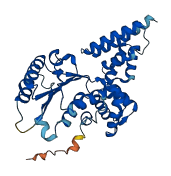
Descriptions
The autoinhibited protein was predicted that may have potential autoinhibitory elements via cis-regPred.
Autoinhibitory domains (AIDs)
Target domain |
|
Relief mechanism |
|
Assay |
cis-regPred |
Accessory elements
No accessory elements
Autoinhibited structure

Activated structure
1 structures for Q9D0F6
| Entry ID | Method | Resolution | Chain | Position | Source |
|---|---|---|---|---|---|
| AF-Q9D0F6-F1 | Predicted | AlphaFoldDB |
19 variants for Q9D0F6
| Variant ID(s) | Position | Change | Description | Diseaes Association | Provenance |
|---|---|---|---|---|---|
| rs3388785332 | 21 | W>* | No | EVA | |
| rs3395708673 | 28 | Q>L | No | EVA | |
| rs3396053627 | 46 | F>* | No | EVA | |
| rs3396033469 | 47 | I>F | No | EVA | |
| rs3395400157 | 48 | S>T | No | EVA | |
| rs3395714264 | 49 | E>D | No | EVA | |
| rs3396126325 | 60 | P>HREVGVAGGLH* | No | EVA | |
| rs3388773374 | 112 | T>I | No | EVA | |
| rs3388778428 | 119 | K>N | No | EVA | |
| rs3388786270 | 132 | D>V | No | EVA | |
| rs3388756730 | 148 | T>S | No | EVA | |
| rs46753499 | 187 | H>R | No | EVA | |
| rs3388775978 | 207 | L>P | No | EVA | |
| rs3388780243 | 210 | G>W | No | EVA | |
| rs3413105167 | 218 | I>V | No | EVA | |
| rs3388790841 | 225 | A>* | No | EVA | |
| rs3388780253 | 255 | N>I | No | EVA | |
| rs3388773357 | 264 | N>D | No | EVA | |
| rs3388784998 | 274 | L>V | No | EVA |
No associated diseases with Q9D0F6
3 GO annotations of cellular component
| Name | Definition |
|---|---|
| Ctf18 RFC-like complex | A heptameric complex related to replication factor C, which loads the DNA polymerase processivity factor proliferating cell nuclear antigen (PCNA) onto DNA and plays a vital role in chromosome cohesion. In Saccharomyces the subunits are known as Ctf18p, Rfc2p, Rfc3p, Rfc4p, Rfc5p, Dcc1p, and Ctf8p. |
| DNA replication factor C complex | A complex that loads the DNA polymerase processivity factor proliferating cell nuclear antigen (PCNA) onto DNA, thereby permitting processive DNA synthesis catalyzed by DNA polymerase. In eukaryotes the complex consists of five polypeptides. |
| nucleus | A membrane-bounded organelle of eukaryotic cells in which chromosomes are housed and replicated. In most cells, the nucleus contains all of the cell's chromosomes except the organellar chromosomes, and is the site of RNA synthesis and processing. In some species, or in specialized cell types, RNA metabolism or DNA replication may be absent. |
6 GO annotations of molecular function
| Name | Definition |
|---|---|
| ATP binding | Binding to ATP, adenosine 5'-triphosphate, a universally important coenzyme and enzyme regulator. |
| ATP hydrolysis activity | Catalysis of the reaction: ATP + H2O = ADP + H+ phosphate. ATP hydrolysis is used in some reactions as an energy source, for example to catalyze a reaction or drive transport against a concentration gradient. |
| DNA binding | Any molecular function by which a gene product interacts selectively and non-covalently with DNA (deoxyribonucleic acid). |
| DNA clamp loader activity | Facilitating the opening of the ring structure of the PCNA complex, or any of the related sliding clamp complexes, and their closing around the DNA duplex, driven by ATP hydrolysis. |
| enzyme binding | Binding to an enzyme, a protein with catalytic activity. |
| single-stranded DNA helicase activity | Catalysis of the reaction: ATP + H2O = ADP + phosphate, in the presence of single-stranded DNA; drives the unwinding of a DNA helix. |
3 GO annotations of biological process
| Name | Definition |
|---|---|
| DNA repair | The process of restoring DNA after damage. Genomes are subject to damage by chemical and physical agents in the environment (e.g. UV and ionizing radiations, chemical mutagens, fungal and bacterial toxins, etc.) and by free radicals or alkylating agents endogenously generated in metabolism. DNA is also damaged because of errors during its replication. A variety of different DNA repair pathways have been reported that include direct reversal, base excision repair, nucleotide excision repair, photoreactivation, bypass, double-strand break repair pathway, and mismatch repair pathway. |
| DNA-templated DNA replication | A DNA replication process that uses parental DNA as a template for the DNA-dependent DNA polymerases that synthesize the new strands. |
| positive regulation of DNA-directed DNA polymerase activity | Any process that activates or increases the frequency, rate or extent of DNA-directed DNA polymerase activity. |
4 homologous proteins in AiPD
| UniProt AC | Gene Name | Protein Name | Species | Evidence Code |
|---|---|---|---|---|
| P06710 | dnaX | DNA polymerase III subunit tau | Escherichia coli (strain K12) | PR |
| Q99J62 | Rfc4 | Replication factor C subunit 4 | Mus musculus (Mouse) | PR |
| Q8R323 | Rfc3 | Replication factor C subunit 3 | Mus musculus (Mouse) | PR |
| F4JRP8 | At4g24790 | Protein STICHEL-like 2 | Arabidopsis thaliana (Mouse-ear cress) | PR |
| 10 | 20 | 30 | 40 | 50 | 60 |
| MTAAAPSQQR | PAAARARNLP | WVEKYRPQTL | ADLISHQDIL | STIQKFISED | RLPHLLLYGP |
| 70 | 80 | 90 | 100 | 110 | 120 |
| PGTGKTSTIL | ACAKQLYKDK | EFGSMVLELN | ASDDRGIDIV | RGPILSFAST | RTIFKKGFKL |
| 130 | 140 | 150 | 160 | 170 | 180 |
| VILDEADAMT | QDAQNALRRV | IEKFTENTRF | CLICNYLSKI | IPALQSRCTR | FRFGPLTPEL |
| 190 | 200 | 210 | 220 | 230 | 240 |
| MVPRLEHVVQ | EENVDISEDG | MKALVTLSSG | DMRRALNILQ | STNMAFGKVT | EETVYTCTGH |
| 250 | 260 | 270 | 280 | 290 | 300 |
| PLKTDIANIL | DWMLNQDFTT | AYKNIMELKT | LKGLALHDIL | TEVHLFVHRV | DFPSSVRIHL |
| 310 | 320 | 330 | |||
| LTKMADIEYR | LSVGTSEKIQ | LSSLIAAFQV | TRDLIVAEA |