F4JRP8
Gene name |
At4g24790 (F22K18.10) |
Protein name |
Protein STICHEL-like 2 |
Names |
|
Species |
Arabidopsis thaliana (Mouse-ear cress) |
KEGG Pathway |
ath:AT4G24790 |
EC number |
|
Protein Class |
|
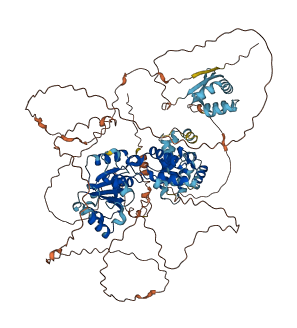
Descriptions
The autoinhibited protein was predicted that may have potential autoinhibitory elements via cis-regPred.
Autoinhibitory domains (AIDs)
Target domain |
|
Relief mechanism |
|
Assay |
cis-regPred |
Accessory elements
No accessory elements
Autoinhibited structure

Activated structure
1 structures for F4JRP8
| Entry ID | Method | Resolution | Chain | Position | Source |
|---|---|---|---|---|---|
| AF-F4JRP8-F1 | Predicted | AlphaFoldDB |
45 variants for F4JRP8
| Variant ID(s) | Position | Change | Description | Diseaes Association | Provenance |
|---|---|---|---|---|---|
| ENSVATH12205985 | 18 | V>I | No | 1000Genomes | |
| ENSVATH00536137 | 63 | D>A | No | 1000Genomes | |
| ENSVATH06769220 | 63 | D>E | No | 1000Genomes | |
| tmp_4_12778436_C_T | 72 | A>V | No | 1000Genomes | |
| tmp_4_12778441_G_A | 74 | V>M | No | 1000Genomes | |
| tmp_4_12778514_G_C | 98 | S>T | No | 1000Genomes | |
| tmp_4_12778530_T_A | 103 | N>K | No | 1000Genomes | |
| ENSVATH00536138 | 118 | S>G | No | 1000Genomes | |
| ENSVATH00536139 | 137 | V>A | No | 1000Genomes | |
| ENSVATH06769223 | 149 | H>R | No | 1000Genomes | |
| tmp_4_12778669_T_A | 150 | Y>N | No | 1000Genomes | |
| ENSVATH12205988 | 155 | A>S | No | 1000Genomes | |
| ENSVATH00536140 | 171 | S>T | No | 1000Genomes | |
| tmp_4_12778744_A_T | 175 | S>C | No | 1000Genomes | |
| tmp_4_12778745_G_T | 175 | S>I | No | 1000Genomes | |
| ENSVATH14293065 | 202 | P>L | No | 1000Genomes | |
| tmp_4_12778838_G_A | 206 | G>E | No | 1000Genomes | |
| tmp_4_12778850_C_A | 210 | S>Y | No | 1000Genomes | |
| tmp_4_12778892_A_T | 224 | N>I | No | 1000Genomes | |
| tmp_4_12778909_G_A | 230 | V>M | No | 1000Genomes | |
| tmp_4_12779104_G_A | 295 | A>T | No | 1000Genomes | |
| tmp_4_12779132_C_A | 304 | A>E | No | 1000Genomes | |
| tmp_4_12779230_C_T | 337 | P>S | No | 1000Genomes | |
| tmp_4_12779258_G_A | 346 | S>N | No | 1000Genomes | |
| ENSVATH02920711 | 352 | V>L | No | 1000Genomes | |
| tmp_4_12779611_G_A | 464 | G>S | No | 1000Genomes | |
| tmp_4_12779788_C_A | 494 | S>Y | No | 1000Genomes | |
| ENSVATH06769229 | 546 | R>S | No | 1000Genomes | |
| ENSVATH14293067 | 609 | V>I | No | 1000Genomes | |
| ENSVATH02920716 | 623 | I>T | No | 1000Genomes | |
| tmp_4_12780403_A_C | 636 | N>T | No | 1000Genomes | |
| ENSVATH06769232 | 651 | C>S | No | 1000Genomes | |
| tmp_4_12780498_C_G | 668 | L>V | No | 1000Genomes | |
| ENSVATH00536147 | 673 | G>D | No | 1000Genomes | |
| ENSVATH06769233 | 682 | Y>C | No | 1000Genomes | |
| ENSVATH00536148 | 712 | Q>R | No | 1000Genomes | |
| tmp_4_12780843_G_T | 754 | D>Y | No | 1000Genomes | |
| ENSVATH00536149 | 759 | S>F | No | 1000Genomes | |
| tmp_4_12780927_C_T | 782 | R>C | No | 1000Genomes | |
| ENSVATH06769235 | 803 | A>T | No | 1000Genomes | |
| ENSVATH02920718 | 811 | P>S | No | 1000Genomes | |
| tmp_4_12781162_C_T | 829 | P>L | No | 1000Genomes | |
| tmp_4_12781272_A_C | 834 | Q>P | No | 1000Genomes | |
| tmp_4_12781304_C_T | 845 | L>F | No | 1000Genomes | |
| tmp_4_12781341_A_G | 857 | N>S | No | 1000Genomes |
2 associated diseases with F4JRP8
[MIM: 614504]: Usher syndrome 3B (USH3B)
A syndrome characterized by progressive vision and hearing loss during early childhood. Some patients have the so-called 'Charles Bonnet syndrome,' involving decreased visual acuity and vivid visual hallucinations. USH is a genetically heterogeneous condition characterized by the association of retinitis pigmentosa with sensorineural deafness. Age at onset and differences in auditory and vestibular function distinguish Usher syndrome type 1 (USH1), Usher syndrome type 2 (USH2) and Usher syndrome type 3 (USH3). USH3 is characterized by postlingual, progressive hearing loss, variable vestibular dysfunction, and onset of retinitis pigmentosa symptoms, including nyctalopia, constriction of the visual fields, and loss of central visual acuity, usually by the second decade of life. {ECO:0000269|PubMed:22279524}. Note=The disease is caused by variants affecting the gene represented in this entry.
[MIM: 616625]: Charcot-Marie-Tooth disease 2W (CMT2W)
An autosomal dominant, axonal form of Charcot-Marie-Tooth disease, a disorder of the peripheral nervous system, characterized by progressive weakness and atrophy, initially of the peroneal muscles and later of the distal muscles of the arms. Charcot-Marie-Tooth disease is classified in two main groups on the basis of electrophysiologic properties and histopathology
Without disease ID
- A syndrome characterized by progressive vision and hearing loss during early childhood. Some patients have the so-called 'Charles Bonnet syndrome,' involving decreased visual acuity and vivid visual hallucinations. USH is a genetically heterogeneous condition characterized by the association of retinitis pigmentosa with sensorineural deafness. Age at onset and differences in auditory and vestibular function distinguish Usher syndrome type 1 (USH1), Usher syndrome type 2 (USH2) and Usher syndrome type 3 (USH3). USH3 is characterized by postlingual, progressive hearing loss, variable vestibular dysfunction, and onset of retinitis pigmentosa symptoms, including nyctalopia, constriction of the visual fields, and loss of central visual acuity, usually by the second decade of life. {ECO:0000269|PubMed:22279524}. Note=The disease is caused by variants affecting the gene represented in this entry.
- An autosomal dominant, axonal form of Charcot-Marie-Tooth disease, a disorder of the peripheral nervous system, characterized by progressive weakness and atrophy, initially of the peroneal muscles and later of the distal muscles of the arms. Charcot-Marie-Tooth disease is classified in two main groups on the basis of electrophysiologic properties and histopathology
17 regional properties for F4JRP8
| Type | Name | Position | InterPro Accession |
|---|---|---|---|
| domain | NGN domain | 183 - 265 | IPR005100 |
| domain | KOW | 273 - 300 | IPR005824-1 |
| domain | KOW | 425 - 452 | IPR005824-2 |
| domain | KOW | 477 - 522 | IPR005824-3 |
| domain | KOW | 601 - 628 | IPR005824-4 |
| domain | KOW | 712 - 739 | IPR005824-5 |
| domain | KOW | 988 - 1015 | IPR005824-6 |
| conserved_site | Ribosomal protein L24/L26, conserved site | 429 - 446 | IPR005825 |
| domain | NusG-like, N-terminal | 181 - 268 | IPR006645 |
| domain | Spt5 transcription elongation factor, N-terminal | 90 - 177 | IPR022581 |
| domain | NGN domain, eukaryotic | 183 - 266 | IPR039385 |
| domain | Spt5, KOW domain repeat 1 | 277 - 314 | IPR041973 |
| domain | Spt5, KOW domain repeat 2 | 426 - 476 | IPR041975 |
| domain | Spt5, KOW domain repeat 3 | 477 - 527 | IPR041976 |
| domain | Spt5, KOW domain repeat 4 | 605 - 647 | IPR041977 |
| domain | Spt5, KOW domain repeat 5 | 711 - 758 | IPR041978 |
| domain | Spt5, KOW domain repeat 6 | 982 - 1039 | IPR041980 |
3 GO annotations of cellular component
| Name | Definition |
|---|---|
| DNA polymerase III complex | The DNA polymerase III holoenzyme is a complex that contains 10 different types of subunits. These subunits are organized into 3 functionally essential sub-assemblies: the pol III core, the beta sliding clamp processivity factor and the clamp-loading complex. The pol III core carries out the polymerase and the 3'-5' exonuclease proofreading activities. The polymerase is tethered to the template via the sliding clamp processivity factor. The clamp-loading complex assembles the beta processivity factor onto the primer template and plays a central role in the organization and communication at the replication fork. |
| DNA replication factor C complex | A complex that loads the DNA polymerase processivity factor proliferating cell nuclear antigen (PCNA) onto DNA, thereby permitting processive DNA synthesis catalyzed by DNA polymerase. In eukaryotes the complex consists of five polypeptides. |
| nucleus | A membrane-bounded organelle of eukaryotic cells in which chromosomes are housed and replicated. In most cells, the nucleus contains all of the cell's chromosomes except the organellar chromosomes, and is the site of RNA synthesis and processing. In some species, or in specialized cell types, RNA metabolism or DNA replication may be absent. |
3 GO annotations of molecular function
| Name | Definition |
|---|---|
| ATP binding | Binding to ATP, adenosine 5'-triphosphate, a universally important coenzyme and enzyme regulator. |
| DNA binding | Any molecular function by which a gene product interacts selectively and non-covalently with DNA (deoxyribonucleic acid). |
| DNA-directed DNA polymerase activity | Catalysis of the reaction: deoxynucleoside triphosphate + DNA(n) = diphosphate + DNA(n+1); the synthesis of DNA from deoxyribonucleotide triphosphates in the presence of a DNA template and a 3'hydroxyl group. |
2 GO annotations of biological process
| Name | Definition |
|---|---|
| DNA repair | The process of restoring DNA after damage. Genomes are subject to damage by chemical and physical agents in the environment (e.g. UV and ionizing radiations, chemical mutagens, fungal and bacterial toxins, etc.) and by free radicals or alkylating agents endogenously generated in metabolism. DNA is also damaged because of errors during its replication. A variety of different DNA repair pathways have been reported that include direct reversal, base excision repair, nucleotide excision repair, photoreactivation, bypass, double-strand break repair pathway, and mismatch repair pathway. |
| DNA-templated DNA replication | A DNA replication process that uses parental DNA as a template for the DNA-dependent DNA polymerases that synthesize the new strands. |
4 homologous proteins in AiPD
| UniProt AC | Gene Name | Protein Name | Species | Evidence Code |
|---|---|---|---|---|
| P06710 | dnaX | DNA polymerase III subunit tau | Escherichia coli (strain K12) | PR |
| P35249 | RFC4 | Replication factor C subunit 4 | Homo sapiens (Human) | PR |
| Q99J62 | Rfc4 | Replication factor C subunit 4 | Mus musculus (Mouse) | PR |
| Q9D0F6 | Rfc5 | Replication factor C subunit 5 | Mus musculus (Mouse) | PR |
| 10 | 20 | 30 | 40 | 50 | 60 |
| MGETRRHSVD | VPITRTLVAL | RRVRSLRDPC | TTSMSKFASL | LDNVKWETGS | NNGISLQFVE |
| 70 | 80 | 90 | 100 | 110 | 120 |
| HADDACKAAA | DAPVGLIPFG | SYSIMEELES | GCDLHKLSSK | VINVEGDACS | RSSERSCSDL |
| 130 | 140 | 150 | 160 | 170 | 180 |
| SVKGRDLACN | APSISHVEEA | GSGGRYRTHY | STKLASSVGE | YGSRLGSPMN | STNHSYYGDE |
| 190 | 200 | 210 | 220 | 230 | 240 |
| DVDFDSQSNR | GCGITYCWSR | TPRYRGSNQS | SDVEEYPLLP | GNGNGESDVV | TPSHEVLSRS |
| 250 | 260 | 270 | 280 | 290 | 300 |
| LSQKFRPKSF | DELVGQEVVV | KCLLSTILRG | RITSVYLFHG | PRGTGKTSTS | KIFAAALNCL |
| 310 | 320 | 330 | 340 | 350 | 360 |
| SQAAHSRPCG | LCSECKSYFS | GRGRDVMETD | SGKLNRPSYL | RSLIKSASLP | PVSSRFKVFI |
| 370 | 380 | 390 | 400 | 410 | 420 |
| IDECQLLCQE | TWGTLLNSLD | NFSQHSVFIL | VTSELEKLPR | NVLSRSQKYH | FSKVCDADIS |
| 430 | 440 | 450 | 460 | 470 | 480 |
| TKLAKICIEE | GIDFDQGAVD | FIASKSDGSL | RDAEIMLDQL | SLLGKRITTS | LAYKLIGVVS |
| 490 | 500 | 510 | 520 | 530 | 540 |
| DDELLDLLDL | AMSSDTSNTV | IRARELMRSK | IDPMQLISQL | ANVIMDIIAG | NSQESSSATR |
| 550 | 560 | 570 | 580 | 590 | 600 |
| LRFLTRHTSE | EEMQKLRNAL | KILSDAEKHL | RASKNQTTWL | TVALLQLSNT | DSSSFATDEN |
| 610 | 620 | 630 | 640 | 650 | 660 |
| GRNQINKDVE | LSSTSSGCPG | DVIKSDAEKG | QERNCNETVE | SVWKTVTDLC | CSDSLKRFLW |
| 670 | 680 | 690 | 700 | 710 | 720 |
| KRGRLTSLTV | DKGVAIAELE | FYTPQHVARA | EKSWKLIADS | FQSVLGCNVE | IQMNLVISAC |
| 730 | 740 | 750 | 760 | 770 | 780 |
| SPPKSAKAAA | SLFFGLFSCS | RRMLHKSYLT | TRTDSDCASE | KPAVTNSLRS | CQGNVLRARS |
| 790 | 800 | 810 | 820 | 830 | 840 |
| VRSSANASSR | MSCSSDQGDA | TSAMCTPHIP | PGEKRPEDDT | DVLCWKKTPL | GKGQSETQNS |
| 850 | |||||
| KSSRLIGRVL | PCSTAAN |