Q9CR59
Gene name |
Gadd45gip1 (Mrpl59) |
Protein name |
Growth arrest and DNA damage-inducible proteins-interacting protein 1 |
Names |
39S ribosomal protein L59, mitochondrial, MRP-L59 |
Species |
Mus musculus (Mouse) |
KEGG Pathway |
mmu:102060 |
EC number |
|
Protein Class |
|
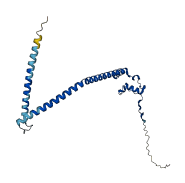
Descriptions
The autoinhibited protein was predicted that may have potential autoinhibitory elements via cis-regPred.
Autoinhibitory domains (AIDs)
Target domain |
|
Relief mechanism |
|
Assay |
cis-regPred |
Accessory elements
No accessory elements
Autoinhibited structure

Activated structure
1 structures for Q9CR59
| Entry ID | Method | Resolution | Chain | Position | Source |
|---|---|---|---|---|---|
| AF-Q9CR59-F1 | Predicted | AlphaFoldDB |
8 variants for Q9CR59
| Variant ID(s) | Position | Change | Description | Diseaes Association | Provenance |
|---|---|---|---|---|---|
| rs50271456 | 19 | G>S | No | EVA | |
| rs33181488 | 71 | P>L | No | EVA | |
| rs3399369364 | 77 | P>L | No | EVA | |
| rs3398447532 | 104 | R>Q | No | EVA | |
| rs3389001304 | 142 | R>C | No | EVA | |
| rs3388994272 | 181 | D>V | No | EVA | |
| rs3389001319 | 208 | S>F | No | EVA | |
| rs51467123 | 209 | A>V | No | EVA |
No associated diseases with Q9CR59
No regional properties for Q9CR59
| Type | Name | Position | InterPro Accession |
|---|---|---|---|
| No domain, repeats, and functional sites for Q9CR59 | |||
Functions
4 GO annotations of cellular component
| Name | Definition |
|---|---|
| mitochondrial inner membrane | The inner, i.e. lumen-facing, lipid bilayer of the mitochondrial envelope. It is highly folded to form cristae. |
| mitochondrial large ribosomal subunit | The larger of the two subunits of a mitochondrial ribosome. Two sites on the ribosomal large subunit are involved in translation: the aminoacyl site (A site) and peptidyl site (P site). |
| mitochondrion | A semiautonomous, self replicating organelle that occurs in varying numbers, shapes, and sizes in the cytoplasm of virtually all eukaryotic cells. It is notably the site of tissue respiration. |
| nucleoplasm | That part of the nuclear content other than the chromosomes or the nucleolus. |
No GO annotations of molecular function
| Name | Definition |
|---|---|
| No GO annotations for molecular function |
2 GO annotations of biological process
| Name | Definition |
|---|---|
| cell cycle | The progression of biochemical and morphological phases and events that occur in a cell during successive cell replication or nuclear replication events. Canonically, the cell cycle comprises the replication and segregation of genetic material followed by the division of the cell, but in endocycles or syncytial cells nuclear replication or nuclear division may not be followed by cell division. |
| mitochondrial translation | The chemical reactions and pathways resulting in the formation of a protein in a mitochondrion. This is a ribosome-mediated process in which the information in messenger RNA (mRNA) is used to specify the sequence of amino acids in the protein; the mitochondrion has its own ribosomes and transfer RNAs, and uses a genetic code that differs from the nuclear code. |
2 homologous proteins in AiPD
| 10 | 20 | 30 | 40 | 50 | 60 |
| MAALAMRSGY | LLRLSVALGP | RSRSYRAPPP | PRRRPGPHSP | DPENLLTPRW | QLTPRYVAKQ |
| 70 | 80 | 90 | 100 | 110 | 120 |
| FGRHGAISGV | PPASLWPTPE | QLRELEAEEQ | EWYPSLATMQ | ESLRLQQQAL | EARRQAREQR |
| 130 | 140 | 150 | 160 | 170 | 180 |
| IAECMAKMPQ | MIENWRKQKR | ERWEKIQADK | ERRARLQAEA | QERLGYHVDP | RSARFQELLQ |
| 190 | 200 | 210 | 220 | ||
| DLDKQQRKRL | KEERQRQKKE | ARIAAMASAE | AQDSAVSGEP | SS |