Q9CQV1
Gene name |
Pam16 |
Protein name |
Mitochondrial import inner membrane translocase subunit TIM16 |
Names |
Mitochondria-associated granulocyte macrophage CSF-signaling molecule, Presequence translocated-associated motor subunit PAM16 |
Species |
Mus musculus (Mouse) |
KEGG Pathway |
mmu:66449 |
EC number |
|
Protein Class |
|
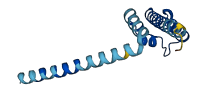
Descriptions
The autoinhibited protein was predicted that may have potential autoinhibitory elements via cis-regPred.
Autoinhibitory domains (AIDs)
Target domain |
|
Relief mechanism |
|
Assay |
cis-regPred |
Accessory elements
No accessory elements
Autoinhibited structure

Activated structure
1 structures for Q9CQV1
| Entry ID | Method | Resolution | Chain | Position | Source |
|---|---|---|---|---|---|
| AF-Q9CQV1-F1 | Predicted | AlphaFoldDB |
11 variants for Q9CQV1
| Variant ID(s) | Position | Change | Description | Diseaes Association | Provenance |
|---|---|---|---|---|---|
| rs3406526701 | 3 | K>R | No | EVA | |
| rs3389377238 | 14 | Q>E | No | EVA | |
| rs3389406916 | 23 | A>T | No | EVA | |
| rs3389377204 | 40 | R>H | No | EVA | |
| rs3389107333 | 47 | A>V | No | EVA | |
| rs3389367228 | 62 | I>S | No | EVA | |
| rs231364387 | 65 | V>I | No | EVA | |
| rs3389403068 | 73 | V>I | No | EVA | |
| rs3389406886 | 90 | G>D | No | EVA | |
| rs3389077290 | 104 | R>H | No | EVA | |
| rs6210089 | 123 | P>L | No | EVA |
No associated diseases with Q9CQV1
No regional properties for Q9CQV1
| Type | Name | Position | InterPro Accession |
|---|---|---|---|
| No domain, repeats, and functional sites for Q9CQV1 | |||
8 GO annotations of cellular component
| Name | Definition |
|---|---|
| cytoplasm | The contents of a cell excluding the plasma membrane and nucleus, but including other subcellular structures. |
| extrinsic component of mitochondrial inner membrane | The component of mitochondrial inner membrane consisting of gene products and protein complexes that are loosely bound to one of its surfaces, but not integrated into the hydrophobic region. |
| mitochondrial inner membrane | The inner, i.e. lumen-facing, lipid bilayer of the mitochondrial envelope. It is highly folded to form cristae. |
| mitochondrial matrix | The gel-like material, with considerable fine structure, that lies in the matrix space, or lumen, of a mitochondrion. It contains the enzymes of the tricarboxylic acid cycle and, in some organisms, the enzymes concerned with fatty acid oxidation. |
| mitochondrion | A semiautonomous, self replicating organelle that occurs in varying numbers, shapes, and sizes in the cytoplasm of virtually all eukaryotic cells. It is notably the site of tissue respiration. |
| PAM complex, Tim23 associated import motor | Protein complex located on the matrix side of the mitochondrial inner membrane and associated with the TIM23 mitochondrial import inner membrane translocase complex (GO:0005744); ATPase motor activity to drive import of proteins into the mitochondrial matrix. |
| protein-containing complex | A stable assembly of two or more macromolecules, i.e. proteins, nucleic acids, carbohydrates or lipids, in which at least one component is a protein and the constituent parts function together. |
| TIM23 mitochondrial import inner membrane translocase complex | The protein transport machinery of the mitochondrial inner membrane that typically transports proteins that possess a matrix-targeting N-terminal presequence. The TIM23 complex contains three essential Tim proteins: Tim17 and Tim23 are thought to build a preprotein translocation channel while Tim44 interacts transiently with the matrix heat-shock protein Hsp70 to form an ATP-driven import motor. |
No GO annotations of molecular function
| Name | Definition |
|---|---|
| No GO annotations for molecular function |
5 GO annotations of biological process
| Name | Definition |
|---|---|
| DNA biosynthetic process | The biosynthetic process resulting in the formation of DNA. |
| negative regulation of apoptotic signaling pathway | Any process that stops, prevents or reduces the frequency, rate or extent of apoptotic signaling pathway. |
| negative regulation of ATP-dependent activity | Any process that stops or reduces the rate of an ATP-dependent activity. |
| ossification | The formation of bone or of a bony substance, or the conversion of fibrous tissue or of cartilage into bone or a bony substance. |
| protein import into mitochondrial matrix | The import of proteins across the outer and inner mitochondrial membranes into the matrix. Unfolded proteins enter the mitochondrial matrix with a chaperone protein; the information required to target the precursor protein from the cytosol to the mitochondrial matrix is contained within its N-terminal matrix-targeting sequence. Translocation of precursors to the matrix occurs at the rare sites where the outer and inner membranes are close together. |
| 10 | 20 | 30 | 40 | 50 | 60 |
| MAKYLAQIIV | MGVQVVGRAF | ARALRQEFAA | SQAAADARGR | AGHQSAAASN | LSGLSLQEAQ |
| 70 | 80 | 90 | 100 | 110 | 120 |
| QILNVSKLSP | EEVQKNYEHL | FKVNDKSVGG | SFYLQSKVVR | AKERLDEELR | IQAQEDREKG |
| QKPKT |