Q9CQT2
Gene name |
Rbm7 |
Protein name |
RNA-binding protein 7 |
Names |
RNA-binding motif protein 7 |
Species |
Mus musculus (Mouse) |
KEGG Pathway |
mmu:67010 |
EC number |
|
Protein Class |
|
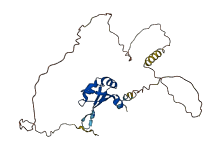
Descriptions
The autoinhibited protein was predicted that may have potential autoinhibitory elements via cis-regPred.
Autoinhibitory domains (AIDs)
Target domain |
|
Relief mechanism |
|
Assay |
cis-regPred |
Accessory elements
No accessory elements
Autoinhibited structure

Activated structure
1 structures for Q9CQT2
| Entry ID | Method | Resolution | Chain | Position | Source |
|---|---|---|---|---|---|
| AF-Q9CQT2-F1 | Predicted | AlphaFoldDB |
18 variants for Q9CQT2
| Variant ID(s) | Position | Change | Description | Diseaes Association | Provenance |
|---|---|---|---|---|---|
| rs3389044071 | 25 | L>I | No | EVA | |
| rs3389037360 | 32 | Q>H | No | EVA | |
| rs3389037346 | 96 | S>N | No | EVA | |
| rs48047900 | 123 | N>S | No | EVA | |
| rs3400119662 | 125 | S>C | No | EVA | |
| rs3389036490 | 148 | N>I | No | EVA | |
| rs3389044070 | 162 | S>P | No | EVA | |
| rs3389049705 | 167 | Q>K | No | EVA | |
| rs3389043354 | 170 | F>Y | No | EVA | |
| rs3389009360 | 174 | A>T | No | EVA | |
| rs3389022938 | 188 | Q>* | No | EVA | |
| rs3400233966 | 212 | Y>* | No | EVA | |
| rs3389043353 | 214 | R>H | No | EVA | |
| rs3400121369 | 241 | H>N | No | EVA | |
| rs3399574690 | 241 | H>R | No | EVA | |
| rs3400215472 | 242 | D>H | No | EVA | |
| rs3400131202 | 244 | W>C | No | EVA | |
| rs3400215426 | 244 | W>S | No | EVA |
No associated diseases with Q9CQT2
2 GO annotations of cellular component
| Name | Definition |
|---|---|
| nucleoplasm | That part of the nuclear content other than the chromosomes or the nucleolus. |
| nucleus | A membrane-bounded organelle of eukaryotic cells in which chromosomes are housed and replicated. In most cells, the nucleus contains all of the cell's chromosomes except the organellar chromosomes, and is the site of RNA synthesis and processing. In some species, or in specialized cell types, RNA metabolism or DNA replication may be absent. |
5 GO annotations of molecular function
| Name | Definition |
|---|---|
| 14-3-3 protein binding | Binding to a 14-3-3 protein. A 14-3-3 protein is any of a large family of approximately 30kDa acidic proteins which exist primarily as homo- and heterodimers within all eukaryotic cells, and have been implicated in the modulation of distinct biological processes by binding to specific phosphorylated sites on diverse target proteins, thereby forcing conformational changes or influencing interactions between their targets and other molecules. Each 14-3-3 protein sequence can be roughly divided into three sections: a divergent amino terminus, the conserved core region and a divergent carboxy-terminus. The conserved middle core region of the 14-3-3s encodes an amphipathic groove that forms the main functional domain, a cradle for interacting with client proteins. |
| pre-mRNA intronic binding | Binding to an intronic sequence of a pre-messenger RNA (pre-mRNA). |
| RNA binding | Binding to an RNA molecule or a portion thereof. |
| single-stranded RNA binding | Binding to single-stranded RNA. |
| snRNA binding | Binding to a small nuclear RNA (snRNA). |
3 GO annotations of biological process
| Name | Definition |
|---|---|
| meiotic cell cycle | Progression through the phases of the meiotic cell cycle, in which canonically a cell replicates to produce four offspring with half the chromosomal content of the progenitor cell via two nuclear divisions. |
| regulation of alternative mRNA splicing, via spliceosome | Any process that modulates the frequency, rate or extent of alternative splicing of nuclear mRNAs. |
| snRNA catabolic process | The chemical reactions and pathways resulting in the breakdown of snRNA, small nuclear RNA, low-molecular-mass RNA molecules found in the eukaryotic nucleus as components of the small nuclear ribonucleoprotein. |
1 homologous proteins in AiPD
| UniProt AC | Gene Name | Protein Name | Species | Evidence Code |
|---|---|---|---|---|
| Q9Y580 | RBM7 | RNA-binding protein 7 | Homo sapiens (Human) | PR |
| 10 | 20 | 30 | 40 | 50 | 60 |
| MGAAAAEADR | TLFVGNLETK | VTEELLFELF | HQAGPVIKVK | IPKDKDGKLK | QFAFVNFKHE |
| 70 | 80 | 90 | 100 | 110 | 120 |
| VSVPYAMNLL | NGIKLFGRPI | KIQFRSGSSH | ASQDASVSYP | QHHVGNLSPT | STSPNSYERT |
| 130 | 140 | 150 | 160 | 170 | 180 |
| VGNVSPTAQM | VQRSFSSPED | YQRQAVMNSV | FRQMSYAGKF | GSPHADQLGF | SPSAQPHGHT |
| 190 | 200 | 210 | 220 | 230 | 240 |
| FNQSSSSQWR | QDALSSQRKR | QNSHPYLADR | HYSREQRYSD | HGSDYHYRGS | REDFYYDDRN |
| 250 | 260 | ||||
| HDGWSHDYDN | RRDSSRGGKW | PSSRH |