Q9CQE0
Gene name |
Rnf138 |
Protein name |
E3 ubiquitin-protein ligase RNF138 |
Names |
RING finger protein 138, RING-type E3 ubiquitin transferase RNF138 |
Species |
Mus musculus (Mouse) |
KEGG Pathway |
mmu:56515 |
EC number |
2.3.2.27: Aminoacyltransferases |
Protein Class |
|
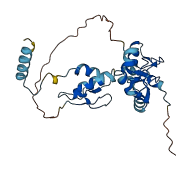
Descriptions
The autoinhibited protein was predicted that may have potential autoinhibitory elements via cis-regPred.
Autoinhibitory domains (AIDs)
Target domain |
|
Relief mechanism |
|
Assay |
cis-regPred |
Accessory elements
No accessory elements
Autoinhibited structure

Activated structure
1 structures for Q9CQE0
| Entry ID | Method | Resolution | Chain | Position | Source |
|---|---|---|---|---|---|
| AF-Q9CQE0-F1 | Predicted | AlphaFoldDB |
3 variants for Q9CQE0
| Variant ID(s) | Position | Change | Description | Diseaes Association | Provenance |
|---|---|---|---|---|---|
| rs3408352009 | 44 | L>P | No | EVA | |
| rs3408287814 | 101 | H>L | No | EVA | |
| rs3389490828 | 225 | L>F | No | EVA |
No associated diseases with Q9CQE0
4 regional properties for Q9CQE0
| Type | Name | Position | InterPro Accession |
|---|---|---|---|
| domain | Zinc finger, RING-type | 18 - 58 | IPR001841-1 |
| domain | Zinc finger, RING-type | 159 - 192 | IPR001841-2 |
| domain | Drought induced 19 protein type, zinc-binding domain | 156 - 216 | IPR008598 |
| domain | Zinc finger C2HC RNF-type | 80 - 112 | IPR034734 |
Functions
| Description | ||
|---|---|---|
| EC Number | 2.3.2.27 | Aminoacyltransferases |
| Subcellular Localization |
|
|
| PANTHER Family | ||
| PANTHER Subfamily | ||
| PANTHER Protein Class | ||
| PANTHER Pathway Category | No pathway information available | |
1 GO annotations of cellular component
| Name | Definition |
|---|---|
| site of double-strand break | A region of a chromosome at which a DNA double-strand break has occurred. DNA damage signaling and repair proteins accumulate at the lesion to respond to the damage and repair the DNA to form a continuous DNA helix. |
4 GO annotations of molecular function
| Name | Definition |
|---|---|
| metal ion binding | Binding to a metal ion. |
| protein kinase binding | Binding to a protein kinase, any enzyme that catalyzes the transfer of a phosphate group, usually from ATP, to a protein substrate. |
| single-stranded DNA binding | Binding to single-stranded DNA. |
| ubiquitin protein ligase activity | Catalysis of the transfer of ubiquitin to a substrate protein via the reaction X-ubiquitin + S -> X + S-ubiquitin, where X is either an E2 or E3 enzyme, the X-ubiquitin linkage is a thioester bond, and the S-ubiquitin linkage is an amide bond: an isopeptide bond between the C-terminal glycine of ubiquitin and the epsilon-amino group of lysine residues in the substrate or, in the linear extension of ubiquitin chains, a peptide bond the between the C-terminal glycine and N-terminal methionine of ubiquitin residues. |
5 GO annotations of biological process
| Name | Definition |
|---|---|
| cellular response to leukemia inhibitory factor | Any process that results in a change in state or activity of a cell (in terms of movement, secretion, enzyme production, gene expression, etc.) as a result of a leukemia inhibitory factor stimulus. |
| DNA double-strand break processing involved in repair via single-strand annealing | The 5' to 3' exonucleolytic resection of the DNA at the site of the break to form a 3' single-strand DNA overhang that results in the repair of a double strand break via single-strand annealing. |
| double-strand break repair via homologous recombination | The error-free repair of a double-strand break in DNA in which the broken DNA molecule is repaired using homologous sequences. A strand in the broken DNA searches for a homologous region in an intact chromosome to serve as the template for DNA synthesis. The restoration of two intact DNA molecules results in the exchange, reciprocal or nonreciprocal, of genetic material between the intact DNA molecule and the broken DNA molecule. |
| protein ubiquitination | The process in which one or more ubiquitin groups are added to a protein. |
| Wnt signaling pathway | The series of molecular signals initiated by binding of a Wnt protein to a frizzled family receptor on the surface of the target cell and ending with a change in cell state. |
1 homologous proteins in AiPD
| UniProt AC | Gene Name | Protein Name | Species | Evidence Code |
|---|---|---|---|---|
| Q8WVD3 | RNF138 | E3 ubiquitin-protein ligase RNF138 | Homo sapiens (Human) | PR |
| 10 | 20 | 30 | 40 | 50 | 60 |
| MSEELSAATS | YTEDDFYCPV | CQEVLKTPVR | TAACQHVFCR | KCFLTAMRES | GIHCPLCRGS |
| 70 | 80 | 90 | 100 | 110 | 120 |
| VTRRERACPE | RALDLENIMR | RFSGSCRCCS | KKIKFYRMRH | HYKSCKKYQD | EYGVSSVIPN |
| 130 | 140 | 150 | 160 | 170 | 180 |
| FKISQDSVRS | SNRSETSASD | NTETYQEDTS | SSGHPTFKCP | LCQESNFTRQ | RLLDHCNSNH |
| 190 | 200 | 210 | 220 | 230 | 240 |
| LFQIVPVTCP | ICVSLPWGDP | SQITRNFVSH | LNQRHQFDYG | EFVNLQLDEE | TQYQTAVEES |
| FQVNM |