Q9CQA8
Gene name |
Cep19 |
Protein name |
Centrosomal protein of 19 kDa |
Names |
Cep19 |
Species |
Mus musculus (Mouse) |
KEGG Pathway |
mmu:66994 |
EC number |
|
Protein Class |
|
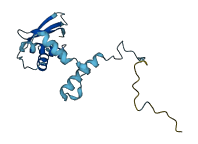
Descriptions
The autoinhibited protein was predicted that may have potential autoinhibitory elements via cis-regPred.
Autoinhibitory domains (AIDs)
Target domain |
|
Relief mechanism |
|
Assay |
cis-regPred |
Accessory elements
No accessory elements
Autoinhibited structure

Activated structure
1 structures for Q9CQA8
| Entry ID | Method | Resolution | Chain | Position | Source |
|---|---|---|---|---|---|
| AF-Q9CQA8-F1 | Predicted | AlphaFoldDB |
12 variants for Q9CQA8
| Variant ID(s) | Position | Change | Description | Diseaes Association | Provenance |
|---|---|---|---|---|---|
| rs3389414975 | 8 | C>* | No | EVA | |
| rs3389417979 | 51 | Q>H | No | EVA | |
| rs3389372488 | 54 | N>H | No | EVA | |
| rs3406742741 | 63 | E>* | No | EVA | |
| rs3406222713 | 63 | E>D | No | EVA | |
| rs3406730739 | 63 | E>V | No | EVA | |
| rs3389379248 | 120 | M>V | No | EVA | |
| rs3389408342 | 125 | E>K | No | EVA | |
| rs3389391652 | 125 | E>V | No | EVA | |
| rs3389427500 | 158 | A>S | No | EVA | |
| rs3389421202 | 163 | F>L | No | EVA | |
| rs3406652160 | 164 | F>S | No | EVA |
No associated diseases with Q9CQA8
No regional properties for Q9CQA8
| Type | Name | Position | InterPro Accession |
|---|---|---|---|
| No domain, repeats, and functional sites for Q9CQA8 | |||
Functions
7 GO annotations of cellular component
| Name | Definition |
|---|---|
| centriole | A cellular organelle, found close to the nucleus in many eukaryotic cells, consisting of a small cylinder with microtubular walls, 300-500 nm long and 150-250 nm in diameter. It contains nine short, parallel, peripheral microtubular fibrils, each fibril consisting of one complete microtubule fused to two incomplete microtubules. Cells usually have two centrioles, lying at right angles to each other. At division, each pair of centrioles generates another pair and the twin pairs form the pole of the mitotic spindle. |
| centrosome | A structure comprised of a core structure (in most organisms, a pair of centrioles) and peripheral material from which a microtubule-based structure, such as a spindle apparatus, is organized. Centrosomes occur close to the nucleus during interphase in many eukaryotic cells, though in animal cells it changes continually during the cell-division cycle. |
| ciliary basal body | A membrane-tethered, short cylindrical array of microtubules and associated proteins found at the base of a eukaryotic cilium (also called flagellum) that is similar in structure to a centriole and derives from it. The cilium basal body is the site of assembly and remodelling of the cilium and serves as a nucleation site for axoneme growth. As well as anchoring the cilium, it is thought to provide a selective gateway regulating the entry of ciliary proteins and vesicles by intraflagellar transport. |
| cilium | A specialized eukaryotic organelle that consists of a filiform extrusion of the cell surface and of some cytoplasmic parts. Each cilium is largely bounded by an extrusion of the cytoplasmic (plasma) membrane, and contains a regular longitudinal array of microtubules, anchored to a basal body. |
| cytoplasm | The contents of a cell excluding the plasma membrane and nucleus, but including other subcellular structures. |
| nucleoplasm | That part of the nuclear content other than the chromosomes or the nucleolus. |
| spindle pole | Either of the ends of a spindle, where spindle microtubules are organized; usually contains a microtubule organizing center and accessory molecules, spindle microtubules and astral microtubules. |
No GO annotations of molecular function
| Name | Definition |
|---|---|
| No GO annotations for molecular function |
3 GO annotations of biological process
| Name | Definition |
|---|---|
| cilium assembly | The assembly of a cilium, a specialized eukaryotic organelle that consists of a filiform extrusion of the cell surface. Each cilium is bounded by an extrusion of the cytoplasmic membrane, and contains a regular longitudinal array of microtubules, anchored basally in a centriole. |
| microtubule anchoring at centrosome | Any process in which a microtubule is maintained in a specific location in a cell by attachment to a centrosome. |
| vesicle targeting, trans-Golgi to periciliary membrane compartment | The process in which vesicles formed at the trans-Golgi network are directed to the plasma membrane surrounding the base of the cilium, including the ciliary pocket, mediated by molecules at the vesicle membrane and target membrane surfaces. |
| 10 | 20 | 30 | 40 | 50 | 60 |
| MKYIAKKCGV | RFQPPAVILI | YENETEGKSR | QRIMPVRNFS | KFSDCTRAAE | QLKNNPRHKS |
| 70 | 80 | 90 | 100 | 110 | 120 |
| YLEQVPLKQL | EKLFVFLRGS | LQGQSLAETM | EQIRRETTID | PEEDLNKLDD | KELAKRKSIM |
| 130 | 140 | 150 | 160 | ||
| DELFEKNQKR | KDDPTFVYDV | EVEFPQDEQL | LSCSWDTASV | DDF |