Q9CPV5
Gene name |
Pmf1 |
Protein name |
Polyamine-modulated factor 1 |
Names |
PMF-1 |
Species |
Mus musculus (Mouse) |
KEGG Pathway |
mmu:67037 |
EC number |
|
Protein Class |
|
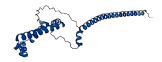
Descriptions
The autoinhibited protein was predicted that may have potential autoinhibitory elements via cis-regPred.
Autoinhibitory domains (AIDs)
Target domain |
|
Relief mechanism |
|
Assay |
cis-regPred |
Accessory elements
No accessory elements
Autoinhibited structure

Activated structure
1 structures for Q9CPV5
| Entry ID | Method | Resolution | Chain | Position | Source |
|---|---|---|---|---|---|
| AF-Q9CPV5-F1 | Predicted | AlphaFoldDB |
15 variants for Q9CPV5
| Variant ID(s) | Position | Change | Description | Diseaes Association | Provenance |
|---|---|---|---|---|---|
| rs3388643195 | 13 | R>G | No | EVA | |
| rs3388621884 | 37 | A>T | No | EVA | |
| rs32889020 | 52 | Y>F | No | EVA | |
| rs3388643768 | 85 | I>T | No | EVA | |
| rs3388632394 | 93 | K>* | No | EVA | |
| rs3388630002 | 111 | E>K | No | EVA | |
| rs32888348 | 112 | G>D | No | EVA | |
| rs32888345 | 115 | R>H | No | EVA | |
| rs3388639916 | 119 | A>V | No | EVA | |
| rs3388643791 | 167 | R>C | No | EVA | |
| rs3388630032 | 167 | R>E | No | EVA | |
| rs3388632370 | 170 | V>G | No | EVA | |
| rs3388632316 | 170 | V>L | No | EVA | |
| rs237964105 | 176 | Q>E | No | EVA | |
| rs1132511244 | 200 | A>T | No | EVA |
No associated diseases with Q9CPV5
No regional properties for Q9CPV5
| Type | Name | Position | InterPro Accession |
|---|---|---|---|
| No domain, repeats, and functional sites for Q9CPV5 | |||
7 GO annotations of cellular component
| Name | Definition |
|---|---|
| Golgi apparatus | A membrane-bound cytoplasmic organelle of the endomembrane system that further processes the core oligosaccharides (e.g. N-glycans) added to proteins in the endoplasmic reticulum and packages them into membrane-bound vesicles. The Golgi apparatus operates at the intersection of the secretory, lysosomal, and endocytic pathways. |
| intracellular membrane-bounded organelle | Organized structure of distinctive morphology and function, bounded by a single or double lipid bilayer membrane and occurring within the cell. Includes the nucleus, mitochondria, plastids, vacuoles, and vesicles. Excludes the plasma membrane. |
| kinetochore | A multisubunit complex that is located at the centromeric region of DNA and provides an attachment point for the spindle microtubules. |
| MIS12/MIND type complex | A multiprotein kinetochore subcomplex that binds to centromeric chromatin and forms part of the inner kinetochore. It helps to recruit outer kinetochore subunits that will bind to microtubules. In humans, it consists of MIS12, DSN1, NSL1 and PMF1. |
| NMS complex | A supercomplex formed by the association of two subcomplexes (known as MIND and Ndc80 in Schizosaccharomyces) with additional proteins at the kinetochores of condensed nuclear chromosomes. |
| nuclear MIS12/MIND complex | A multiprotein kinetochore subcomplex that binds to centromeric chromatin and forms part of the inner kinetochore of a chromosome in the nucleus. It helps to recruit outer kinetochore subunits that will bind to microtubules. Nuclear localization arises in some organisms because the nuclear envelope is not broken down during mitosis. In S. cerevisiae, it consists of at least four proteins: Mtw1p, Nnf1p, Nsl1p, and Dsn1. |
| nucleoplasm | That part of the nuclear content other than the chromosomes or the nucleolus. |
2 GO annotations of molecular function
| Name | Definition |
|---|---|
| leucine zipper domain binding | Binding to a leucine zipper domain, a protein secondary structure exhibiting a periodic repetition of leucine residues at every seventh position over a distance covering eight helical turns. |
| transcription coactivator activity | A transcription coregulator activity that activates or increases the transcription of specific gene sets via binding to a DNA-bound DNA-binding transcription factor, either on its own or as part of a complex. Coactivators often act by altering chromatin structure and modifications. For example, one class of transcription coactivators modifies chromatin structure through covalent modification of histones. A second class remodels the conformation of chromatin in an ATP-dependent fashion. A third class modulates interactions of DNA-bound DNA-binding transcription factors with other transcription coregulators. A fourth class of coactivator activity is the bridging of a DNA-binding transcription factor to the general (basal) transcription machinery. The Mediator complex, which bridges sequence-specific DNA binding transcription factors and RNA polymerase, is also a transcription coactivator. |
3 GO annotations of biological process
| Name | Definition |
|---|---|
| cell cycle | The progression of biochemical and morphological phases and events that occur in a cell during successive cell replication or nuclear replication events. Canonically, the cell cycle comprises the replication and segregation of genetic material followed by the division of the cell, but in endocycles or syncytial cells nuclear replication or nuclear division may not be followed by cell division. |
| cell division | The process resulting in division and partitioning of components of a cell to form more cells; may or may not be accompanied by the physical separation of a cell into distinct, individually membrane-bounded daughter cells. |
| chromosome segregation | The process in which genetic material, in the form of chromosomes, is organized into specific structures and then physically separated and apportioned to two or more sets. In eukaryotes, chromosome segregation begins with the condensation of chromosomes, includes chromosome separation, and ends when chromosomes have completed movement to the spindle poles. |
1 homologous proteins in AiPD
| UniProt AC | Gene Name | Protein Name | Species | Evidence Code |
|---|---|---|---|---|
| Q6P1K2 | PMF1 | Polyamine-modulated factor 1 | Homo sapiens (Human) | PR |
| 10 | 20 | 30 | 40 | 50 | 60 |
| MAEVSRDSEA | AERGPEGSSP | EAVPGDATIP | RVKLLDAIVD | TFLQKLVADR | SYERFTTCYK |
| 70 | 80 | 90 | 100 | 110 | 120 |
| HFHQLNPEVT | QRIYDKFVAQ | LQTSIREEIS | EIKEEGNLEA | VLNSLDKIIE | EGRERGEPAW |
| 130 | 140 | 150 | 160 | 170 | 180 |
| RPSGIPEKDL | CSVMAPYFLK | QQDTLCHQVR | KQEAKNQELA | DAVLAGRRQV | EELQQQVRAL |
| 190 | 200 | ||||
| QQTWQALHRE | QRELLSVLRA | PE |