Q99LM9
Gene name |
Tada1 (Tada1l) |
Protein name |
Transcriptional adapter 1 |
Names |
Transcriptional adapter 1-like protein |
Species |
Mus musculus (Mouse) |
KEGG Pathway |
mmu:27878 |
EC number |
|
Protein Class |
|
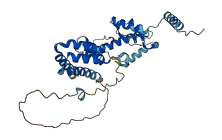
Descriptions
The autoinhibited protein was predicted that may have potential autoinhibitory elements via cis-regPred.
Autoinhibitory domains (AIDs)
Target domain |
|
Relief mechanism |
|
Assay |
cis-regPred |
Accessory elements
No accessory elements
Autoinhibited structure

Activated structure
1 structures for Q99LM9
| Entry ID | Method | Resolution | Chain | Position | Source |
|---|---|---|---|---|---|
| AF-Q99LM9-F1 | Predicted | AlphaFoldDB |
14 variants for Q99LM9
| Variant ID(s) | Position | Change | Description | Diseaes Association | Provenance |
|---|---|---|---|---|---|
| rs3390865942 | 9 | E>D | No | EVA | |
| rs3388511504 | 40 | K>N | No | EVA | |
| rs3388513658 | 100 | K>N | No | EVA | |
| rs3388514733 | 141 | H>L | No | EVA | |
| rs3388515950 | 141 | H>Y | No | EVA | |
| rs3390893462 | 236 | S>Y | No | EVA | |
| rs3390866273 | 239 | C>* | No | EVA | |
| rs3390937459 | 239 | C>F | No | EVA | |
| rs3390797324 | 240 | A>P | No | EVA | |
| rs261372847 | 241 | N>S | No | EVA | |
| rs3388511253 | 308 | L>F | No | EVA | |
| rs3388513205 | 308 | L>H | No | EVA | |
| rs3388508958 | 319 | D>N | No | EVA | |
| rs3388514741 | 321 | V>L | No | EVA |
No associated diseases with Q99LM9
No regional properties for Q99LM9
| Type | Name | Position | InterPro Accession |
|---|---|---|---|
| No domain, repeats, and functional sites for Q99LM9 | |||
5 GO annotations of cellular component
| Name | Definition |
|---|---|
| cytosol | The part of the cytoplasm that does not contain organelles but which does contain other particulate matter, such as protein complexes. |
| focal adhesion | A cell-substrate junction that anchors the cell to the extracellular matrix and that forms a point of termination of actin filaments. In insects focal adhesion has also been referred to as hemi-adherens junction (HAJ). |
| nucleoplasm | That part of the nuclear content other than the chromosomes or the nucleolus. |
| nucleus | A membrane-bounded organelle of eukaryotic cells in which chromosomes are housed and replicated. In most cells, the nucleus contains all of the cell's chromosomes except the organellar chromosomes, and is the site of RNA synthesis and processing. In some species, or in specialized cell types, RNA metabolism or DNA replication may be absent. |
| SAGA complex | A SAGA-type histone acetyltransferase complex that deubiquitinates H2A and/or H2B. This complex is organized into several functional submodules: a structural core including the activator binding module and consisting of ADA1 or a homolog, members of the SPT and TAF protein families as well as promotor recruitment factor TRRAP/TRA1, a histone acetyltransferase (HAT) module consisting of GCN5/KAT2A or PCAF/KAT2B, ADA2, ADA3/NGG1, and SGF29 or homologues thereof, a histone deubiquitinase (DUB) module consisting of ATXN7/SGF73, ATXN7L3/SGF11, ENY2/SUS1 and USP22/UBP8 or homologues thereof, and in some taxa a splicing module consisting of SF3B3 and SF3B5 or homologues thereof (not in fungi). In budding yeast also contains Spt8 which distinguishes it from SAGA-like (SLIK) complex (GO:0046695). |
1 GO annotations of molecular function
| Name | Definition |
|---|---|
| transcription coactivator activity | A transcription coregulator activity that activates or increases the transcription of specific gene sets via binding to a DNA-bound DNA-binding transcription factor, either on its own or as part of a complex. Coactivators often act by altering chromatin structure and modifications. For example, one class of transcription coactivators modifies chromatin structure through covalent modification of histones. A second class remodels the conformation of chromatin in an ATP-dependent fashion. A third class modulates interactions of DNA-bound DNA-binding transcription factors with other transcription coregulators. A fourth class of coactivator activity is the bridging of a DNA-binding transcription factor to the general (basal) transcription machinery. The Mediator complex, which bridges sequence-specific DNA binding transcription factors and RNA polymerase, is also a transcription coactivator. |
7 GO annotations of biological process
| Name | Definition |
|---|---|
| histone H3 acetylation | The modification of histone H3 by the addition of an acetyl group. |
| monoubiquitinated histone deubiquitination | The removal of the ubiquitin group from a monoubiquitinated histone protein. |
| monoubiquitinated histone H2A deubiquitination | The removal of the ubiquitin group from a monoubiquitinated histone H2A protein. |
| positive regulation of DNA-templated transcription | Any process that activates or increases the frequency, rate or extent of cellular DNA-templated transcription. |
| regulation of DNA repair | Any process that modulates the frequency, rate or extent of DNA repair. |
| regulation of RNA splicing | Any process that modulates the frequency, rate or extent of RNA splicing, the process of removing sections of the primary RNA transcript to remove sequences not present in the mature form of the RNA and joining the remaining sections to form the mature form of the RNA. |
| regulation of transcription by RNA polymerase II | Any process that modulates the frequency, rate or extent of transcription mediated by RNA polymerase II. |
| 10 | 20 | 30 | 40 | 50 | 60 |
| MATFVSELEA | AKKNLSEALG | DNVKQYWANL | KLWFKQKISK | EEFDLEAHRL | LTQDNVHSHN |
| 70 | 80 | 90 | 100 | 110 | 120 |
| DFLLAILTRC | QILVSTPEGA | GSLPWTGGSA | AKPGKPKGKK | KLSSVRQKFD | HRFQPQNPLS |
| 130 | 140 | 150 | 160 | 170 | 180 |
| GAQQFVAKEP | QGDDDLKLCS | HTMMLPTRGQ | LEGRMIVTAY | EHGLDNVTEE | AVSAVVYAVE |
| 190 | 200 | 210 | 220 | 230 | 240 |
| NHLKDILTSV | VSRRKAYRVR | DGHFKYAFGS | NVTPQPYLKN | SVVAYNNLVE | GPPAFSAPCA |
| 250 | 260 | 270 | 280 | 290 | 300 |
| NQSPASQPHP | DDAEQQAAFL | LACSGDTLPA | SLPPVNMYDL | FEALQVHREV | IPTHTVYALN |
| 310 | 320 | 330 | |||
| IERIIMKLWH | PNHEELQQDK | VHRQRLAAKE | GLLLC |