Q6NWA8
Gene name |
tada1 (tada1l, zgc:85851) |
Protein name |
Transcriptional adapter 1 |
Names |
Transcriptional adapter 1-like protein |
Species |
Danio rerio (Zebrafish) (Brachydanio rerio) |
KEGG Pathway |
dre:402899 |
EC number |
|
Protein Class |
|
Descriptions
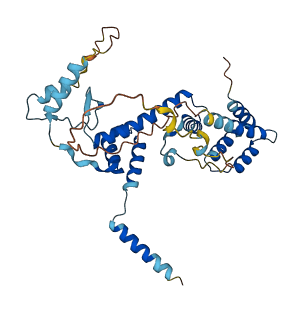
The autoinhibited protein was predicted that may have potential autoinhibitory elements via cis-regPred.
Autoinhibitory domains (AIDs)
Target domain |
|
Relief mechanism |
|
Assay |
cis-regPred |
Accessory elements
No accessory elements
Autoinhibited structure

Activated structure
1 structures for Q6NWA8
| Entry ID | Method | Resolution | Chain | Position | Source |
|---|---|---|---|---|---|
| AF-Q6NWA8-F1 | Predicted | AlphaFoldDB |
No variants for Q6NWA8
| Variant ID(s) | Position | Change | Description | Diseaes Association | Provenance |
|---|---|---|---|---|---|
| No variants for Q6NWA8 | |||||
No associated diseases with Q6NWA8
No regional properties for Q6NWA8
| Type | Name | Position | InterPro Accession |
|---|---|---|---|
| No domain, repeats, and functional sites for Q6NWA8 | |||
1 GO annotations of cellular component
| Name | Definition |
|---|---|
| SAGA complex | A SAGA-type histone acetyltransferase complex that deubiquitinates H2A and/or H2B. This complex is organized into several functional submodules: a structural core including the activator binding module and consisting of ADA1 or a homolog, members of the SPT and TAF protein families as well as promotor recruitment factor TRRAP/TRA1, a histone acetyltransferase (HAT) module consisting of GCN5/KAT2A or PCAF/KAT2B, ADA2, ADA3/NGG1, and SGF29 or homologues thereof, a histone deubiquitinase (DUB) module consisting of ATXN7/SGF73, ATXN7L3/SGF11, ENY2/SUS1 and USP22/UBP8 or homologues thereof, and in some taxa a splicing module consisting of SF3B3 and SF3B5 or homologues thereof (not in fungi). In budding yeast also contains Spt8 which distinguishes it from SAGA-like (SLIK) complex (GO:0046695). |
1 GO annotations of molecular function
| Name | Definition |
|---|---|
| transcription coactivator activity | A transcription coregulator activity that activates or increases the transcription of specific gene sets via binding to a DNA-bound DNA-binding transcription factor, either on its own or as part of a complex. Coactivators often act by altering chromatin structure and modifications. For example, one class of transcription coactivators modifies chromatin structure through covalent modification of histones. A second class remodels the conformation of chromatin in an ATP-dependent fashion. A third class modulates interactions of DNA-bound DNA-binding transcription factors with other transcription coregulators. A fourth class of coactivator activity is the bridging of a DNA-binding transcription factor to the general (basal) transcription machinery. The Mediator complex, which bridges sequence-specific DNA binding transcription factors and RNA polymerase, is also a transcription coactivator. |
1 GO annotations of biological process
| Name | Definition |
|---|---|
| regulation of transcription by RNA polymerase II | Any process that modulates the frequency, rate or extent of transcription mediated by RNA polymerase II. |
| 10 | 20 | 30 | 40 | 50 | 60 |
| MAAHASELEI | AKKNLTDAIG | ENVKHYWANL | KLWFKQKISK | EEFDLEARRL | LAQDNVHVHN |
| 70 | 80 | 90 | 100 | 110 | 120 |
| DFLLAILTRC | QIIVSTSEGP | GSLQWSGGSA | SKPGKPSRGK | KKFPSVRQKF | DHRFQPQNPL |
| 130 | 140 | 150 | 160 | 170 | 180 |
| AGVPVFSPRE | AEEEELKLSA | QTLLLPSRGQ | LEARMMVSAF | ESDLDSVAED | AVSCMLCALQ |
| 190 | 200 | 210 | 220 | 230 | 240 |
| VHLKDILTAL | VSRRKAYRLR | DGHFLYAFGS | DVTPRPYLKN | SLPAYHSATE | CPPASASLPA |
| 250 | 260 | 270 | 280 | 290 | 300 |
| AAPARVCPDE | AEQNAALLLA | CSADTAAPPL | QPVSVYDLLE | ALQVQRRVMP | SHSMYALNME |
| 310 | 320 | 330 | |||
| RILARLWHPS | HEELEQDHIH | RQHLALRDGL | VT |